Nigeria has emerged as an increasingly important supplier of tantalum-bearing concentrates to international markets, supported by abundant columbite-tantalite (coltan) resources and a well-established artisanal and small-scale mining (ASM) sector. As demand for tantalum continues to be driven by the electronics, aerospace and advanced manufacturing industries, understanding the country's pricing mechanisms, concentrate quality and export flows has become increasingly relevant for global market participants.
Based on first-hand discussions with Nigerian exporters and market participants, SMM's latest research indicates that the country's tantalum concentrate market is characterised by Free on Board (FOB) pricing, a broad range of concentrate grades and a strong dependence on Chinese demand. While informal trade continues to affect market transparency, direct engagement with industry participants provides valuable insight into conditions within one of Africa's most important tantalum-producing regions.
FOB Pricing Remains the Dominant Export Mechanism
SMM's discussions indicate that FOB Nigerian ports, principally Onne Port in Rivers State and Apapa Port in Lagos State, remain the predominant pricing basis for formal Nigerian tantalum concentrate exports. FOB contracts are widely adopted by exporters and international buyers because they provide a transparent basis for allocating logistics costs and commercial responsibilities.
Although FOB is the prevailing pricing mechanism, some international transactions, particularly those involving Chinese trading companies and processors, are initially negotiated on a Cost, Insurance and Freight (CIF) basis before the equivalent FOB value is determined by deducting freight and marine insurance costs. Smaller transactions involving regional intermediaries may also be concluded on an Ex Works (EXW) or truck-delivered-to-port basis, although these arrangements are generally associated with informal trading channels rather than formal export markets. The continued preference for FOB pricing reflects Nigeria's established export logistics while allowing overseas buyers flexibility in arranging shipping and insurance according to their own commercial requirements.
Higher Grades Continue to Command Significant Price Premiums
Market participants reported that Nigerian tantalum concentrate prices continue to vary substantially according to tantalum pentoxide (Ta₂O₅) grade, consistency of concentrate quality, shipment size and commercial terms. Current indicative FOB price ranges reported by the market are represented in the figure below:
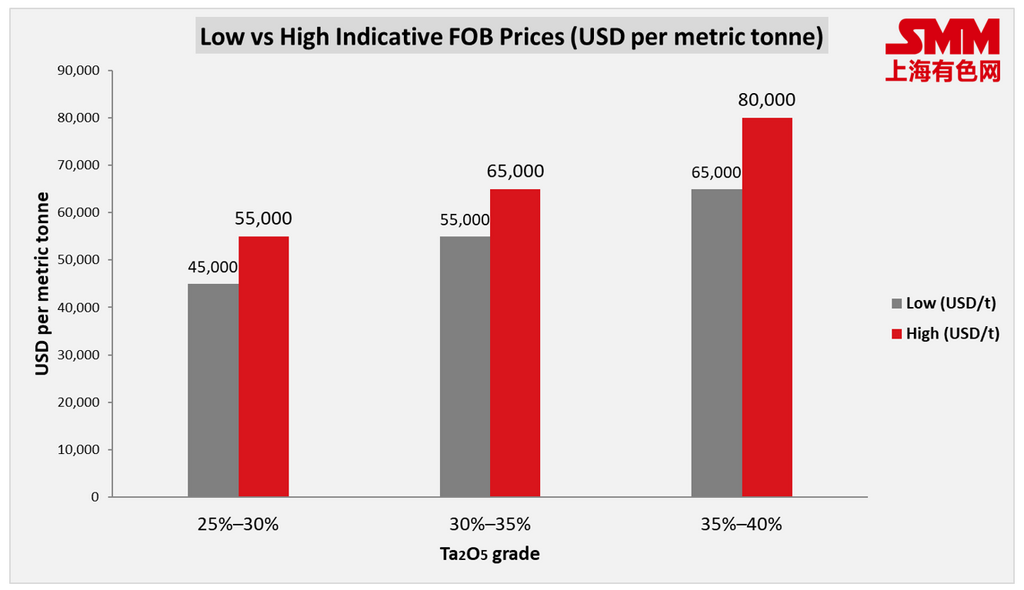
Accordingly, these indicative FOB values broadly correspond with prevailing CIF China market conditions after accounting for freight, marine insurance and handling costs, which are estimated at approximately USD 80–120 per metric tonne, depending on cargo configuration and destination port.
Actual transaction prices may differ depending on concentrate consistency, due diligence requirements, shipment volumes and payment terms, illustrating that commercial negotiations remain highly transaction-specific.
Artisanal Mining Continues to Shape Nigeria's Supply Profile
Nigeria's tantalum concentrate production remains heavily dependent on artisanal and small-scale mining operations, resulting in a relatively broad distribution of concentrate grades entering domestic and export markets.
Market participants indicated that 20%–30% Ta₂O₅ concentrate represents the largest share of production, largely originating from run-of-mine material with limited beneficiation. Concentrates within the 30%–40% Ta₂O₅ range are typically produced through hand sorting and gravity separation and command higher prices because of their improved quality. Material containing more than 40% Ta₂O₅ is comparatively scarce and generally achieves the highest premiums in export markets.
Feedback from market participants suggests that international buyers, particularly Chinese processors, generally prefer concentrates containing 30% Ta₂O₅ or more, as higher-grade material reduces downstream processing costs. Material containing less than 25% Ta₂O₅ is typically purchased at discounted prices because additional upgrading is required before refining.
Nigerian columbite-tantalite concentrates also contain varying quantities of niobium pentoxide (Nb₂O₅), with the tantalum-to-niobium ratio differing between producing regions. Deposits in parts of the Jos Plateau are generally considered more niobium-rich, while some production from Nasarawa and Kwara states contains relatively higher tantalum concentrations. Commercial pricing is therefore often based on the combined Ta₂O₅ and Nb₂O₅ content, although tantalum content typically carries the greater commercial weighting.
China Remains the Principal Export Destination
Based on market participant estimates, China accounts for approximately 80%–90% of Nigeria's formal tantalum concentrate exports, reinforcing its position as the country's dominant export market. Chinese trading companies and processors remain the principal buyers, with downstream processing concentrated in Jiangxi, Fujian and Guangdong provinces. These established processing centres continue to underpin demand for Nigerian tantalum raw materials.
Europe represents an important secondary market, with exports reportedly reaching processors and trading companies in Germany, Estonia, Belgium and the Netherlands. Smaller volumes are also understood to move through Malaysia and Singapore before onward shipment, while interest from the United States may continue to increase as efforts to diversify critical mineral supply chains gather momentum.
The concentration of exports towards China reflects both its extensive tantalum processing capacity and its long-standing commercial relationships with Nigerian exporters.
Informal Trade Continues to Affect Market Transparency
Despite Nigeria's growing importance as a tantalum supplier, market participants emphasise that a significant proportion of production is believed to move through informal cross-border trading networks before entering international supply chains.
Such movements make it difficult to accurately measure production volumes, export flows and realised transaction prices using official trade statistics alone. This creates additional uncertainty for market participants attempting to assess the country's contribution to global tantalum supply.
Against this backdrop, first-hand engagement with producers, exporters, traders and downstream consumers remains an important complement to official statistics, supporting a more comprehensive understanding of regional supply conditions and market dynamics.
Market Outlook
Nigeria is expected to remain an important supplier of tantalum concentrate to international markets, supported by extensive artisanal production and continued demand from global processors. China's established processing industry is likely to maintain its position as the primary destination for Nigerian exports in the near term, while higher-grade concentrates should continue to attract price premiums because of their lower processing requirements.
Looking ahead, market participants will be closely monitoring developments in beneficiation capacity, concentrate quality, logistics and evolving critical mineral supply chain strategies. At the same time, improving transparency around informal trade flows could enhance market visibility and strengthen confidence in assessments of Nigeria's production and export performance.

![[SMM Analysis] MoM Surge in Silicon-Manganese Exports Offers Only Marginal Support Amid Thin Absolute Volume](https://imgqn.smm.cn/usercenter/teIej20251217171724.jpeg)