July marked a triple inflection point for the solid-state battery industry: ① Policy: China's first national standard for vehicle solid-state batteries (GB/T43568-2026) took effect, paired with a consumption tax exemption; ② Materials: multiple hundred-ton-level sulfide production lines commenced commissioning in Q3, with a leading EV manufacturer completing a 1‑ton electrolyte tender (awarded below RMB 2 million/ton), signaling the industry's shift to "ton‑level transactions"; ③ Products: SVOLT Energy's hybrid solid-liquid batteries entered volume production in Q3, while Ampace achieved full capacity of 2GWh cell + 2GWh pack. Though all-solid-state batteries remain in validation, CATL's 420Wh/kg and Farasis' 500Wh/kg results underscore a clear path to 2027 vehicle integration.
Table of Contents:
I. Materials: Sulfide hundred-ton production ramp-up; oxide monthly output of 200+ tons.
II. Technology: CATL 420Wh/kg, Farasis 500Wh/kg; SVOLT & Gotion semi-solid mass production.
III. Projects: Ampace's 2GWh cell + 2GWh pack full-chain commissioning; Gotion's 20,000-ton lithium sulfide project launched.
IV. Financing: Heyuan Lithium-Ion A round worth hundreds of millions (Xiaomi led); Furui's RMB 399.6 million acquisition of Bosailisi.
V. Overseas: Mitsubishi Chemical, Sumitomo Chemical, Factorial, ECOPROBM.
VI. Voices: Yang Hongxin's bearish all-solid-state view vs. SMM's bullish 2030 outlook; market consensus favors semi-solid initial scale-up.
VII. Policy: National standard effective July 1; consumption tax exemption effective September; MIIT's four-key-material initiative.
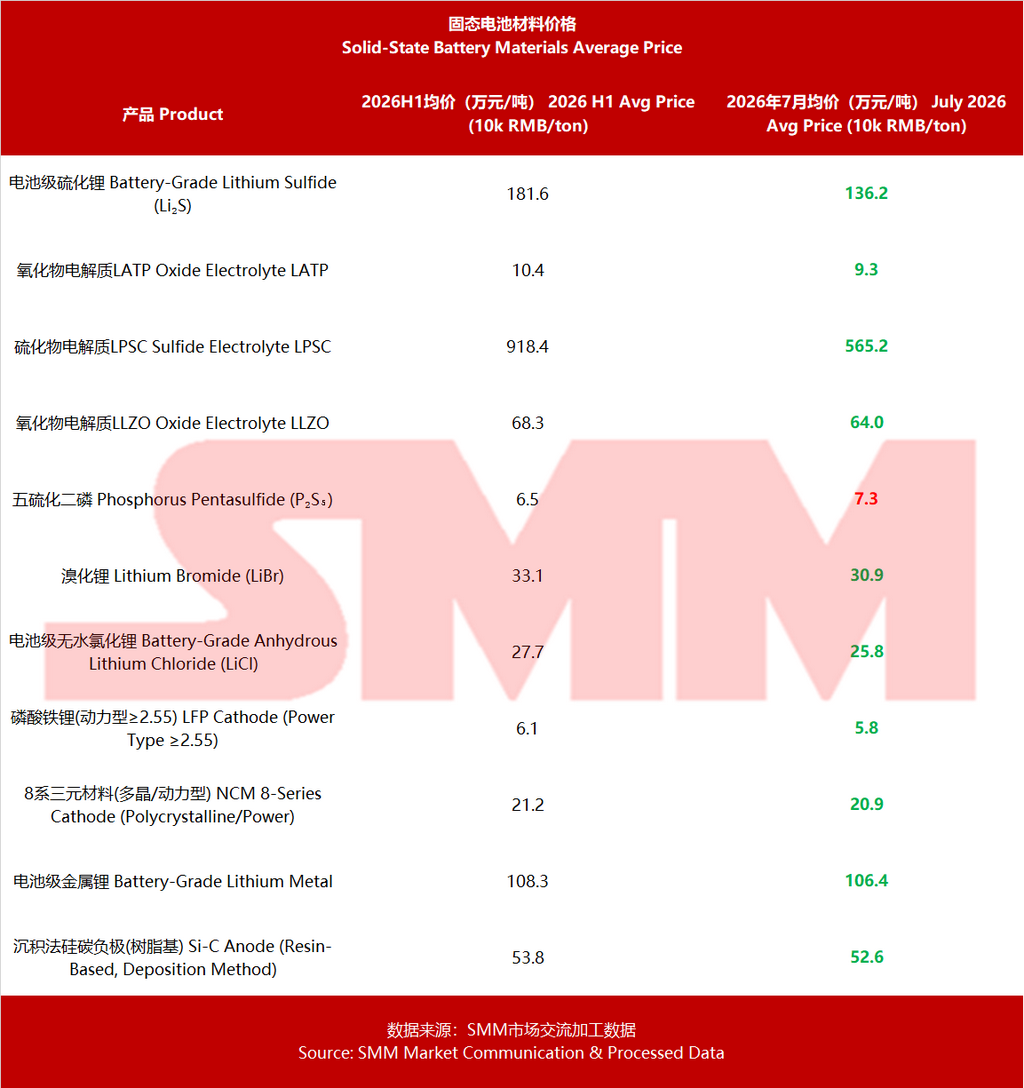
In July 2026, solid-state battery material prices continued their downward trend, with the price gap between sulfide and oxide routes widening significantly. In the first half of the year, the industry was dominated by "line construction, commissioning, and sample delivery." In July, downstream cell manufacturers accelerated production and R&D in preparation for the 2027 vehicle integration milestone.
Lithium sulfide and sulfide electrolyte production increased compared to June, with active downstream procurement. In July, a major new energy vehicle manufacturer tendered for 1 ton of sulfide electrolyte at the lowest feasible price. According to SMM, a company won the bid at less than RMB 2 million/ton. Falling raw material prices are a key driver of solid-state battery industry growth.
Oxide electrolyte monthly output exceeded 200 tons, primarily used in semi-solid batteries via separator coating and electrode material addition.
July major material price trends:
I. Solid-State Battery Materials
1. Electrolytes
Sulfide Electrolytes: Hundred-ton lines to be commissioned in Q3; inflection point for volume supply approaching.
Tianci Materials: Sulfide solid-state electrolyte is in kg-level pilot sample delivery and customer validation; its 100 t/y lithium sulfide and sulfide solid-state electrolyte pilot line is expected to be commissioned in Q3 2026. It is also developing oxide solid-state electrolytes (small-scale pilot stage) and UV frame glue for solid-state batteries (small-batch sample delivery).
Gotion High-Tech: On July 21, launched a 20,000 t/y solid-state battery key materials project (Anqing, Anhui)—the world's first 10,000-ton-scale high-purity lithium sulfide production line. Pilot construction is scheduled for completion by the end of December 2026, with full production in 2027. High-purity lithium sulfide accounts for 70%–80% of sulfide electrolyte costs, and Gotion has achieved 99.99% purity stable production.
Huashang Zhongke: Its lithium sulfide pilot material was tested by the National Automotive Power Battery Innovation Center (CNAS/CMA accredited), achieving 99.95% purity. It has built a 60 t/y sulfide solid-state electrolyte R&D pilot line and is a contributing member of the national solid-state battery standard.
Tianqi Lithium: Its 50 t/y lithium sulfide pilot project in Meishan, Sichuan, commenced construction. Using self-developed slurry-based reduction at 350°C, costs are ~60% of the industry average, purity 99.9%, with 100% domestic equipment.
Guanghua Technology: Lithium sulfide products have reached the market; capacity, validation, and orders are progressing as planned. It plans to expand lithium sulfide capacity to 3,000 t/y in 2026. SMM note: Please monitor project progress updates.
Hongyuan Pharmaceutical: Filed a lithium sulfide preparation patent (CN122403374A) using a novel process: porous carbon derived from glucose/concentrated sulfuric acid dehydration, then ball-milled with lithium sulfate and lithium hydroxide.
Capchem: Oxide electrolyte has achieved commercial production and sales; a thousand-ton scale line will be commissioned in 2026. Sulfide/polymer electrolytes are in small-batch supply; it holds 30+ solid-state electrolyte patents.
Jiuwu Hi-Tech: LATP solid-state electrolyte was successfully applied in 1Ah pouch cells (NCM811 + graphite anode), passing extreme overcharge and over-discharge abuse tests per GB38031-2020 with no smoke, fire, explosion, swelling, or leakage. The material is applied via coated separator technology.
Oxide Electrolytes: Semi-solid vehicle integration accelerating; shipments steadily rising. SMM data shows first-half oxide electrolyte production of ~1,380 tons. H2 is expected to reach 2,000–2,500 tons, driven by consumer electronics, two-wheelers, and other semi-solid applications—bringing full-year production to ~3,400–3,900 tons.
2. Cathodes
GEM: Achieved breakthroughs across high-nickel, ultra-high-nickel, and lithium-rich manganese-based cathode material routes, with ton-level shipments across all routes. It has established a "Solid-State Battery Cathode Materials Joint Laboratory" with Ningbo Eastern University of Technology and Academician Sun Xueliang's team, focusing on full-chain cathode materials, interface modification, cell assembly, and recycling.
Shandong Chuanglu: Completed pilot validation of its full range of solid-state electrolytes and lithium-rich manganese-based cathode materials; product batch stability and mass production processes fully qualified. The thousand-ton cathode line has entered trial production.
Lithium-Rich Manganese-Based Cathode Cost Advantage: ~RMB 120,000/ton, far below high-nickel NCM (~250,000/ton) and LCO (~380,000/ton)—a 50%+ cost reduction. Lithium consumption per kWh is 40% lower. When paired with solid-state systems, can achieve 450–600Wh/kg cell energy density.
3. Anodes
Furui Shares: Announced on July 20 a proposed RMB 399.6 million acquisition of 78.80% equity of Bosailisi (Nanjing). Bosailisi has completed validation with Gotion and Yinrui and entered volume supply, with annual capacity ~540 tons.
Toyota: On July 22, published a patent for a multi-layer composite binder for silicon-carbon anodes (JP2026-123456A), capable of suppressing silicon expansion by 80% and achieving 91.5% first-cycle Coulombic efficiency—targeted for 2027 mass-production all-solid-state batteries.
Furui Honggui: Planning a 50,000 t/y CVD silicon-carbon anode project, currently in pilot stage.
4. Others
Zhonglun New Materials: Its BOPA film for solid-state batteries is advancing through sample validation and market promotion, not yet in mass production. BOPA serves as the outer layer of pouch-cell aluminum-plastic film.
Huitian New Materials: Its lithium battery anode adhesive and thermal conductive adhesive can be adapted for semi-solid battery applications, though volume delivery to semi-solid clients has not yet started.
II. Solid-State Battery Technology
1. Technology Developments
CATL: Announced at its July 21 supplier conference that its third-generation condensed solid-state battery (high-nickel NCM cathode + silicon-carbon anode) has achieved 420Wh/kg, >1,500 cycles, and has passed nail penetration and 150°C hot-box tests—targeting Q2 2027 mass production. SMM notes that the company's historical product timelines are subject to change.
Farasis Energy: On July 14, disclosed completion of its second-generation sulfide all-solid-state battery technology development, featuring lithium-rich manganese-based/high-nickel NCM cathodes + lithium metal anodes with thermal runaway self-shutdown functionality, energy density of 500Wh/kg.
Zhongke Yuanben: Its 2Ah vehicle sulfide all-solid-state cells passed a 220°C hot-box test, with >60 minutes holding—no swelling, fire, or explosion. SMM notes: small-capacity cells have lower test difficulty; 40–60Ah large-capacity sulfide cells face significantly greater challenges.
SVOLT Energy: Its medium-nickel hybrid solid-liquid battery will enter volume production in Q3, with 2026 deliveries >8,000 units and >70,000 units in 2027. Energy density 245Wh/kg, peak charge rate 6C, thermal runaway trigger temperature elevated to >350°C—~90% combustion risk reduction—with cost parity with liquid batteries.
Gotion High-Tech: G-series solid-liquid hybrid batteries have completed extreme climate and GB 9-item safety tests and are production-ready. 197Ah prismatic cell at 300Wh/kg, system at 235Wh/kg; 3mm nail penetration no fire; 4C fast charge adds 500km range in 9 minutes.
Qingdao Institute of Bioenergy and Bioprocess Technology: Proposed EICN strategy with ASZ@Li anode and Ni90 high-nickel cathode, completing charge/discharge in 72 seconds at 55°C.
Baima Lake Laboratory: Completed 20Ah large-capacity boride solid-state battery cell prototyping—400Wh/kg, >2,000 cycles, 180°C thermal tolerance, operating pressure <5MPa—targeting low-altitude flight, embodied AI/robotics, and premium 3C markets. Wide temperature range (-20°C to 120°C), increasing drone endurance by 30%–40% at same volume.
2. Products
Ampace: Anhui 2GWh solid-state battery advanced manufacturing base completed capacity ramp-up to design capacity—from start to full ramp-up in under 3 months, cell yield reaching 99.8%, products for high-end electric motorcycles, battery-swapping e-motorcycles, drones, and robotics. Also commissioned Wuxi 2GWh advanced battery pack manufacturing base.
Docxs: All-solid-state battery GWh line officially commissioned at 350Wh/kg; 500Wh/kg all-solid-state battery has completed process validation—targeting 2028 mass production; 800Wh/kg Li-air battery design confirmed, targeting commercialization by 2030.
Sunwoda Mobility: Zhaozhuang Phase III commenced construction, planning 12 lines including 2 solid-state lines—full capacity 120GWh; 400Wh/kg "Xin·Bixiao" polymer all-solid-state battery has completed 0.2GWh sample line—targeting 2026 vehicle validation.
Saike Power: Its 0.1GWh all-solid-state battery smart manufacturing platform in Yibin is expected to be completed by year-end—China's first all-solid-state smart manufacturing pilot line focused on sulfide all-solid-state battery products, open to the industry.
III. Solid-State Battery Projects
Gotion Holdings (Anqing, Anhui): 20,000 t/y solid-state battery key materials project launched—world's first 10,000-ton-scale high-purity lithium sulfide line; pilot completion by end-Dec 2026, full production 2027.
Weilan New Energy (Qingyang, Gansu): 3GWh solid-state battery pack manufacturing & electric heavy truck logistics park—total investment RMB 1.5 billion. Pack plant planned for 3GWh annual capacity; heavy truck logistics park targeting 3,000 electric truck rentals/sales annually.
Weilan New Energy (Huzhou, Zhejiang): Joint venture subsidiary Zhejiang Weilan Digital Energy launched, entering the AIDC (AI data center) energy storage market with one-stop solutions.
Shandong Chuanglu (Jinan): Phase I total investment RMB 250 million: 6,000 t/y high-energy cathode + 150 t/y solid-state electrolyte + all-solid-state battery pilot line, combining "sulfide + oxide + polymer" composite route.
All-Solid-State Battery Smart Manufacturing Pilot Line Equipment Base (Changzhou Tianning): Total investment RMB 550 million—derived from Xi'an Jiaotong University's Institute of Materials & Chemicals, with proprietary "in-situ lamination" process—already delivered small and pilot-scale solid-state lines to CATL, Sunwoda, Dongfeng.
Samsung SDI (Korea): Announced a KRW 16 trillion (~RMB 88 billion) investment in Ulsan through 2040 for all-solid-state batteries, ESS LFP, and sodium-ion batteries—plus KRW 9 trillion for Cheonan—totaling KRW 25 trillion.
IV. Solid-State Battery Financing & Partnerships
Heyuan Lithium-Ion: Completed RMB several-hundred-million Series A round led by Xiaomi Yangtze River Fund—with China Reinsurance Fund, Chengdu Sci-Tech Innovation, and Changjiang Green Water Fund participating. Xiantao plant shipped central China's first solid-state battery line; cumulative delivery >1 million cells. Strategic cooperation with Yunzhou Intelligence for unmanned vessel applications.
Ganfeng Lithium Battery: Received new equity investment co-led by CMC Capital's Huawen Qingneng Fund.
Shen'an Lithium Energy: Completed nearly RMB 100 million Pre-A round with Sany Group's Huaxu Fund, Shengshi Investment, and Jianlong Group's Changzhe Investment—funding 0.5GWh line construction and "air-space-ground-sea" market expansion.
Furui Shares: RMB 399.6 million acquisition of 78.80% equity of Bosailisi (Nanjing).
Jiangsu Yili Technology: Completed Series A round with Skyworth, Jieyi Investment, and Yuanhang Precision—registered capital increased 36%.
V. International Progress
Factorial Energy (USA): Announced July 29 a non-binding MOU with Korea's SK On to jointly evaluate the mass-production feasibility of Factorial's FEST solid-state battery technology. Previously secured its first commercial drone battery order—flight tests show 30%+ endurance improvement.
Mitsubishi Chemical (Japan): Announced ~¥15 billion (~$100 million) investment for a new oxide solid-state electrolyte line in Fukuoka—1,000 t/y capacity—targeting Japanese and Korean automakers—commissioning Q1 2028.
Sumitomo Chemical (Japan): Plans to begin mass-production of halide solid-state electrolytes by FY2028—chlorine-based materials considered an alternative to sulfides/oxides—developed with Kyoto and Tottori Universities.
ECOPROBM (Korea): Disclosed all-solid-state battery core materials roadmap—covering solid-state electrolytes, next-gen cathode/anode materials, and sodium-ion batteries. Its 40 t/y sulfide pilot line is stable with validation through downstream battery makers.
Toyota (Japan): Published silicon-carbon anode binder patent—targeting 2027 all-solid-state mass production.
Samsung SDI (Korea): KRW 25 trillion next-gen battery investment plan covering all-solid-state battery production bases.
VI. Industry Voices
Yang Hongxin (SVOLT Energy Chairman): Hybrid solid-liquid batteries will remain the long-term mainstream; all-solid-state batteries won't be cost-competitive even by 2035. SMM disagrees, forecasting all-solid-state battery Wh-cost to fall below RMB 1/Wh by 2030–2031—on par with current high-nickel NCM.
Wang Deping (FAW Chief Scientist): Clarified two major misconceptions about all-solid-state batteries at the 2026 China Auto Forum.
SMM Views: (1) All-solid-state batteries will be cost-competitive by 2030–2031 with <RMB 1/Wh. (2) CATL product mass-production timelines may shift. (3) 40–60Ah all-solid-state large-format cells face significantly higher 220°C thermal testing challenges than 2Ah small cells.
Market Consensus: 2026 is the inaugural year for hybrid solid-liquid battery mass production—with priority deployment in high-performance segments such as low-altitude vehicles and premium EVs. All-solid-state vehicles targeted for 2027 demonstration. 2026–2028 will be the semi-solid adoption window, while all-solid-state will gradually move into premium models post-2028.
VII. Policies & Regulations
National Standard Effective July 1: China's first national standard for vehicle solid-state batteries (GB/T43568-2026) took effect—defining all-solid-state as <5% liquid electrolyte mass fraction. Semi-solid and condensed-state test standard: <0.5% mass loss after 6h vacuum drying at 120°C. Terms "semi-solid," "quasi-solid," and "pseudo-solid" are banned from product marketing.
MIIT Four-Key-Material Initiative (July 21): MIIT issued guidance designating cathode, anode, electrolyte, and separator R&D as a "manufacturing core competitiveness enhancement" priority. Specific directions: high-nickel low-cobalt & lithium-rich manganese-based cathodes; silicon-carbon composite & lithium metal anodes; solid & semi-solid electrolytes; ultra-high-strength wet separator & composite current collector interface optimization.
10 Solid-State Battery Industry Standards Consultation (July 27–28): MIIT working group held consultation meetings for 10 solid-state battery standards—managed and drafted by the China Electronics Standardization Institute.
Battery Consumption Tax Differentiation (July 17): Joint MOF/GAC/STA announcement—effective Sept 1, 2026 through Dec 31, 2028: solid-state batteries, sodium-ion, fuel cells, and specified PV cells are exempt from consumption tax. Lithium-ion batteries return to tax: 2% from Sept 2026, rising to 4% from Sept 2027. This provides a targeted policy window for solid-state batteries.
Summary
In July 2026, the solid-state battery industry reached three significant milestones: policy standardization, the concentration of hundred-ton line commissions, and the opening of large-scale commercial delivery of semi-solid batteries. The national standard ended years of definitional ambiguity; sulfide materials transitioned from "kilogram-scale" to "ton-scale" transactions; and SVOLT Energy's Q3 semi-solid mass production confirmed the start of genuine scale delivery. While all-solid-state batteries remain in the validation phase, the combined forces of material cost reduction (lithium sulfide from RMB 2M → 1.5M/ton), technology advances (CATL 420Wh/kg, Farasis 500Wh/kg), and capital inflows (Heyuan Lithium-Ion's Series A, Samsung SDI's KRW 25T investment) make the 2027 vehicle demonstration target increasingly tangible.
**Note:** For further details or inquiries regarding solid-state battery development, please contact:
Phone: 021-20707860 (or WeChat: 13585549799)
Contact: Chaoxing Yang. Thank you!
![Solid-State Battery Next Decade Series, Part 6 of 9: Ternary Route May Become Great Again [SMM Analysis]](https://imgqn.smm.cn/usercenter/JSjkr20251217171728.jpg)
![Solid-state Battery September Analysis and Quarterly Review: Policy and Capital Heat Up, Material Spot Cools Down, Industrialisation Moves from "kg" to "mt" [SMM Analysis]](https://imgqn.smm.cn/usercenter/olwlF20251217171731.jpg)