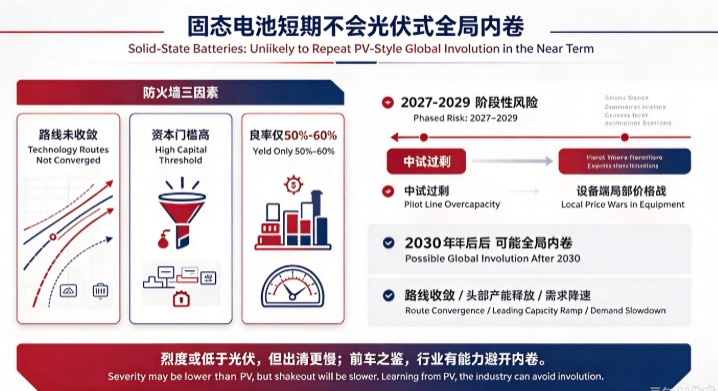
Key points: Solid-state batteries will not see PV-style industry-wide involution in the short term: unconverged technology routes, high capital thresholds, and yields of only 50%-60% form a firewall. There are phased risks in 2027-2029, with surplus pilot lines and localized price wars on the equipment side; after 2030, if technology routes converge, leading capacity is released, and demand growth slows, industry-wide involution could occur, with intensity likely lower than in PV but with slower market exit. Given the lessons from PV, the solid-state battery industry is fully capable of avoiding involution.

SMM has recently reviewed the future of solid-state batteries and compiled a ten-year series. Using the current development of the lithium battery industry as a reference, especially the intertwined history of the LFP and ternary routes, which has written an epic chapter over time. In the long history of conventional liquid lithium batteries, semi-solid and solid-state batteries will take the stage, outlining a new generation of high-specific-energy battery world.
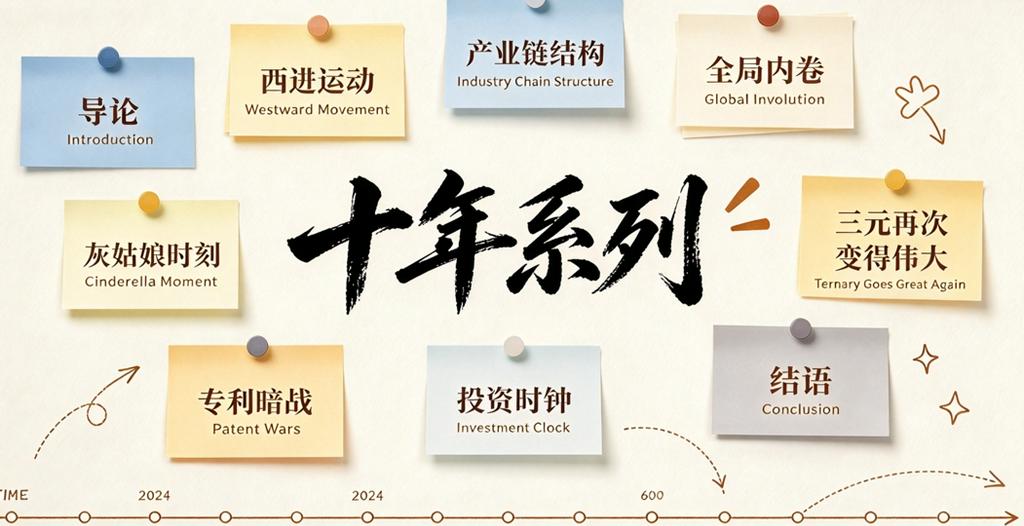
The ten-year series will be divided into nine parts: introduction, westward movement, industry chain structure, industry-wide involution, Cinderella moment, ternary becoming great again, patent shadow war, investment clock, and conclusion.
Introduction: Dreams will surely shine into reality: why we need to re-understand the industrial logic of solid-state batteries - the gap between ideal and reality, and the result is that dreams shine into reality
Part One: Will it replicate the westward movement of liquid batteries? The logic of western concentration - will solid-state batteries replicate the "westward movement" of liquid lithium batteries?
Part Two: A good opportunity to reverse the distorted power structure of the industry chain: power structure of the industry chain - upstream windfall profits, midstream pressure, downstream payment delays?
Part Three: Warning of PV-style industry-wide involution: will solid-state batteries enter PV-style industry-wide involution?
Part Four: The Cinderella comeback in technology routes: the "Cinderella moment" of solid-state batteries - which technology route will follow the LFP comeback path?
Part Five: Ternary may become great again: can ternary batteries "become great again" through solid-state batteries?
Part Six: Global competitive landscape - the "patent shadow war" and industrialisation race among China, Japan and South Korea
Part Seven: Entering the market early will show you yourself ten years later: investment clock - the "five-stage model" of solid-state battery industrialisation
Conclusion: A brand-new track: solid-state batteries are not a "simple sequel" to liquid lithium batteries
This article is the third in the series, a warning about PV-style industry-wide involution. Will solid-state batteries enter PV-style industry-wide involution? Will they be dragged under the wheels of PV-style industry-wide involution?
Review of the previous article, the third of nine articles in the ten-year series on solid-state batteries: Power structure of the industry chain - upstream windfall profits, midstream pressure, downstream payment delays. Solid-state batteries will not simply replicate the liquid lithium battery pattern of "upstream windfall profits, midstream pressure, downstream payment delays." Lithium sulphide accounts for 50%-64% of sulphide battery costs, with scarce initial capacity and extremely strong pricing power; solid-state electrolytes are upgrading into core components and becoming the power centre of the industry chain. Downstream players are hedging through in-house development and equity stakes, but near-term bargaining power is limited. The core logic is shifting from "resource is king" to "technology is king," with the key being lithium sulphide capacity expansion and cost reduction.
Will solid-state batteries enter PV-style industry-wide involution? This topic is one of the hot discussions in the current liquid lithium battery industry. The painful experience of the PV industry has repeatedly struck the fast-growing yet involution-plagued liquid lithium battery industry. Here, SMM is also guiding everyone to consider whether the high-hope solid-state battery industry can avoid the pitfalls of its predecessors in advance and create a healthier operating environment.
I. Why use PV as a reference frame to analyse solid-state batteries
The PV industry has experienced a textbook-level involutionary collapse over the past three years. In 2025, China's nominal capacity for polysilicon, wafers, solar cells, and modules was between 1,100 GW and 1,400 GW, with capacity in each segment exceeding global demand by more than twofold, and utilization rates in the polysilicon segment were insufficient. According to SMM data, effective polysilicon capacity reached 3 million mt in 2025, while actual production was only 1.3 million mt, with a utilization rate below 50%; wafer segment capacity exceeded 1,300 GW, far surpassing global installation demand. On the price side, under SMM's data, the average price of P-type dense polysilicon fell from 59 yuan/kg at the end of 2023 to 35.5 yuan/kg at the end of 2024, a decline of 39.83%; polysilicon prices briefly fell to around 34,000 yuan/mt in July 2025. For modules, SMM's module cost index shows that integrated enterprises' module production cost was 0.729 Yuan/W, while specialized enterprises were at only 0.687 Yuan/W. Actual transaction prices for wafers, cells, and modules of various sizes basically fell below cash costs, triggering significant production cuts. Although some leading polysilicon enterprises saw marginal improvement in performance as polysilicon prices recovered due to "anti-involution" policies, the industry as a whole remained in a state of widespread losses.
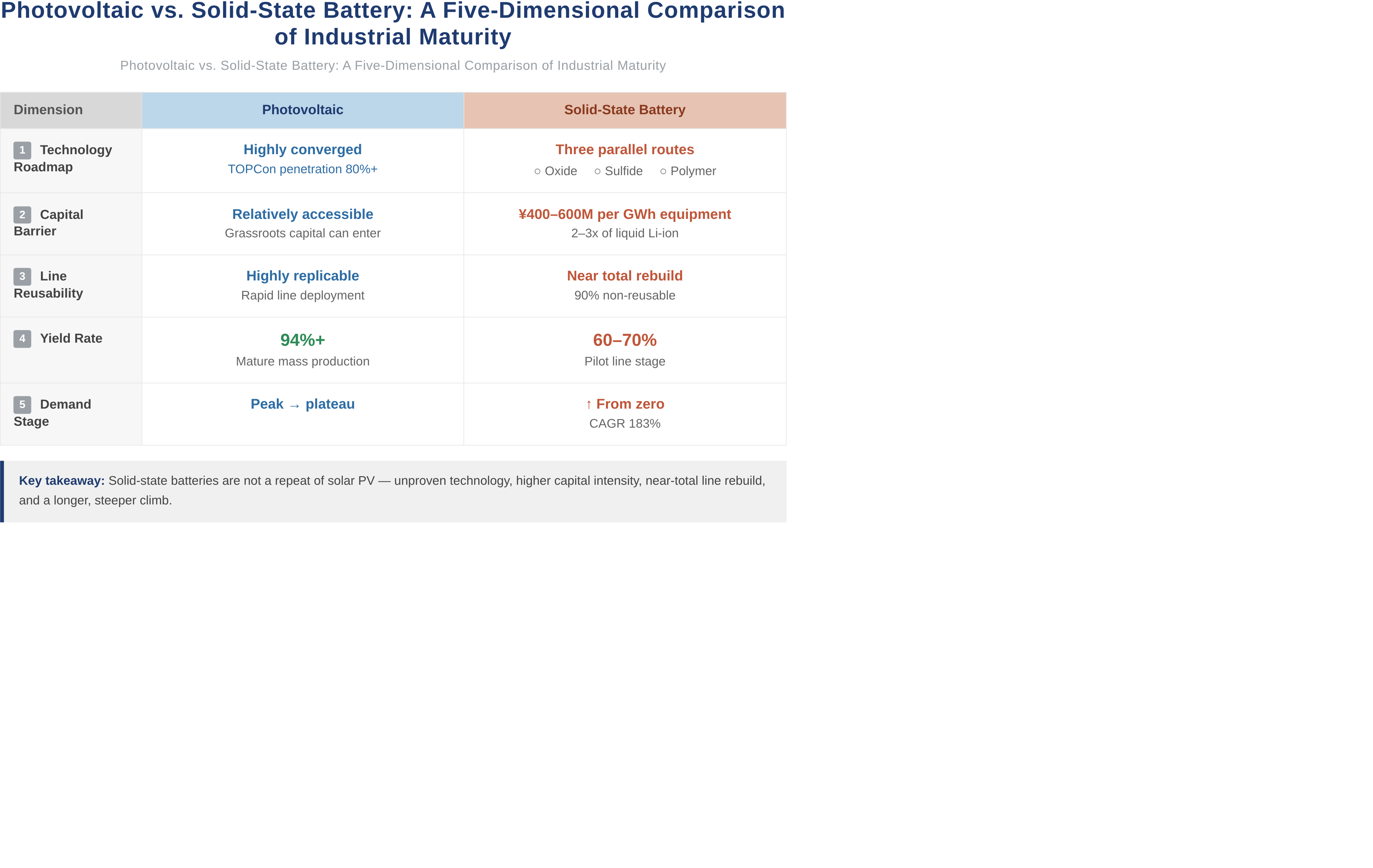
The root cause of this involution can be broken down into the simultaneous satisfaction of three conditions: convergence of technology routes (PERC→TOPCon→HJT, with limited differentiation), relatively controllable capital thresholds (PV module production line investment threshold is lower than that of lithium batteries), and demand growth shifting from an explosive phase to a stable phase. The combination of these three factors has led to massive capital inflows, rapid capacity surplus, and sustained price wars.
Whether solid-state batteries possess the same "perfect storm" conditions needs to be examined item by item.
II. Condition Testing: The "Anti-Involution" Genes of Solid-State Batteries
Condition 1: Are technology routes converging?—Far from settled
The technological premise of PV involution is route convergence. TOPCon technology penetration rate exceeds 80%, CR5 enterprises account for 80% of capacity, products are highly homogenised, and competition can only rely on price.
Solid-state batteries are exactly the opposite.Sulphide, oxide, and polymer routes are competing in parallel, and each route has further subdivisions within it. Although the sulphide route is gradually becoming the mainstream for all-solid-state batteries due to its excellent ionic conductivity and good mechanical properties, the oxide route has already been installed in vehicles at the semi-solid stage, while the polymer route retains advantages in specific application scenarios. This means capital cannot "bet on one route and replicate production lines at scale" as it did in PV. Without route consensus, the risk of blind capacity expansion is extremely high—production lines put into operation may become sunk costs due to route switching.
Condition 2: Is the capital threshold low enough?—Extremely high and production lines are not reusable
The investment threshold for PV module production lines is far lower than that for lithium batteries, which has provided the conditions for a massive influx of "grassroots capital".
The threshold for solid-state batteries is the complete opposite. The production process for all-solid-state batteries undergoes significant changes: the front-end dry process replaces wet coating, the middle-end adhesive frame printing + stacking + isostatic pressing replaces traditional winding + electrolyte filling, and the equipment side requires new dry electrode, solid-state electrolyte transfer printing, adhesive frame printing, isostatic pressing, and other equipment. All-solid-state production lines are close to being rebuilt from scratch, existing liquid-state production lines cannot meet the requirements, and core equipment must be redeveloped. Equipment investment per GWh reaches 400 to 600 million yuan, which is 2 to 3 times that of traditional liquid-state batteries. This capital threshold naturally suppresses the influx of "grassroots capital"—the players currently entering the solid-state battery field are mainly top-tier players with existing liquid lithium battery foundations and cross-sector enterprises with chemical industry backgrounds.
Condition 3: Is demand growth fast enough?—Starting from zero, but with a mismatch between planning and demand
Solid-state batteries are currently on the eve of industrialisation, with sufficient time to plan and sort things out properly, avoiding the detours of history and bypassing that Waterloo battlefield.
According to SMM forecasts, all-solid-state battery shipments will exceed 10 GWh by 2030, and the penetration rate of all-solid-state batteries is expected to reach around 9% by 2035. In the short term, there is no issue of "slowing demand growth"—demand is starting almost from zero. However, the hidden risk lies in the fact that capacity planning has yet to take shape, and in the short to medium term, it far exceeds demand. SMM forecasts that planned solid-state battery capacity will exceed 1,100 GWh by 2035.
In the short to medium term from 2026 to 2030, the operating rate will be only 1%-15%, with a severe demand mismatch, and volume will only gradually ramp up after 2032.
An additional condition that PV does not have: the yield bottleneck
The overall yield of all-solid-state pilot lines is only 50%-60%, while liquid batteries have already exceeded 95%. The yield bottleneck means that even if capital pours in and production lines are built, effective capacity cannot be quickly formed. This is a "natural firewall."
III. Risk window of phased involution and transmission paths
Solid-state batteries will not enter PV-style systemic involution in the short term. However, the risk of "phased involution" is real and concentrated in the specific window of 2027-2029.
3.1 The logic behind the formation of the risk window
2025-2026 is a period of intensive pilot line deployment. Market rumours suggest that CATL's 5 GWh sulphide all-solid-state pilot line in Hefei started production in May 2025, BYD's 2 GWh pilot line in Shenzhen Pingshan started production in February 2026, and Gotion High-tech's 2 GWh mass production line is expected to begin equipment commissioning at the end of 2026. This information has not yet been fully verified, and current demand is not yet sufficient to support rapid capacity ramp-up. What remains to be verified is the effectiveness of small-batch vehicle installation validation starting in 2027, and whether the pace of technology iteration and cost adaptability around 2030 can support large-scale mass production targets.
The problem is that if a large number of pilot lines are converted into mass production lines in a concentrated manner in 2027-2028, while demand growth falls short of expectations, phased overcapacity will be inevitable. More critically, the technology routes for all-solid-state batteries will not converge before 2027—sulphide, oxide, and polymer routes are still competing, which means production lines cannot achieve rapid replication and cost dilution through standardisation the way PV has.
3.2 Transmission path: localised price wars from the equipment end to the materials end
The transmission path of PV involution is "overcapacity → price collapse → losses across the entire chain." The phased involution transmission path for solid-state batteries is different and will exhibit a "layered transmission" characteristic.
Layer 1: "Arms race" and localised price wars at the equipment end . The equipment segment is the first to benefit from industrialisation investment, but it may also be the first to feel oversupply pressure. Equipment orders in 2026 may grow 70%-80% YoY, and especially from 2027-2028 onwards, as downstream clients release mass production demand, the growth curve will show exponential improvement. However, the risk at the equipment end is that if multiple battery cell enterprises are building pilot lines simultaneously, equipment producers may face short-term capacity constraints; once the wave of pilot line construction passes and mass production lines have not yet started on a large scale, equipment orders may experience a gap. More critically, when technology routes have not yet converged, equipment producers need to simultaneously develop equipment solutions for multiple routes, with high R&D investment and limited per-line order scale, which will compress profit margins.
Layer 2: "Structural differentiation" at the materials end . Effective capacity for core materials such as lithium sulphide is extremely scarce, and there will be no price war in the short term. However, as more enterprises break through the hundred-tonne-level pilot bottleneck, competition at the materials end will shift from "availability" to "quality," and whether first movers can defend their first-mover advantage will depend on how deep a moat they have built in process maturity and cost control. The electrolyte materials segment may see competition even earlier—Tinci's global market share in sulphide electrolyte precursors has already exceeded 60%, and Capchem is simultaneously laying out in four directions, so the materials end is not monolithic.
Layer 3: "Dislocated competition" at the battery cell end. Unlike PV, the initial application scenarios for solid-state batteries are highly fragmented—eVTOL, humanoid robots, high-end car models, and energy storage all have different requirements for energy density and safety, as well as different price sensitivities. This means battery cell enterprises will not engage in head-on competition on the same price dimension the way PV module producers do, but will instead each lock in different market segments.
3.3 An easily overlooked variable: the "diversion effect" of solid-liquid batteries
Solid-liquid batteries (semi-solid), as a transitional route, are diverting demand and capital away from solid-state batteries . Solid-liquid battery capacity will grow from 15 GWh in 2025 to 350 GWh and 2,000 GWh in 2030 and 2035 respectively, roughly 1.8 times the scale of solid-state batteries. The capacity expansion pace of solid-liquid batteries is more stable, with an operating rate reaching 49% as early as 2026 and stabilising at around 75% after 2031, in sharp contrast to the 1%-15% operating rate of solid-state batteries.
Semi-solid-state batteries actually serve as a "pressure relief valve." When technological breakthroughs in all-solid-state batteries lag behind expectations, capital and capacity can shift to semi-solid-state batteries, avoiding excessive concentration of overcapacity in the all-solid-state field. However, another risk must also be guarded against: if semi-solid-state battery capacity expands too rapidly, and all-solid-state batteries suddenly achieve technological breakthroughs and rapid cost reduction around 2030, the large volume of semi-solid-state battery capacity may face the risk of being eliminated by "generational leapfrogging."
IV. Risk Window for Industry-Wide Involution: After 2030
The real risk window for industry-wide involution lies after 2030.There are three trigger conditions: technology + capacity + cost!
4.1 Technology Routes Basically Converge. When the sulphide or oxide route establishes dominance, the production line value of other routes will be reduced to zero, and the capacity of surviving enterprises will be released in a concentrated manner. The process of technology route convergence itself is accompanied by a round of brutal "route elimination"—the capacity of eliminated routes is not "surplus," but "invalid."
4.2 Top-Tier Players Complete Capacity Layout. The mass production lines of top-tier players such as CATL and BYD will come online in a concentrated manner around 2030, and the industry's effective capacity will see a stepwise increase. If demand growth gradually pulls back from a 183% CAGR to medium-speed growth, the supply-demand gap will narrow rapidly.
4.3 Cost Reduction Triggers the "Ceiling Effect" on Demand. When solid-state battery costs fall to a level competitive with conventional liquid batteries, market demand will shift from "high-end early adoption" to "mass-market popularization." However, the mass market is far more price-sensitive than the high-end market, which means battery cell enterprises will be forced into price competition. And when technology routes converge and production lines can be standardized and replicated, the pace of cost reduction will accelerate, and the conditions for a price war will mature.
The judgment of experts such as Academician Ouyang Minggao deserves attention: the industry currently faces structural contradictions—on the one hand, capacity continues to expand, and oversupply pressure has emerged in certain segments; on the other hand, high-end products, new-type batteries, and safety technologies still have shortcomings. The industry is accelerating its concentration toward top-tier players with core technological capabilities, while small and medium-sized producers lacking technological barriers face mounting survival pressure. This pattern of "structural surplus" rather than "industry-wide surplus" will persist before 2030.
V. Conclusion
The comparison of involution conditions between solid-state batteries and PV can be summarized as follows:
Short-term judgment (2026-2028): industry-wide involution will not occur, but pilot-line overcapacity and localized price wars on the equipment side are high-probability events. The core risk at this stage is not "overcapacity," but "invalid capacity"—a large number of pilot lines are built but cannot be converted into effective mass production, and equipment investment cannot generate returns.
Medium-term outlook (2028-2030): Technology routes will enter a convergence window. Capacity tied to eliminated routes will become sunk costs, and competition among surviving enterprises will shift from a "battle of routes" to a "battle of costs." The first genuine round of price competition may emerge during this phase, but it will be confined to battery cells and electrolyte materials, without spreading across the entire industry chain.
Long-term outlook (post-2030): Once technology routes have largely converged, top-tier players have completed their capacity deployment, and demand growth has downshifted from high speed to moderate speed, solid-state batteries will face a genuine risk of full-scale involution. However, the intensity of this risk may be lower than that seen in PV, for the following reasons: solid-state batteries have higher capital thresholds and higher exit barriers—once committed, enterprises will find it far harder than PV module makers to quickly repurpose or shut down production lines. This means capacity rationalization will proceed more slowly, but price wars may also last longer.
The lesson from PV involution is not "do not expand capacity," but rather "do not expand capacity at scale before technology routes have converged." The current restraint in the solid-state battery industry—where materials suppliers generally adopt a cautious produce-based-on-sales strategy and most production lines operate at low utilization or in validation mode—is precisely a reflection of that lesson being absorbed. The real risk lies in what happens after small-batch vehicle validation results emerge in 2027-2028: if one route significantly outperforms the others, capital may flood into that route in the short term, triggering a new wave of "bet-style capacity expansion." At that point, what the industry will need is more mature capacity planning discipline, not more aggressive expansion impulses.
The next article is the fourth in the series: Which Cinderella among technology routes will stage a comeback
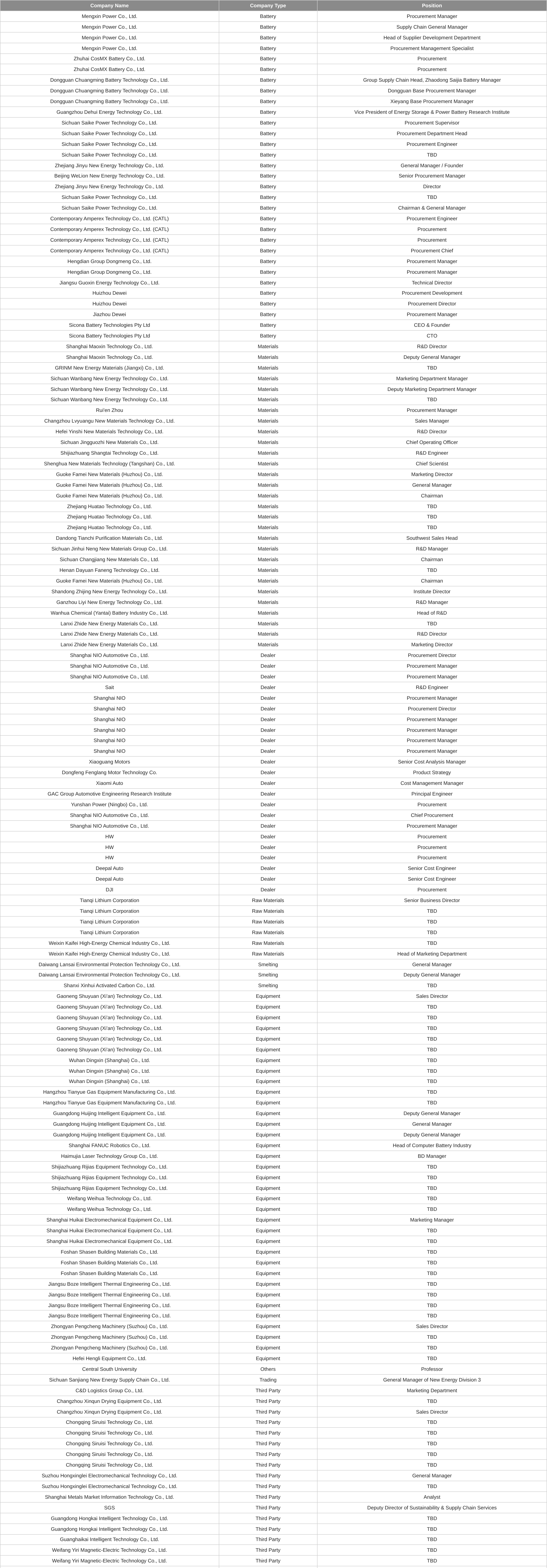
Finally, we recommend SMM's premium conference. Current progress and some participating enterprises and representatives:
Tel: 021-20707860 (or add WeChat 13585549799) Yang Chaoxing. Thank you!
Related information