On July 16, SVOLT Energy Technology held its 2026 Global Partner Summit in Changzhou, Jiangsu, unveiling four major strategic weapons: the upgraded Fengxing Short Blade 3.0, mixed solid-liquid batteries poised for launch, dual-track expansion into energy storage and emerging markets, and the in-year mass production of Flying Stack 4.0. Once a pioneer of the "stacking era," the company once again showcased its cutting-edge strengths.
Fengxing Short Blade 3.0: Bringing 10C Ultra-Fast Charging to the Mainstream Market
When SVOLT Energy Technology committed to short-blade and lamination technology in 2019, few outside the firm believed in the approach. Seven years later, cumulative shipments of SVOLT short-blade batteries have surpassed 1.2 million sets.
At the summit, the newly upgraded Fengxing Short Blade 3.0 was one of the most closely watched products. With 130+ Ah cells, an energy density exceeding 181 Wh/kg, and a driving range of over 650 km, its specifications are not extraordinary in today's battery industry. What truly drew attention was its charging speed: a peak 10C and average 8C charge rate, taking just 5.25 minutes to go from 10% to 80% SOC and only 8.5 minutes from 10% to 97% SOC.
Yang Hongxin, Chairman and CEO of SVOLT Energy Technology, did not overstate the technical difficulty, but achieving this level of ultra-fast charging involves not only optimizing the electrochemical system but also a series of system engineering efforts in thermal management, anode materials, and electrolyte formulation.
Moreover, SVOLT Energy Technology's Fengxing Short Blade 3.0 brings ultra-fast charging technology at an accessible price point to mainstream car models, meaning ultra-fast charging is no longer the exclusive label of high-end vehicles.
Targeting the rigid demand for battery life and extreme environmental adaptability in the hybrid market, the company also launched a 5.1 kWh high-capacity LFP HEV battery pack designed specifically for hybrids, featuring 16.4 Ah cells, energy density over 130 Wh/kg, 50C pulse discharge capability, cycle life exceeding 40,000 cycles, and stable output in extreme conditions from -40°C to 60°C.
Mixed Solid-Liquid Batteries: Mass Production Targeted for Q3 2027
As a major direction for next-generation battery technology, mixed solid-liquid batteries have now entered vehicle validation, with various technical routes showing early cost-reduction effects, while all-solid-state batteries are beginning the exploratory transition from engineering breakthroughs to early commercialization, and industry chain players are stepping up their deployment.
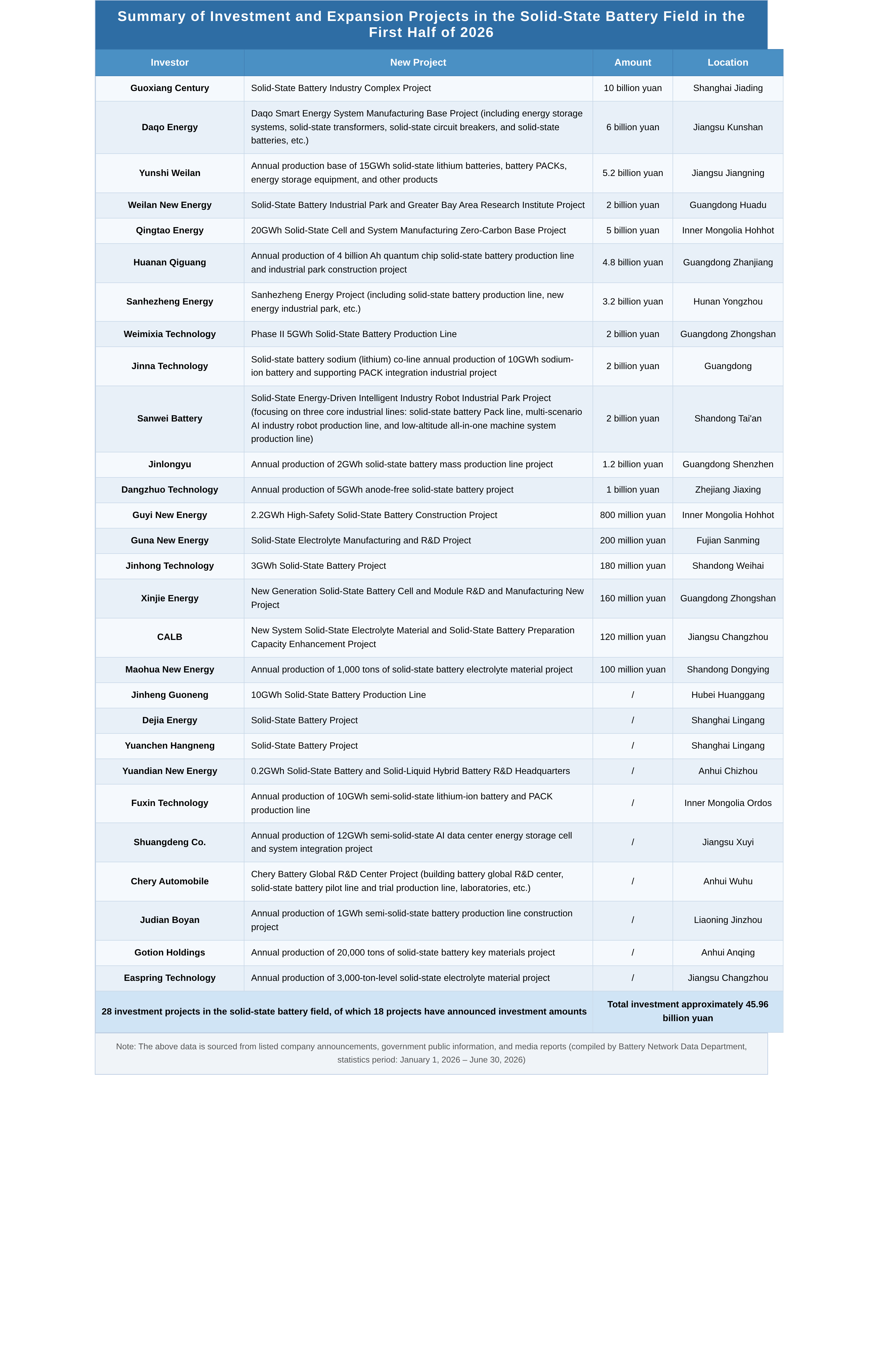
According to incomplete statistics from Battery China, 29 new investment projects were officially announced in the solid-state battery sector in H1 2026, with 18 projects disclosing investment amounts totaling approximately 50.96 billion yuan.
SVOLT Energy Technology had already made forward-looking deployments in solid-state batteries, and in December 2025, its first-generation low-cost mixed solid-liquid battery rolled off a mass-production line in small batches.
At the summit, SVOLT Energy Technology announced the official launch of its first mixed solid-liquid 6C battery, with mass production locked in for Q3 2027.
This 150+ Ah ternary battery cell, paired with a 120+ kWh battery pack, offers a range exceeding 750 km and an energy density of 233 Wh/kg, and can complete 10%–80% SOC charging in 7 minutes thanks to peak 8C fast-charging capability.
More critical data lie in safety: supported by the innovative solid-liquid composite structure, the thermal runaway risk of this mixed solid-liquid cell is reduced by 25%, and cell voltage deviation decreases by 18.5%.
In an interview, Yang Hongxin revealed that the battery has already been designated for two clients – a mid-nickel design entering mass production this year, and a high-nickel design early next year.
It is reported that SVOLT Energy Technology will deliver over 8,000 units of its mid-nickel mixed solid-liquid battery this year, and over 70,000 units in 2027.
"The cost of our current mixed solid-liquid battery is already close to that of liquid batteries, just a little bit higher. As scale expands and technology advances, solid-state electrolyte costs will drop significantly. The scale is small now, but costs will certainly come down once volume increases next year," Yang Hongxin predicted. "SVOLT Energy Technology is expected to become the top-tier player in China truly achieving low-cost mass production of mixed solid-liquid batteries within the next two years."
Energy Storage and Emerging Markets: A Dual-Front Offensive
While strengthening its core power battery business, SVOLT Energy Technology is simultaneously deploying in two other areas: energy storage and emerging markets.
In the energy storage track, the company announced comprehensive iterations of four core products: for residential ESS, 122/120 Ah laminated cells; for C&I ESS, the 285 kWh CTR energy storage system; for utility-scale storage, the 6.29 MWh CTR battery cabin; and for AIDC-UPS scenarios, 90/102 Ah mixed solid-liquid batteries.
Beyond lithium battery energy storage technology, SVOLT Energy Technology also showcased sodium-ion battery technology as a core reserve solution for utility-scale energy storage shared systems, providing long-duration, low-cost support for grid frequency regulation and new energy consumption.
For emerging markets, the company is also pushing forward: in the low-altitude economy, a 21 Ah mixed solid-liquid eVTOL battery with an energy density of 340 Wh/kg and continuous high-power 5C discharge has completed B-sample delivery and installation with a client. In the light EV sector, LFP cell solutions spanning 40 Ah to 196 Ah support continuous 10C high-rate discharge, with a maximum energy density of 197 Wh/kg. In AIDC-UPS scenarios, nano high-rate LFP technology enables continuous 10C high-power output to meet the uninterrupted power supply needs of computing data centers.
Why target energy storage and emerging markets? Yang Hongxin frankly stated: "To put idle capacity to use and balance the fluctuations in power battery orders." At the same time, these markets are high-growth blue oceans offering both business opportunity and profitability.
In Yang Hongxin's view, the power battery business has off-seasons – around the Chinese New Year and in July and August – while Q4 volumes more than double those of Q1, with very significant fluctuations. While businesses like energy storage, electric motorcycles, and unmanned logistics may not match power batteries in absolute volume, they serve as a buffer, and he predicts that both electric motorcycles and unmanned logistics have the potential to reach GWh-scale.
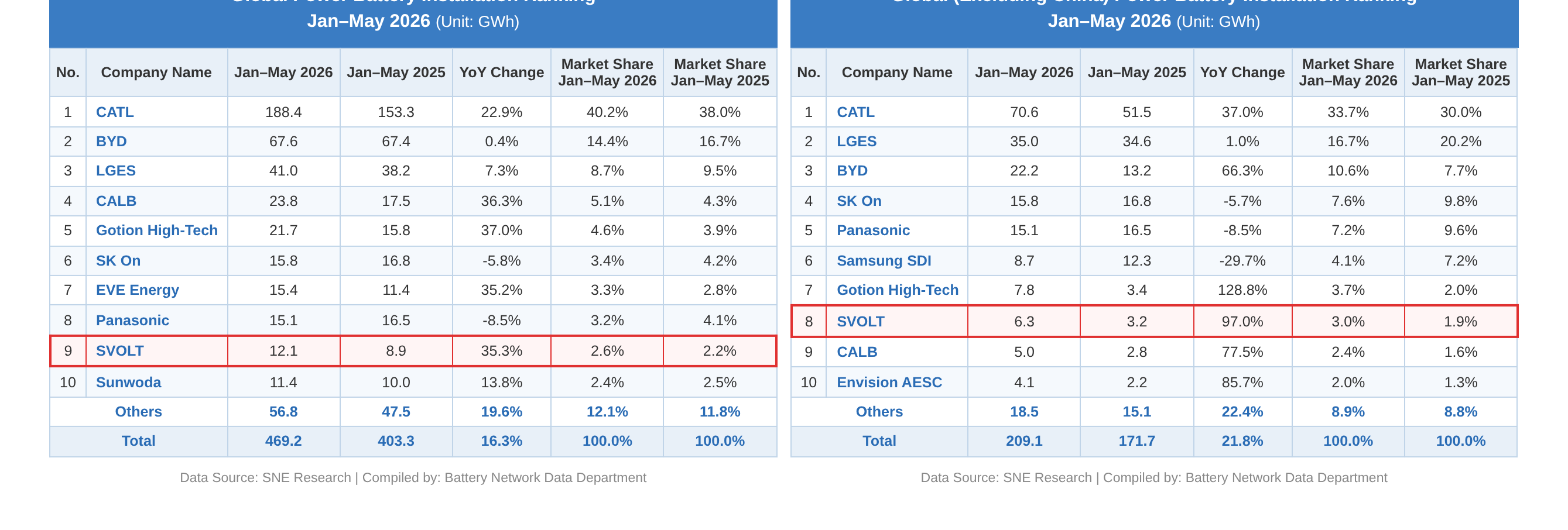
For markets outside China, SVOLT Energy Technology's global expansion is also accelerating. According to data from South Korean research firm SNE Research, SVOLT Energy Technology has entered the global Top 10 for power battery installations and also ranks among the Top 10 in markets outside China on both lists. From January to May 2026, its global power battery installations grew 35.3% YoY, and installations in markets outside China jumped 97% YoY, with growth rates ranking among the highest in the Top 10.
Yang Hongxin disclosed, "Our largest client currently has annual demand of over a dozen GWh; the second-largest client requires over five GWh; other clients each demand more than three GWh and around two GWh, respectively. Overall, markets outside China are now dominated by external clients, with not only substantial volumes but also very strong growth momentum."
Manufacturing Efficiency Revolution: Flying Stack 4.0 to Begin Mass Production This Year
These product iterations are inseparable from the support of manufacturing.
SVOLT Energy Technology's proprietary Flying Stack + thermal composite technology has overcome the long-standing challenges of traditional lamination processes – low efficiency, low yield, and high cost.
At the summit, Yang Hongxin announced that the Flying Stack 4.0 design for both 2D and 3D has been frozen and will be delivered for mass production within this year. The world's first 16-sheet simultaneous stacking technology doubles efficiency compared to the 3.0-generation thermal composite 8-sheet stacking process, making it suitable for scaled production of larger-format laminated batteries.
Additionally, the company's globally unique "separator transfer printing technology" has moved from concept to large-scale manufacturing, accurately attaching solid-state electrolyte separators to electrodes to enhance cell intrinsic safety while maintaining compatibility with existing liquid-electrolyte production lines.
"The process only requires parameter adjustments; the key lies in customized separator development," Yang further explained. SVOLT Energy Technology co-developed a specialized separator with electrolyte coating in collaboration with a separator manufacturer, requiring the coating to adhere firmly upon delivery and achieve over 90% efficient transfer to the electrode surface during hot pressing without backflow – placing stringent demands on the separator's adhesion, morphology, and particle characteristics.
Through sustained investment in lamination processes, short-blade batteries, and mixed solid-liquid technology, SVOLT Energy Technology has built a full-chain patent portfolio covering materials, cells, systems, and manufacturing processes, constructing a differentiated technological moat.
This technical prowess is directly reflected in its patent layout. In January this year, the "2025 Statistical Analysis of China's Automotive Patent Data," jointly released by the China Automotive Intellectual Property Utilization Promotion Center and the CATARC Technology and Innovation Support Center, showed that SVOLT Energy Technology ranked second in the power battery system field with 2,227 published patents.
Beyond patents, its market valuation has also risen alongside. Recently, Hurun Research Institute released the "2026 Global Unicorn Index," ranking SVOLT Energy Technology 256th globally with a valuation of 30 billion yuan.
Conclusion:From "a lonely pioneer that few believed in" to "the world's No.1 in short-blade shipments and a leader whose 4.0 stacking efficiency surpasses winding," what is SVOLT Energy Technology's next move?
At this gathering of global partners, the company has already provided an answer: the Fengxing Short Blade 3.0 cements the technological moat for power batteries through extreme fast charging, mixed solid-liquid batteries target the next-generation technological high ground, energy storage and emerging markets open up new growth spaces, and the Flying Stack 4.0's hardcore innovation underpins smart manufacturing upgrades.
![Solid-State Battery Next Decade Series, Part 6 of 9: Ternary Route May Become Great Again [SMM Analysis]](https://imgqn.smm.cn/usercenter/JSjkr20251217171728.jpg)
![Solid-state Battery September Analysis and Quarterly Review: Policy and Capital Heat Up, Material Spot Cools Down, Industrialisation Moves from "kg" to "mt" [SMM Analysis]](https://imgqn.smm.cn/usercenter/olwlF20251217171731.jpg)