According to a report on Mining.com, Lion One Metals Limited (Lion One Metals Limited) announced that infill and grade control drilling at its wholly-owned Tuvatu (Tuvatu) gold project in Fiji has intersected high-grade gold mineralization, with a total drilling footage of 4,040.90 meters.
The drilling was primarily focused on Zone 5 (Zone 5) of the mine, targeting the down-dip extension of the UR2 lode beneath the 1084 and 1066 levels, which is currently the lowest level of mine development.
Drilling commenced from an underground drilling site on the 1135 level. High-grade mineralization was intersected in 17 of the 22 holes drilled, with two holes abandoned. Most of the intersections were located between 20 and 60 meters below the 1084 level. Due to the proximity of these drill holes to existing workings, the majority of these results are expected to be incorporated into the mining plan for the next 3 to 12 months.
The deepest high-grade intersection was encountered approximately 125 meters below the 1084 level in hole TGC-0503, which intersected over 1 meter grading 16.09 grams per tonne gold. This represents an extension of six levels and indicates the vertical continuity of the high-grade mineralization in this part of the deposit. The most significant intersection was 0.3 meters grading 459.05 grams per tonne gold, along with an intersection of over 0.5 meters grading 338.00 grams per tonne gold, located approximately 60 meters below the 1084 level. Previous drilling in this part of the deposit had also intersected thin zones of similar grade, such as 0.4 meters grading 236.00 grams per tonne gold.
Key recent intersection results include:
◎ Hole TGC-0454 intersected 3.3 meters grading 99.13 grams per tonne gold at a depth of 136.4 meters, including 0.3 meters grading 459.05 grams per tonne gold and 0.5 meters grading 338.00 grams per tonne gold;
◎ Hole TGC-0457 intersected 1.2 meters grading 218.31 grams per tonne gold at a depth of 109 meters, including 0.6 meters grading 366.00 grams per tonne gold.
◎ Hole TGC-0482 intersected 4.6 meters grading 24.86 grams per tonne gold at a depth of 133.92 meters, including 0.5 meters grading 56.29 grams per tonne gold.
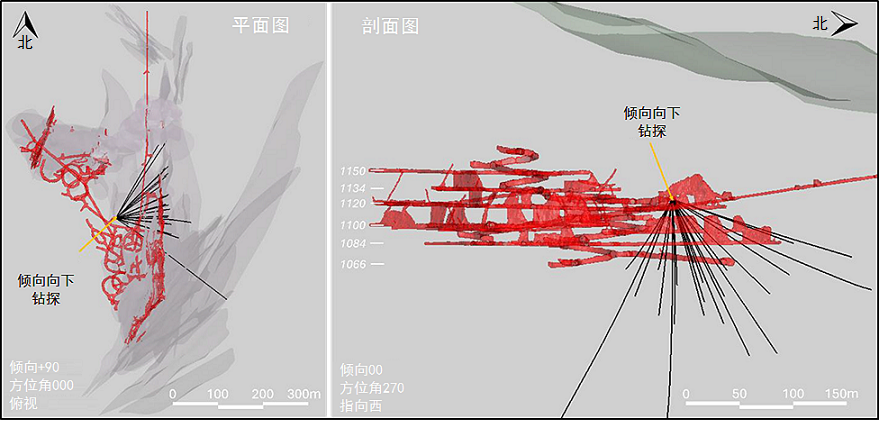
Chart 1 Location of Zone 5
Left: Plan map of drilling in Zone 5, with drilling related to the lode shown in gray and the Tuvatu underground workings shown in red.
Right: Section view of Zone 5, looking west. The primary objective for Zone 5 is the down-dip extension of the lode beneath the current underground workings in the northern part of the deposit.
Drilling in Zone 5
Zone 5 of the Tuvatu project is located on the eastern side of the deposit and is primarily composed of north-south and northeast-southwest trending veins. The drilling announced this time targeted the downward extension of the UR2 vein, which is currently being mined underground. The UR2 vein is one of the north-south trending veins in Mine No. 5. It extends approximately 600 meters along the strike and dips steeply to the east. Current mining along the UR2 vein is taking place both at the top of the mine, on the 1150 and 1170 levels, as well as at the bottom of the 1084 level and the 1066/1068 levels, the latter being the deepest levels currently developed in Mine No. 5. The 1084 level has been developed for 300 meters along the strike, and the 1066/1068 levels are under development.
Drilling commenced from an underground drill station, specifically the 1135 drill station, targeting a section of the UR2 vein over a strike length of 125 meters and a vertical height of 60 meters; a few holes targeted deeper parts of the vein. Seventeen of these holes intersected high-grade ore bodies, mostly located between 20 and 60 meters below the 1084 level, including the most significant intersections of 3.3 meters grading 99.13 grams per metric ton and 1.2 meters grading 218.31 grams per metric ton. The deepest high-grade intersection from this drilling program was 1.0 meter grading 16.09 grams per metric ton, located 125 meters below the 1084 level. This implies the potential for six additional mining levels and continuity of the high-grade ore body along the vertical direction. The two northernmost holes, TGC-0493 and TGC-0495, did not intersect significant mineralization. Further drilling in this area is warranted.
Drilling down-dip intersected multiple thin, high-grade mineralized zones, such as 0.3 meter grading 459.05 grams per metric ton, 0.6 meter grading 366 grams per metric ton, and 0.5 meter grading 338 grams per metric ton. This type of intersection is typical in the Tutatu deposit because the ore-controlling structure is very narrow and also exhibits pinching and swelling along the strike, which also leads to intersections with greater thickness and high grade, such as 4.6 meters grading 24.86 grams per metric ton. The holes reported here were designed to test veins distributed vertically or near-vertically, so the intersection thicknesses approximate true thicknesses.
The results of the down-dip drilling on the UR2 vein in Mine No. 5 are shown in Chart 2. The high-grade ore bodies reported here are expected to be developed within the next 3 to 12 months.
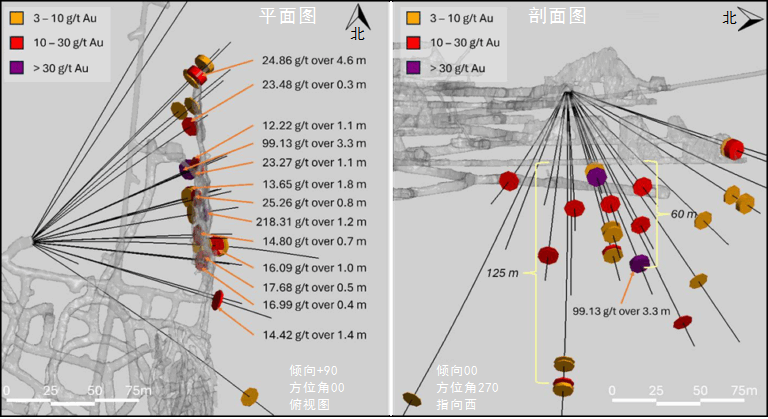
Chart 2: Mine No. 5 - Down-Dip Drilling Results, Highlighting High-Grade Intervals, Using a Cut-Off Grade of 3.0 Grams per Metric Ton.
Left Chart: Plan View, Highlighting High-Grade Intersections.
Right Chart: Section Looking West, Showing the Same High-Grade Intersections.
The drill holes shown here target the down-dip extension zone of the UR2 vein in the northern part of Mine No. 5, associated with current mine development. A high-grade ore body was intersected 125 meters below the 1084 level, and a high-grade intersection of 99.13 grams per metric ton was encountered 60 meters below the 1084 level. The light gray areas in the chart represent the Tutatu underground development workings.