【SMM Analysis】LME Aluminium Prices Hit a Three-Year High in 2025 – Overseas Views on 2026 Outlook

Published: Nov 28, 2025 10:10 (GMT+8)
Source: SMM
【SMM Analysis】 The 2025 aluminium price trajectory has already set the tonne for 2026: high volatility and heightened attention. The aluminium market is at a complex turning point. On one hand, geopolitics, energy transition, and trade policies are reshaping cost structures and supply chains. On the other, strong “green demand” and the reality of supply ceilings form the core contradiction driving price swings. Looking ahead to 2026, aluminium prices may stage a “breakthrough and return” scenario.

【SMM Analysis】LME Aluminium Prices Hit a Three-Year High in 2025 – Overseas Views on 2026 Outlook

In 2025, LME aluminium prices showed a volatile upward trend. From the beginning of the year to mid-March, prices remained relatively stable, before retreating to around USD 2,400/tonne in late March. After April, the market gradually stabilized and edged higher, until a new round of increases began in late October. By November, aluminium prices were fluctuating in the USD 2,800-2,900/tonne range, marking the highest level since the surge triggered by the Russia–Ukraine conflict in 2022.
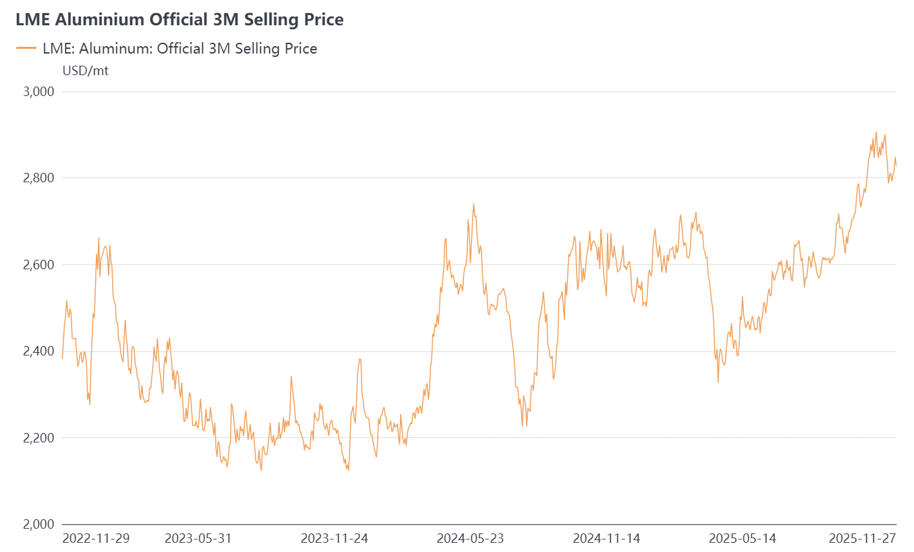
As prices continued to rise, demand in several global markets, especially Southeast Asia and India, fell short of expectations even outside traditional off-season periods. Rising prices for aluminium, scrap, and related products suppressed end-user consumption, leaving upstream, midstream, and downstream players caught in a dilemma of “hard to buy, hard to sell.” Against this backdrop, and with the EU’s Carbon Border Adjustment Mechanism (CBAM) set to take effect in 2026, market attention on the trajectory of LME aluminium prices in 2026 has intensified.

According to reports from multiple overseas institutions and SMM research, the main international perspectives on aluminium’s structural outlook can be summarized as follows:

  • Primary aluminium supply tightness: China’s output is approaching the 45 million tonne capacity ceiling, creating a structural global shortage.
  • Scrap supply under pressure: The EU will implement CBAM in 2026, and scrap export tariffs may be introduced in spring 2026. Policy uncertainty is already affecting global scrap prices and tightening supply.
  • Demand-side support remains: Solar, new energy vehicles, construction, and infrastructure continue to drive steady growth in aluminium demand, providing fundamental support.
  • High European energy costs: Persistently elevated electricity and natural gas prices in Europe are significantly impacting smelter operating rates and production costs.
  • Short-term bullish sentiment: By late 2025 and early 2026, LME aluminium prices may test the USD 3,000/tonne threshold. Many traders and downstream buyers are stockpiling despite high prices.
  • High hopes on new production capacities: With new capacity gradually coming online in Indonesia and elsewhere, the tight global supply situation may ease, leading to possible downward adjustments for LME aluminium prices in the later half of 2026.

Summary & Outlook: Finding New Balance Amid Uncertainty

The 2025 aluminium price trajectory has already set the tonne for 2026: high volatility and heightened attention. The aluminium market is at a complex turning point. On one hand, geopolitics, energy transition, and trade policies are reshaping cost structures and supply chains. On the other, strong “green demand” and the reality of supply ceilings form the core contradiction driving price swings.

Looking ahead to 2026, aluminium prices may stage a “breakthrough and return” scenario. In the short term, structural supply bottlenecks and policy uncertainty could push prices toward the USD 3,000/tonne psychological level. However, market mechanisms will eventually take hold, and the gradual release of new capacity in Indonesia and elsewhere is expected to rebalance supply. SMM forecasts a “high first, then lower” pattern, with prices ultimately finding equilibrium in the USD 2,700–2,800/tonne range.

For overseas enterprises, the challenge lies not only in predicting prices but in adapting to an aluminium industry fundamentally reshaped by energy transition and new trade regulations.

Data Source Statement: Except for publicly available information, all other data are processed by SMM based on publicly available information, market communication, and relying on SMM's internal database model. They are for reference only and do not constitute decision-making recommendations.

For any inquiries or for more information, please contact: lemonzhao@smm.cn
For more information on how to access our research reports, please contact:service.en@smm.cn
Related News
Alba Advances in Acquisition of Aluminium Dunkerque, Aims for Global Low-Carbon Aluminum Expansion
1 hour ago
Alba Advances in Acquisition of Aluminium Dunkerque, Aims for Global Low-Carbon Aluminum Expansion
Read More
Alba Advances in Acquisition of Aluminium Dunkerque, Aims for Global Low-Carbon Aluminum Expansion
[SMM Aluminum Express News] Aluminium Bahrain (Alba) said its proposed acquisition of Aluminium Dunkerque is progressing, with the company working to secure the remaining regulatory approvals required to close the transaction. At its Q3 Board meeting on September 22, Chairman Khalid Al Rumaihi described the deal as an important step in Alba’s international expansion and its ambition to build a global low-carbon aluminum platform. Alba signed the agreement to acquire Aluminium Dunkerque in May 2026, with the transaction subsequently valued at around US$2.2 billion. Aluminium Dunkerque is the EU’s largest primary aluminum smelter, while Alba operates the world’s largest single-site aluminum smelter in Bahrain. The acquisition remains subject to outstanding regulatory approvals and has not yet closed. The Board also approved Alba’s preliminary 2027 Marketing Plan, while reviewing operational, commercial and governance matters. For aluminum supply, the main takeaway is that Alba remains committed to completing the Dunkerque acquisition despite the regional supply disruptions that affected its Bahrain operations earlier this year.
1 hour ago
Guinea Seeks US Financing for CBG's Alumina Refinery Project
1 hour ago
Guinea Seeks US Financing for CBG's Alumina Refinery Project
Read More
Guinea Seeks US Financing for CBG's Alumina Refinery Project
[SMM Aluminum Express News] Guinea is seeking US financing for Compagnie des Bauxites de Guinée’s (CBG) planned alumina refinery, as the country accelerates efforts to process more of its bauxite domestically. Guinea’s Mines Ministry said discussions were held on September 18 with the US International Development Finance Corporation (DFC) and US Export-Import Bank over potential involvement in financing the project. CBG aims to begin construction by the end of 2026, although the refinery’s financing requirement and potential US contribution have not yet been disclosed.
1 hour ago
European Parliament Backs Expanded CBAM for Downstream Aluminum and Steel Products from 2028
1 hour ago
European Parliament Backs Expanded CBAM for Downstream Aluminum and Steel Products from 2028
Read More
European Parliament Backs Expanded CBAM for Downstream Aluminum and Steel Products from 2028
[SMM Aluminum Express News] The European Parliament has backed a broader expansion of the EU Carbon Border Adjustment Mechanism (CBAM) to downstream aluminum and steel products from 2028. Parliament adopted its negotiating position on September 15 by 464 votes to 50, with 159 abstentions, supporting coverage beyond the European Commission’s original proposal for 180 additional downstream products, including aluminum-intensive products such as wire, fasteners, springs and certain finished goods. For aluminum, Parliament also proposes lowering the CBAM exemption threshold from 50 tonnes to just 5 tonnes, meaning smaller-volume importers could become subject to CBAM requirements. It also supports stronger anti-circumvention rules, including the use of emissions default values based on the actual country of origin where authorities suspect attempts to avoid CBAM obligations. The changes are not final yet, with negotiations with the EU Council still required. If adopted, the expansion would increase carbon-reporting and potentially carbon-cost exposure for exporters of downstream aluminum products into the EU, extending CBAM further beyond primary and semi-finished aluminum.
1 hour ago