

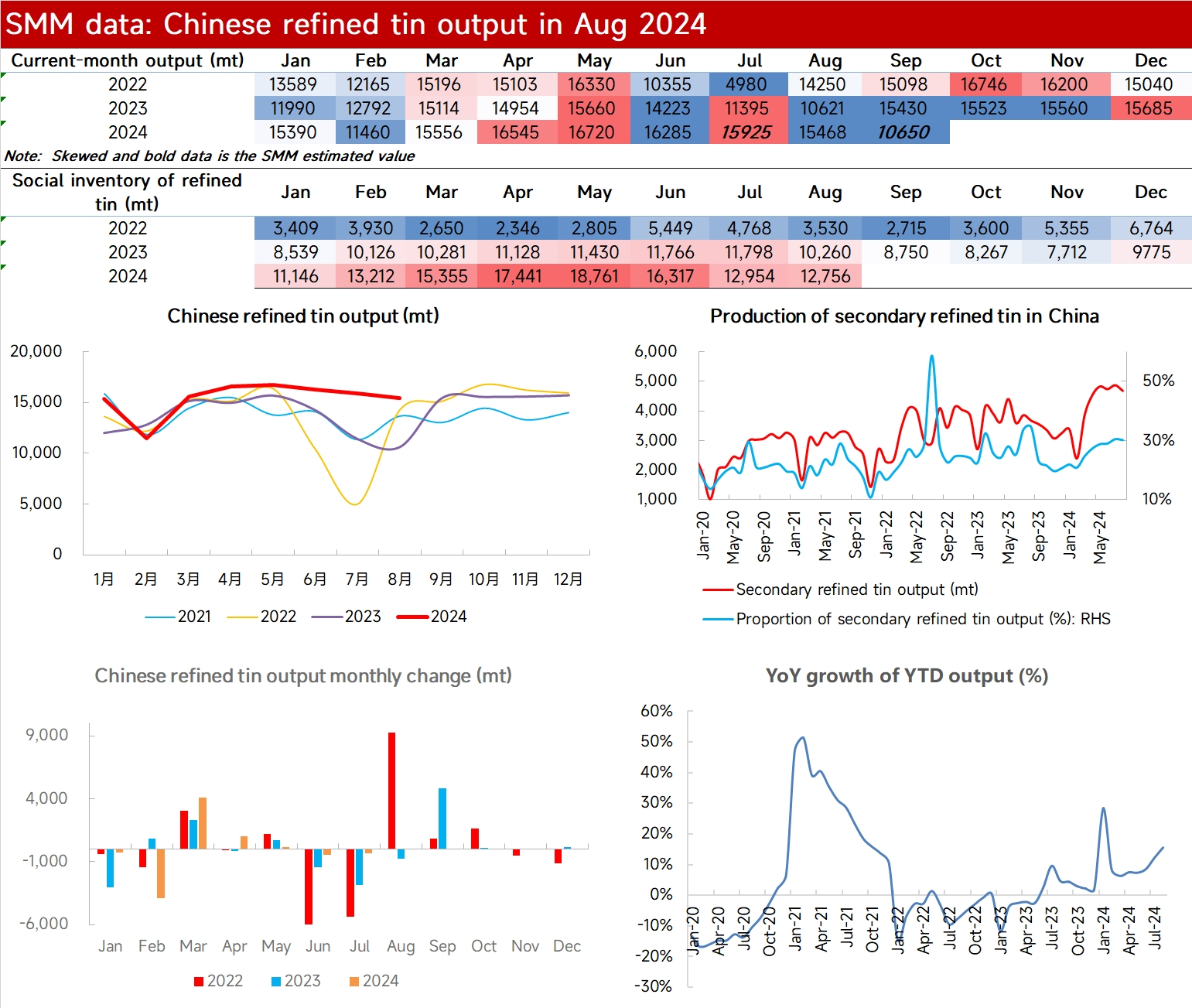
 According to SMM's in-depth research data, in August 2023, the domestic refined tin production reached 15,468 tons. Compared with the previous month, this figure showed a slight decrease of 2.87%, but compared with the same period last year, it increased significantly by 45.64%. In Yunnan, due to the continuous decline in the import volume of Myanmar's tin mines, the tense supply situation at the ore end has begun to have a substantial impact on the smelting process. According to SMM's research results, the amount of tin ore metal imported from the Wa State region of Myanmar in August remained relatively low, which undoubtedly exacerbated the difficulties of smelting enterprises in raw material supply. Against this background, although most smelting companies have made efforts to maintain the current production level, a few companies still have to adjust their production plans based on the purchase volume of tin ore, and it is expected that there may be a slight decline in production in the future. It is also worth paying attention to the Jiangxi region. Here, some smelting companies are also facing severe challenges in raw material supply, which makes it difficult for them to continue to maintain the current production level, resulting in a certain degree of decline in production. In addition, some companies have slightly reduced production due to equipment maintenance, and they plan to make up for the missing production in September. In Inner Mongolia, a large smelting company has also made corresponding adjustments to its production plan due to a slight reduction in raw material supply. However, after experiencing the previous difficulties, the smelting enterprises in Guangxi have fully resumed normal production in August, and the output has also greatly recovered. At the same time, the smelting enterprises in Anhui and other regions maintained a relatively stable production status throughout August. Looking ahead, we have made the following predictions for the refined tin production in various regions in September: In Yunnan, due to the difficulty of effectively replenishing raw material inventories before the lifting of the ban on tin mines in Wa State, Myanmar, and the plan of a large smelting enterprise to shut down for 45 days for maintenance, the production in the region is expected to experience a significant decline. In Jiangxi, due to the dual pressure of raw material supply and production growth faced by most enterprises, the production growth in September is also expected to be very limited. In summary, according to our forecasting model, the national production of tin ingots is expected to reach around 10,650 tons in September 2023. Compared to August, this figure is expected to decrease by 31.15%, while compared to the same period last year, it is expected to decrease by 30.98%.
[SMM Analysis] The volume of tin ore imports from Myanmar continues to shrink, and domestic tin ingot production slightly decreased in August.
According to SMM's in-depth research data, in August 2023, the domestic refined tin production reached 15,468 tons. Compared with the previous month, this figure showed a slight decrease of 2.87%, but compared with the same period last year, it increased significantly by 45.64%
Data Source Statement: Except for publicly available information, all other data are processed by SMM based on publicly available information, market communication, and relying on SMM's internal database model. They are for reference only and do not constitute decision-making recommendations.
For any inquiries or for more information, please contact: lemonzhao@smm.cn
For more information on how to access our research reports, please contact:service.en@smm.cn
Related News

Sep 24, 2026 17:24 (GMT+8)
SMM Newsflash
Read More
SMM Newsflash
【SMM Newsflash】Hassett criticizes recent comments by Fed officials supporting further rate hikes, calling for the restoration of the Fed’s “independence.”
Sep 24, 2026 17:24 (GMT+8)

Sep 24, 2026 15:54 (GMT+8)
Data: SHFE, DCE market movement (Sep 24)
Read More
Data: SHFE, DCE market movement (Sep 24)
The following table shows the ferrous and nonferrous metals movement on the SHFE and DCE on 24 Sep , 2026
Sep 24, 2026 15:54 (GMT+8)
![[SMM Analysis] Mid-Autumn Festival and National Day Holiday and Order Analysis of Downstream Tin Solder Enterprises](https://imgqn.smm.cn/usercenter/pyewj20251217171752.jpg)
Sep 24, 2026 13:48 (GMT+8)
[SMM Analysis] Mid-Autumn Festival and National Day Holiday and Order Analysis of Downstream Tin Solder Enterprises
Read More
[SMM Analysis] Mid-Autumn Festival and National Day Holiday and Order Analysis of Downstream Tin Solder Enterprises
[SMM Analysis: Holiday and Order Status of Downstream Tin Solder Enterprises During Mid-Autumn Festival and National Day]
Sep 24, 2026 13:48 (GMT+8)
Related News
SMM Newsflash
Sep 24, 2026 17:24 (GMT+8)
Data: SHFE, DCE market movement (Sep 24)
Sep 24, 2026 15:54 (GMT+8)
[SMM Analysis] Mid-Autumn Festival and National Day Holiday and Order Analysis of Downstream Tin Solder Enterprises
Sep 24, 2026 13:48 (GMT+8)

[US Treasury yields break above 5% across the board, coupled with pre-holiday caution; the most-traded SHFE tin contract opens lower then stabilizes with sluggish trading [SMM Tin Midday Review]]
Sep 24, 2026 12:03 (GMT+8)