【SMM Analysis】Fluctuations! A Complete Analysis of China's Lithium Market in 2024 (Part 1)

Publicado: May 20, 2024 13:45
Fonte: SMM
Without noticing it, nearly half of 2024 has passed. Looking back at the lithium carbonate market since the beginning of the year has been tumultuous. Since the beginning of the year, the price of battery-grade lithium carbonate has risen from 96,900 RMB/ton to a high of 113,000 RMB/ton, and then experienced a downward trend in recent days after nearly two months of market fluctuations.

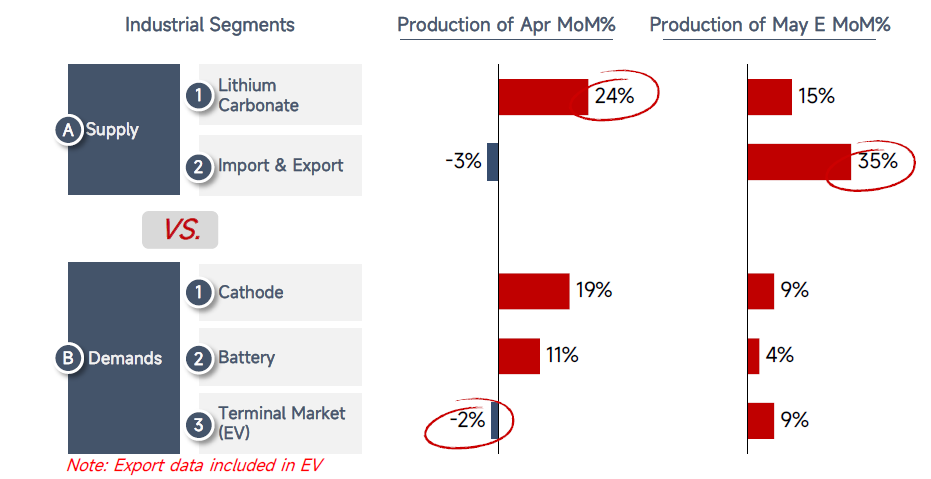
Without noticing it, nearly half of 2024 has passed. Looking back at the lithium carbonate market since the beginning of the year has been tumultuous. Since the beginning of the year, the price of battery-grade lithium carbonate has risen from 96,900 RMB/ton to a high of 113,000 RMB/ton, and then experienced a downward trend in recent days after nearly two months of market fluctuations. This article will analyze in depth the reasons behind the fluctuations in the lithium carbonate market in 2024 from the perspective of supply and demand fundamentals. The analysis will be divided into supply and demand at various stages of the industry. In addition to domestic lithium carbonate production, China is also a net importer of lithium carbonate, and the supplement from the import side should not be underestimated. The demand side will be analyzed based on the conditions of positive electrode materials, battery cells, and end markets.
January-February Review:

Demand side: Historically, after the year-end surge in vehicle sales, vehicle sales usually decline, and the beginning of the year is typically a period of concentrated tenders in the energy storage market. Combined with the impact of the Spring Festival holiday, the first quarter is usually a slow season for demand in the power and energy storage markets, reaching a low point in February due to the lunar new year and Spring Festival effects and gradually warming up after the holiday. Correspondingly, in line with the main theme of sales determining production, production plans for batteries and positive electrode materials remain consistent with changes in end demand. However, due to logistical disruptions during the Spring Festival holiday, early inventory stocking led to a slight increase in positive electrode production in January, which then resumed a downward trend in February.

Supply side: Due to factors such as continuous lithium price declines and cost distortions, some lithium salt companies began to shut down for maintenance in the middle and late January and started their Chinese New Year holidays earlier. As a result, lithium carbonate output began to decline monthly from January and reached a low point in February. At the same time, due to factors such as reduced efficiency in customs clearance during the Spring Festival holiday, imports also showed a downward trend. Balance: With both supply and demand weakening, the balance figures were significantly oversupplied.

March Review: Demand side: After the Spring Festival, leading vehicle companies initiated a price war, and many car manufacturers joined in, continuously lowering prices for various car models. As a result, car sales in March increased by 81%. In the energy storage market, due to the excellent performance of the previous China's large energy storage tendering results exceeding expectations, combined with the demand for stocking brought about by the iteration of battery models, and with the favorable performance of the energy storage market in March due to the low base in February, energy storage battery production increased by 102% compared to February. At the same time, driven by end demand, battery and positive electrode production simultaneously increased significantly. However, most battery factories were concerned that the concentrated stocking in the middle of the year might stimulate a sharp rise in raw material prices in the short term, leading to a significant increase in positive electrode production in the short term. Supply side: After the holiday, some small and medium-sized enterprises in Jiangxi Province faced difficulties in resuming production due to environmental incidents, while most other regions resumed production and output recovery gradually, resulting in a 32% increase in lithium carbonate production in March. With the surge in exports from Chile, lithium carbonate imports maintained a high level from March onwards. Balance: With both supply and demand increasing, the surplus figure decreased slightly due to the faster pace of demand growth.

Others: Given the continuous price decline in the early period, the sentiment of salt factories to support prices is strong; affected by the fermentation of the environmental incidents in Jiangxi, the futures market experienced a significant increase, intensifying the sentiment of salt factories to support prices and withhold sales, leading to a tight spot market. Although imports surged, most arrivals were concentrated in the second half of the month, resulting in a tight spot market in early to mid-month; the role of the futures reservoir continued to expand, absorbing excess levels to some extent, thereby providing some support to prices.

April Review: Demand side: The energy storage market maintains an upward trend, but the overall growth rate has slowed slightly; in the power market, with the end of the quarterly surge in sales and ongoing price wars causing price instability, the details of the old-for-new policy have not yet been implemented. In addition, with the consumer attitude of waiting and seeing strong at the end of the month's auto show, car sales in April showed a slight decline. With the slowdown in terminal demand growth and the early stocking effect, the growth rate in production of positive electrodes and battery cells has gradually decreased. Supply side: The environmental impact in Jiangxi Province has gradually dissipated, but smaller factories continue to face challenges in production due to economic reasons. Sichuan and Qinghai regions have benefited from new capacity ramp-ups, seasonal production increases, and the drive for arbitrage opportunities between futures and spot markets, leading to an overall 24% increase in output. Balance: With both supply and demand increasing, the balance remains slightly oversupplied.

Others: Pre-holiday stocking before Labor Day, combined with a decrease in the customer-to-supplier ratio at the battery cell end, leads to a small increase in demand for spot purchases of lithium carbonate by positive electrode producers; the role of the futures reservoir continues to expand, absorbing excess levels to some extent, thereby providing some support to prices.

Declaração sobre a Fonte de Dados: Com exceção das informações publicamente disponíveis, todos os demais dados são processados pela SMM com base em informações publicamente disponíveis, comunicação de mercado e com base no modelo de base de dados interna da SMM. São apenas para referência e não constituem recomendações para a tomada de decisão.

Para quaisquer perguntas ou para obter mais informações, entre em contato: lemonzhao@smm.cn
Para mais informações sobre como aceder aos nossos relatórios de investigação, entre em contato:service.en@smm.cn
Notícias Relacionadas
Revisão Diária da SMM: Preços do carbonato de lítio à vista caíram em 11 de setembro
há 1 hora
Revisão Diária da SMM: Preços do carbonato de lítio à vista caíram em 11 de setembro
Leia mais
Revisão Diária da SMM: Preços do carbonato de lítio à vista caíram em 11 de setembro
Hoje, os preços spot de carbonato de lítio grau bateria da SMM caíram em comparação com o dia útil anterior. O contrato de carbonato de lítio 2701 abriu em baixa a 140.000 yuans/tonelada hoje. Após a abertura, os comprados resistiram brevemente, e o preço subiu ligeiramente para 140.400 yuans/tonelada. Em seguida, a pressão vendedora foi liberada de forma concentrada, e o preço caiu, rompendo abaixo da linha de preço médio. Perto do meio-dia, surgiram vendas de pânico, e o preço acelerou sua queda, atingindo uma mínima de 128.100 yuans/tonelada. À tarde, compras de oportunidade entraram em níveis baixos, e o preço gradualmente se consolidou e se recuperou, recuperando parte das perdas. Perto do fechamento, o preço se moveu lateralmente em torno de 135.000 yuans/tonelada, fechando em queda de 4,99% a 134.800 yuans/tonelada, com o open interest diminuindo em 1.124 lotes. No mercado spot, com a rápida queda dos preços, a disposição de compra em baixa e de formação de estoques por parte dos compradores continuou a se fortalecer. No entanto, com as plantas químicas de lítio a montante mantendo preços firmes nas ordens spot e segurando as vendas, as ordens spot disponíveis no mercado eram limitadas. No geral, as consultas no mercado foram ativas, mas as transações reais foram relativamente estáveis.
há 1 hora
[Bateria de estado sólido: o 15º Plano Quinquenal de nove departamentos incorpora baterias automotivas de estado sólido ao sistema de normas especializadas, acelerando o fornecimento de padrões de tecnologia de ponta]
há 2 horas
[Bateria de estado sólido: o 15º Plano Quinquenal de nove departamentos incorpora baterias automotivas de estado sólido ao sistema de normas especializadas, acelerando o fornecimento de padrões de tecnologia de ponta]
Leia mais
[Bateria de estado sólido: o 15º Plano Quinquenal de nove departamentos incorpora baterias automotivas de estado sólido ao sistema de normas especializadas, acelerando o fornecimento de padrões de tecnologia de ponta]
[Bateria de estado sólido: o 15º Plano Quinquenal de nove departamentos incorpora baterias automotivas de estado sólido ao sistema de normas especializadas, acelerando o fornecimento de padrões de tecnologia de ponta]
[Bateria de estado sólido: O 15º Plano Quinquenal de nove ministérios incorpora baterias automotivas de estado sólido no sistema de normas especializadas, acelerando o fornecimento de normas de tecnologia de ponta] Em 9 de setembro de 2026, o Ministério da Indústria e Tecnologia da Informação (MIIT) e outros oito ministérios emitiram o 15º Plano Quinquenal para o Desenvolvimento da Indústria de Veículos de Nova Energia Inteligentes e Conectados (Carta de Regulamentação Conjunta do MIIT [2026] nº 305). Na tarefa de "aprimorar continuamente o sistema de normas", o Plano especifica o estabelecimento e o aperfeiçoamento contínuos de sistemas de normas especializadas para chips automotivos, software automotivo, inteligência artificial automotiva, baterias automotivas de estado sólido e desenvolvimento de baixo carbono de automóveis. Na tarefa de "acelerar o fornecimento de normas interdisciplinares de ponta", propõe ainda acelerar a formulação de normas de tecnologia de fronteira para inteligência artificial automotiva, integração cabine-condução, baterias de estado sólido, tração elétrica distribuída, suspensão totalmente ativa, unidades de acionamento integradas e controle de fusão de chassi. O Plano não estabelece uma cláusula especial separada para a industrialização de baterias de estado sólido; os arranjos relevantes concentram-se principalmente na liderança das normas, fornecendo suporte regulatório para avanços tecnológicos subsequentes e aplicação em larga escala.
há 2 horas
[Auto: Nove ministérios divulgam plano de NEV do 15º Plano Quinquenal, com meta de participação de 70%/40% de NEV até 2030]
há 2 horas
[Auto: Nove ministérios divulgam plano de NEV do 15º Plano Quinquenal, com meta de participação de 70%/40% de NEV até 2030]
Leia mais
[Auto: Nove ministérios divulgam plano de NEV do 15º Plano Quinquenal, com meta de participação de 70%/40% de NEV até 2030]
[Auto: Nove ministérios divulgam plano de NEV do 15º Plano Quinquenal, com meta de participação de 70%/40% de NEV até 2030]
O Ministério da Indústria e Tecnologia da Informação da China e outros oito departamentos emitiram conjuntamente o 15º Plano Quinquenal para veículos de nova energia inteligentes e conectados. Até 2030, a meta é que os automóveis de passageiros e os veículos comerciais de nova energia atinjam 70% e 40% das vendas de veículos novos em seus respectivos segmentos, com direção autônoma em escala e consumo médio de energia dos veículos elétricos em torno de 11,5 kWh por 100 km. O plano define 17 tarefas principais em cinco áreas, incluindo a mineração e reciclagem coordenadas de recursos de lítio, cobalto e níquel, normas para baterias de estado sólido para veículos, maior uso de caminhões elétricos pesados na logística de longa distância e o pico de carbono na indústria automotiva antes de 2030.
há 2 horas
【SMM Analysis】Fluctuations! A Complete Analysis of China's Lithium Market in 2024 (Part 1) - Shanghai Metals Market (SMM)