The Overall Silicon Market Stalemate Remained and the Prices Stood Stable Last Week

Published: Nov 14, 2022 16:21
Source: SMM
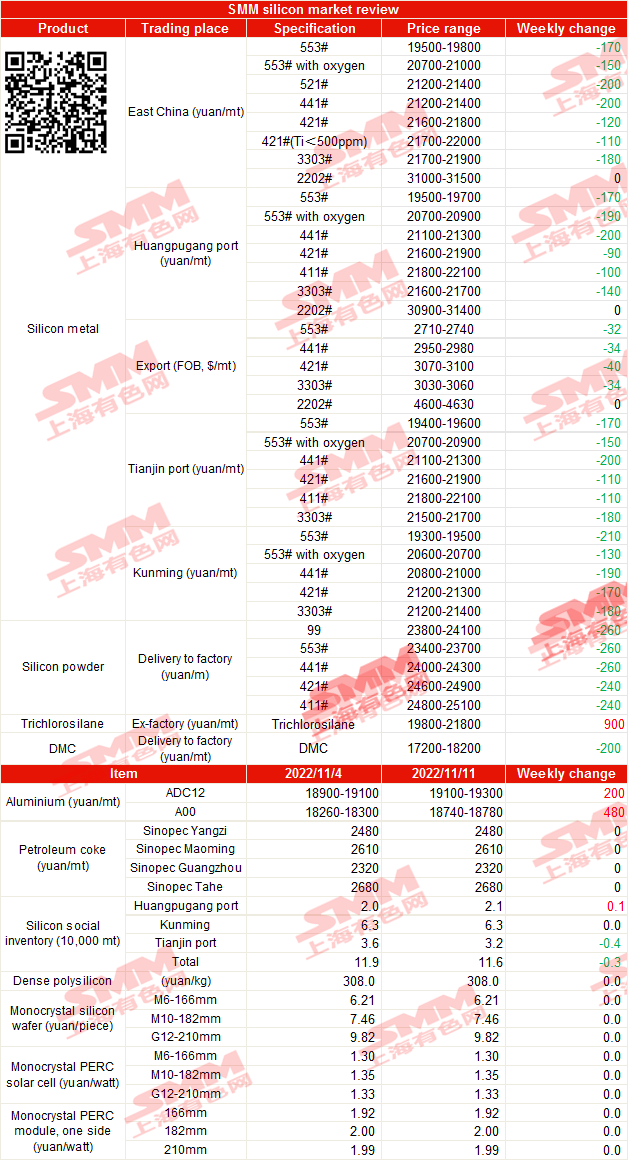
Prices of silicon metal remained stable last week. As of November 10, prices of standard #553 silicon metal in east China were 19,500-19,800 yuan/mt; above-standard #553 silicon metal 20,700-21,000 yuan/mt; #441 silicon metal 21,200-21,400 yuan/mt; and #421 silicon metal 21,600-21,800 yuan/mt.

SHANGHAI, Nov 14 (SMM) - Prices of silicon metal remained stable last week. As of November 10, prices of standard #553 silicon metal in east China were 19,500-19,800 yuan/mt; above-standard #553 silicon metal 20,700-21,000 yuan/mt; #441 silicon metal 21,200-21,400 yuan/mt; and #421 silicon metal 21,600-21,800 yuan/mt. The silicon metal market was in stalemate this week. The top two silicon manufacturers in Xinjiang (Shihezi and Changji) were affected by the pandemic to varying degrees, with a production curtailment of over 50% and roughly 16% respectively. The resumption time is uncertain. Meanwhile, the demand from silicone and aluminium alloy sectors was weak and the bids of polysilicon were released slowly. Therefore, the silicon metal transactions were flat, and silicon prices remained stable amid the weak supply and demand.

The operating rates of secondary aluminium alloy enterprises in Guangdong and Chongqing fell slightly due to the spread of the pandemic. The secondary aluminium alloy enterprises purchased silicon metal as needed due to their poor profits. The operating rates of silicone enterprises remained low. In the early stage, the output of silicone monomer companies declined as some enterprises undertook maintenance. But the supply was still in surplus and the prices of DMC remained low. In mid to late-November, some monomer companies will resume the production and the operating rates are expected to increase slightly. The polysilicon supply continued to increase as the new capacity was ramping up the production. In the mid and late-November, about 80,000 mt of polysilicon capacity will be overhauled and is expected to resume in mid-December.

As the dry season is approaching in Sichuan and Yunnan, the costs increased and enterprises were less willing to lower the prices. Meanwhile, amid the off-season in the aluminium alloy and silicone markets, some traders held a bearish outlook and purchased as needed. It is expected that silicon metal prices will remain stable this week.
Data Source Statement: Except for publicly available information, all other data are processed by SMM based on publicly available information, market communication, and relying on SMM's internal database model. They are for reference only and do not constitute decision-making recommendations.

For any inquiries or for more information, please contact: lemonzhao@smm.cn
For more information on how to access our research reports, please contact:service.en@smm.cn
Related News
[Flash | Chile's Mining Production Index Falls 7.2% YoY in July; Metallic Mining Down 10.7%]
54 mins ago
[Flash | Chile's Mining Production Index Falls 7.2% YoY in July; Metallic Mining Down 10.7%]
Read More
[Flash | Chile's Mining Production Index Falls 7.2% YoY in July; Metallic Mining Down 10.7%]
[Flash | Chile's Mining Production Index Falls 7.2% YoY in July; Metallic Mining Down 10.7%]
On August 31, Chile's National Statistics Institute (INE) reported that the country's industrial production index fell 5.1% year-on-year in July. Within that, the mining production index (IPMin) declined 7.2%, with metallic mining down 10.7%, subtracting 9.301 percentage points from the index, mainly on lower copper extraction and processing. USGS data show Chile accounted for roughly 16% of global molybdenum output in 2025. The recent output losses at Chile's copper-molybdenum mines have been concentrated at the beneficiation stage, which hits by-product molybdenum harder than copper; global molybdenum supply is therefore expected to feel the impact in 2026.
54 mins ago
[SMM Chromium Flash] Zimbabwe Embargoes 1,500t Chrome Concentrate Stockpile in Mineral Smuggling Crackdown
14 hours ago
[SMM Chromium Flash] Zimbabwe Embargoes 1,500t Chrome Concentrate Stockpile in Mineral Smuggling Crackdown
Read More
[SMM Chromium Flash] Zimbabwe Embargoes 1,500t Chrome Concentrate Stockpile in Mineral Smuggling Crackdown
[SMM Chromium Flash] Zimbabwe Embargoes 1,500t Chrome Concentrate Stockpile in Mineral Smuggling Crackdown
Zimbabwe's Minerals Marketing Corporation of Zimbabwe (MMCZ) recorded 18 cases of suspected mineral smuggling and irregular mineral movement between January and August 20, 2026, covering a combined 2,654.88 tonnes of mineral material and metal scrap. Lithium, chrome and silica dominated the case register, according to MMCZ's inaugural Mineral Resource Accounting and Surveillance Market Update. The single largest item was a 1,500-tonne chrome concentrate stockpile in Darwendale, placed under embargo while investigations continue, accounting for more than half of all tonnage flagged across the review period. The remaining cases covered 1,154.88 tonnes. MMCZ General Manager Dr. Nomusa Jane Moyo said the offences detected included movement without valid documentation, misuse or falsification of export papers, cargo misdeclaration, and attempted movement of unbeneficiated mineral ore. Critical minerals have become a particular focus of the corporation's surveillance efforts, in line with government policy on beneficiation and tighter controls on unprocessed mineral exports. Most cases were recorded at border points, reflecting the deployment of a permanent Mineral Resource Accounting Inspectorate at border posts, a capability MMCZ previously lacked, with inspectors now physically verifying cargo, inspecting consignments and collecting samples where technical confirmation is required. Enforcement has been increasingly intelligence-led, drawing on cooperation between MMCZ and Zimbabwe's Criminal Investigation Department Minerals, Flora and Fauna Unit, police intelligence, the Zimbabwe Revenue Authority, and the Zimbabwe Anti-Corruption Commission. Outcomes recorded during the period include arrests, court appearances, fines, forfeiture of mineral ore to the state, impoundment of consignments, and the return of undocumented minerals to their source. Dr. Moyo said the corporation is maintaining a zero-tolerance approach to illegal mineral exports and will continue tightening its surveillance regime through border inspections, mine-level monitoring, sampling and joint enforcement operations, with the objective of ensuring Zimbabwe can account for its mineral resources from source to market in compliance with national beneficiation policy.
14 hours ago
[SMM Chromium Flash] US Forced-Labour Tariff Hits SA Ferrochrome With No Section 232 Exclusion
14 hours ago
[SMM Chromium Flash] US Forced-Labour Tariff Hits SA Ferrochrome With No Section 232 Exclusion
Read More
[SMM Chromium Flash] US Forced-Labour Tariff Hits SA Ferrochrome With No Section 232 Exclusion
[SMM Chromium Flash] US Forced-Labour Tariff Hits SA Ferrochrome With No Section 232 Exclusion
A 12.5% US forced-labor tariff on South African goods took effect on July 24, 2026, and unlike finished steel products, ferrochrome received no exclusion from the levy. Finished steel benefits from an exemption tied to existing Section 232 steel duties, but ferrochrome, classified as an alloy input rather than a finished steel article, has never fallen under that programme, leaving it fully exposed to the new tariff. The exposure carries outsized weight given the scale of US dependence on South African supply. South Africa supplies 96% of the chromite ore imported into the United States and remains the largest single source of finished ferrochrome alloy for the US market, while the country mines close to 45% of the world's chromite ore output. According to the US Geological Survey's February 2026 Mineral Commodity Summaries, the US has no domestic chromite mine production at all and carries a 79% net import reliance on chromium, with recycled stainless scrap covering the remainder. Writing in Business Day, ferrochrome-sector adviser Millard Arnold, a former US deputy assistant secretary of state and former US minister counsellor for commercial affairs at the US embassy in South Africa, argued that most ferrochrome still enters the US through spot markets rather than structured long-term offtake agreements, in contrast to China, which he said has locked in long-term supply arrangements with South African producers to feed its own steel industry. Arnold called for Washington to treat ferrochrome with the same strategic urgency applied to rare earths, pointing to development-finance-backed offtake deals and precedents such as the US Defense Production Act's Title III, under which the UK and Australia were designated eligible critical-minerals sources, as models Washington could extend to South Africa. Whether US policymakers act on that case, rather than allowing the new tariff to stand unaddressed, remains an open question that will shape how much of South Africa's ferrochrome trade continues gravitating toward China in the interim.
14 hours ago
The Overall Silicon Market Stalemate Remained and the Prices Stood Stable Last Week - Shanghai Metals Market (SMM)