World's First LMFP Project with a Capacity over 100,000 mt/year Commissioned in Qujing, Yunnan

Published: Sep 20, 2022 11:16 (GMT+8)
Source: SMM
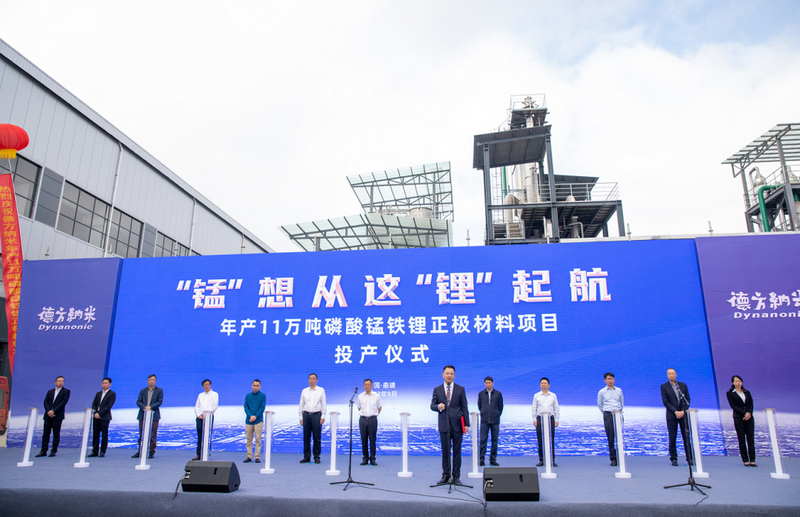
According to official news from Dynanonic, the company's 110,000 mt/year lithium iron manganese phosphate (LMFP) project was officially put into operation in Qujing, Yunnan on September 19, 2022.

According to official news from Dynanonic, the company's 110,000 mt/year lithium iron manganese phosphate (LMFP) project was officially put into operation in Qujing, Yunnan on September 19, 2022. The project is located in the Xicheng Industrial Area of Qujing Economic Development Zone. The construction of the project started in January 2022 and lasted 8 months, with a total investment of 2.59 billion yuan. It is the world's first LMFP project with an annual capacity over 100,000 mt.  
Credit: The WeChat officiant account of Dynanonic

Dynanonic is a leading lithium iron phosphate (LFP) manufacturer in China. Its core product is nano LFP, which has been widely used in new energy vehicles, energy storage systems and other fields. In terms of production, Dynanonic has built four major production bases, boasting a total production capacity of 260,000 mt of LFP. The company also plans to add 80,000 mt of LFP capacity in Sichuan by the end of 2022. Therefore, it is expected to have a LFP capacity of 345,000 mt by the end of 2025.

In fact, LMFP can be regarded as an upgraded version of LFP because manganese element is added to LFP to effectively combine the advantages of iron and manganese elements. At the same time, the high voltage of manganese is tapped into to break through the energy density upper limit of LFP batteries. The comparison between LMFP and LFP/NMC cathode materials is listed as followed.

LMFP vs LFP: LMFP has higher energy density (about 10-20%) than LFP. However, the addition of manganese element makes it less conductive, which poses higher demand for electrolyte.

LMFP vs NMC cathode materials: LMFP outperforms the other in terms of cost effectiveness, security, and cycle life, but is overshadowed in terms of energy density and conductivity.

On the whole, LMFP can be regarded as an upgraded version of LFP, which makes up for the latter's shortcomings in energy density and better fill the market gap between LFP and NMC cathode materials.

Apart from Dynanonic, there are many other enterprises engaged in the production of LMFP.

(1) Litai Lithium Energy. The company already has LMFP production lines with a capacity of 2,000 mt/year, and it has planned to add a capacity of another 3,000 mt in the future. (2) Ronbay Technology. After acquiring Tianjin SKLD Technology in July 2022, the company has now achieved monthly output of 100 mt LMFP for two-wheeled electric vehicles. Ronbay Technology's investor survey report in August revealed that the company’s LMFP output has increased significantly to 200 mt/month. Moreover, the company is actively carrying out research and development as well as cooperation with core downstream customers. (3) Easpring Material Technology. According to the latest news, the company's LMFP materials have so far been sent for sample certification. (4) Lopal Tech. The company is currently conducting verification work for client application. (5) Guanghua Sci-Tech. The company plans to invest 247 million yuan to build 36,000 mt of LMFP and LFP production capacity.

Generally, Dynanonic said that the company's LMFP project will enhance its advantages with distinctive in production capacity. After the 110,000 mt/year LMFP project is commissioned, it becomes the largest LMFP cathode material project in China. In the field of LMFP development, Dynanonic takes a leading position among its counterparts in terms of strategic layout and progress. According to its long-term plan, the company is expected to have a production capacity of 440,000 mt of LMFP in 2025, and at the same time, the annual production capacity of cathode lithium supplement is also scheduled to reach 25,000 mt.

Data Source Statement: Except for publicly available information, all other data are processed by SMM based on publicly available information, market communication, and relying on SMM's internal database model. They are for reference only and do not constitute decision-making recommendations.

For any inquiries or for more information, please contact: lemonzhao@smm.cn
For more information on how to access our research reports, please contact:service.en@smm.cn
Related News
[SMM Lithium News] Zimbabwe: No Reason to Delay Lithium Concentrates Export Ban
13 mins ago
[SMM Lithium News] Zimbabwe: No Reason to Delay Lithium Concentrates Export Ban
Read More
[SMM Lithium News] Zimbabwe: No Reason to Delay Lithium Concentrates Export Ban
[SMM Lithium News] Zimbabwe: No Reason to Delay Lithium Concentrates Export Ban
On October 9, Zimbabwe said there is no reason to delay the lithium concentrates export ban set to take effect in January 2027. The country's Information Minister Nick Mangwana noted that lithium miners have been given ample time to prepare for local processing. Zimbabwe earlier suspended lithium concentrates exports in February this year to promote domestic downstream processing and curb illegal shipments, and began distributing quotas after April, but the full ban in 2027 remains on track as originally planned. The country is following the lead of other African nations in seeking to capture greater added value from its natural resources.
13 mins ago
[Lithium battery: CATL signs ~RMB 2.1bn cathode copper supply deal to secure copper foil feedstock]
3 hours ago
[Lithium battery: CATL signs ~RMB 2.1bn cathode copper supply deal to secure copper foil feedstock]
Read More
[Lithium battery: CATL signs ~RMB 2.1bn cathode copper supply deal to secure copper foil feedstock]
[Lithium battery: CATL signs ~RMB 2.1bn cathode copper supply deal to secure copper foil feedstock]
CATL announced on Sep 30 that its wholly owned unit Hong Kong Times New Energy will purchase 20,000 tonnes of cathode copper from an affiliate for up to USD 320 million (about RMB 2.145 billion), with deliveries from Jan 2027 to Dec 2028 and a USD 100 million prepayment due in Dec 2026. Cathode copper is the key raw material for lithium battery copper foil. CATL said the deal aims to secure stable supply and optimize procurement costs amid growing power and energy storage battery shipments.
3 hours ago
[SMM Cobalt Morning Meeting Summary] Post-holiday demand recovery limited, cost support weakening, material prices under pressure
6 hours ago
[SMM Cobalt Morning Meeting Summary] Post-holiday demand recovery limited, cost support weakening, material prices under pressure
Read More
[SMM Cobalt Morning Meeting Summary] Post-holiday demand recovery limited, cost support weakening, material prices under pressure
[SMM Cobalt Morning Meeting Summary] Post-holiday demand recovery limited, cost support weakening, material prices under pressure
The cobalt industry chain remained weak after the holiday, with sluggish demand and lower costs jointly weighing on prices. Refined cobalt consolidated at lows, traders raised spot-futures price spreads, and downstream buying remained primarily need-based restocking. Trading in intermediate products stalled, with a clear gap between the floor purchase price of $14.5/lb and downstream acceptance prices below $13/lb. Cobalt sulphate offers held near 60,000 yuan/mt, but transactions were difficult, and a lower raw material coefficient further weakened cost support. Cobalt chloride and Co3O4 continued to grind lower, enterprises expanded production cuts and suspensions, and new procurement was insufficient. Leading cobalt powder offers fell to around 360,000 yuan/mt, while small and medium-sized enterprises dropped to 330,000–340,000 yuan/mt, with downstream high-priced inventory dragging on purchases. Ternary cathode precursor prices weakened, export orders were relatively strong, domestic production schedule recovery was limited, and spot order coefficients were expected to trend lower. Ternary cathode materials consolidated at lows, battery cell manufacturers held ample inventory and restocked cautiously; LCO was pressured by both falling costs and weak demand. Going forward, close attention should be paid to end-user order recovery, inventory destocking, and the sustainability of restocking.
6 hours ago