Silicon prices have bottomed out, uncertainty remains for near-term prices

Published: Jul 15, 2020 14:21
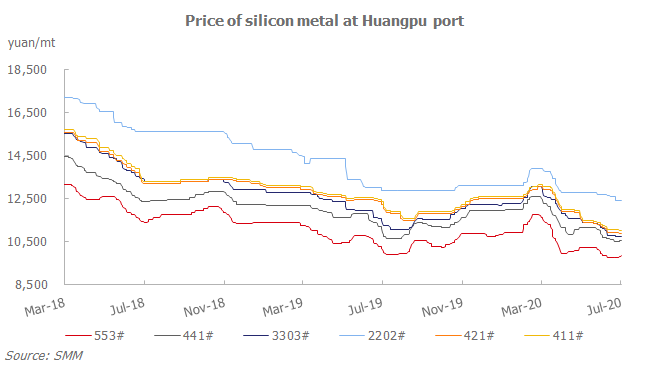
Silicon prices returned to a downward trend in June after stabilising in May, as supply increased with ramped-up production in Yunnan and Sichuan, while demand in the domestic and overseas markets failed to post same growth. Trades were thin amid pessimistic sentiment.

SHANGHAI, Jul 15 (SMM) – Silicon prices returned to a downward trend in June after stabilising in May, as supply increased with ramped-up production in Yunnan and Sichuan, while demand in the domestic and overseas markets failed to post same growth. Trades were thin amid pessimistic sentiment. 

 
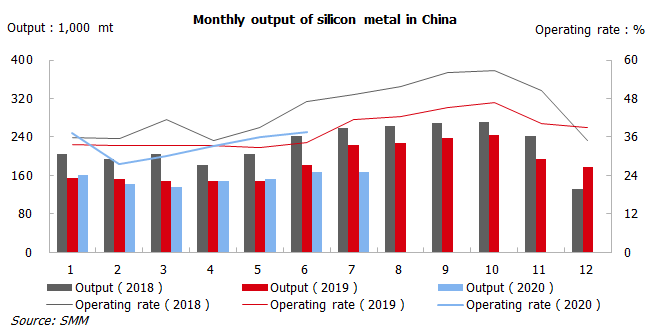
By mid-June, prices of some low-grade specifications declined to the lowest levels in three years, below the costs of some production capacity, and this led to increased suspension at producers. But the capacity additions in south-west China will continue to contribute to output growth. This, coupled with the resumption of work in north China, will likely see the national operating rates of silicon mills in August reaching peak level of the year. 


Resumption of the export market will be the major driver for consumption during the June-September period. Downstream producers in major export destinations of Asia, such as Japan, South Korea and Thailand started to make enquiries and restock after they restarted operation. This improved China’s export trades in June, as compared with May, and new orders will be mostly delivered in July-August. 


However, the resumption of downstream production in Europe and the Middle East remained at a slow pace, as some major producers have cancelled purchase tenders for Q3 or the second half of the year. The shipments for Q2 orders have been delayed to H2 2020. 


SMM expects China’s monthly average exports of silicon in June-September at 50,000 mt, still lower from a year ago, and the loss in exports in H1 may not be offsetted in H2 2020. 


Operations at Chinese silicon mills edge higher in July. On the downstream front, operations at aluminium alloy and polysilicon producers are slightly weaker than June while higher production of organosilicon monomer and a rise in exports result in overall higher demand. 


Purchases have increased after silicon prices rebounded from the bottom levels in June, but restocking demand was limited as most of the procurement was for the fulfilment of backlogged orders. Some buyers raised the quantity for each purchase while lowered the purchase frequency. 


SMM expects silicon prices to remain stable in July. Zero price spread between high and low-grade silicon products at the start of the month will be unable to sustain, as supply resumption from major mills in Xinjiang in late-July will weigh on prices of low-grade silicon. Average prices of chemical-grade 421# silicon will slightly recover in August, and the price spread between different specifications will return to normal levels.


Data Source Statement: Except for publicly available information, all other data are processed by SMM based on publicly available information, market communication, and relying on SMM's internal database model. They are for reference only and do not constitute decision-making recommendations.

For any inquiries or for more information, please contact: lemonzhao@smm.cn
For more information on how to access our research reports, please contact:service.en@smm.cn
Related News
[SMM Analysis] Stronger Profits, Yet Limited Supply Elasticity: H1 2026 Americas Moly Mine Review
23 hours ago
[SMM Analysis] Stronger Profits, Yet Limited Supply Elasticity: H1 2026 Americas Moly Mine Review
Read More
[SMM Analysis] Stronger Profits, Yet Limited Supply Elasticity: H1 2026 Americas Moly Mine Review
[SMM Analysis] Stronger Profits, Yet Limited Supply Elasticity: H1 2026 Americas Moly Mine Review
In H1 2026, Americas moly supply divergence deepened. Despite stronger mining profits, overall output failed to rebound. While H2 may see recoveries at select large mines, supply elasticity remains constrained. Which operations are dragging on supply, and where will incremental growth emerge? SMM data reveals a market entering a new phase of "stronger margins, diverging production, and concentrated incremental gains."...
23 hours ago
[SMM Chromium Week Review] Chrome Ore Flows Rebound as China Port Stocks Build, Zimbabwe Eyes Ferrochrome Capacity
Sep 11, 2026 20:21
[SMM Chromium Week Review] Chrome Ore Flows Rebound as China Port Stocks Build, Zimbabwe Eyes Ferrochrome Capacity
Read More
[SMM Chromium Week Review] Chrome Ore Flows Rebound as China Port Stocks Build, Zimbabwe Eyes Ferrochrome Capacity
[SMM Chromium Week Review] Chrome Ore Flows Rebound as China Port Stocks Build, Zimbabwe Eyes Ferrochrome Capacity
September 11, 2026.
Sep 11, 2026 20:21
[SMM Chromium Flash] Tharisa's Underground Transition at Its Chrome-PGM Flagship Mine Remains on Track
Sep 11, 2026 20:12
[SMM Chromium Flash] Tharisa's Underground Transition at Its Chrome-PGM Flagship Mine Remains on Track
Read More
[SMM Chromium Flash] Tharisa's Underground Transition at Its Chrome-PGM Flagship Mine Remains on Track
[SMM Chromium Flash] Tharisa's Underground Transition at Its Chrome-PGM Flagship Mine Remains on Track
Tharisa confirmed its transition to underground mining at its flagship Tharisa Mine, on the southwestern limb of South Africa's Bushveld Complex, remains on time and within budget, running in parallel with the Karo Platinum Project's construction financing in Zimbabwe. Development of the Apollo underground complex, which commenced in March 2026, is progressing toward first run-of-mine ore in the current quarter, with steady-state production of 255,000 mt per month targeted by the third quarter of calendar year 2029. The Orion complex is expected to follow, targeting first ore in financial year 2031 and steady-state production by the third quarter of calendar year 2033. Together, Tharisa said the two underground complexes are expected to extend mining at the Tharisa Mine, which co-produces chrome concentrate alongside PGMs from the same orebody, for more than 60 years beyond depletion of the current open pit. The underground project is fully funded through development loans from Absa and Standard Bank and an asset-based revolving facility from Nedbank, funding that sits separately from the US$300 million Nordic bond raised this week for Karo. The company did not break out what share of Apollo or Orion's future run-of-mine ore output will be chrome-bearing material versus PGM-bearing material, leaving the underground transition's specific impact on Tharisa's chrome concentrate volumes still to be clarified as the two complexes ramp up toward steady state.
Sep 11, 2026 20:12