SMM7: at the 2020 (Fifth) China International Nickel-Cobalt-Lithium Summit Forum and China International Conference on New Energy Lithium Materials held by SMM, Luo Wenbin, a professor at Northeastern University, said that hard carbon as an anode material can significantly improve the performance of batteries and meet the requirements of high-power, high-rate, wide-temperature regions, especially in high-cold areas for automotive batteries and military industry.
The state has included special new energy materials and devices in the strategic requirements of national planning, and the state encourages the research and development of low-temperature lithium-ion batteries to meet the energy storage needs of "border defense equipment, new energy vehicles in cold areas, engineering construction, field mining" and other industries. At present, there is no commercial high-end hard carbon material supply enterprise in China, individual Japanese enterprises can produce this product, but the price is expensive and the output is limited. Because the material belongs to the special new energy strategic demand material, its high-end products are not exported. It limits the development of our country in this field.
The anode material used in the production of lithium batteries in China is mainly graphite, with an annual consumption of about 50,000 tons. With the increase of national investment in the development of new energy vehicle batteries, the amount of graphite will also increase. However, the low temperature characteristic of graphite negative electrode is poor (serious electrical attenuation below zero), so it is difficult to be applied in national defense and some extremely cold fields.
Luo Wenbin said that the hard carbon anode project mainly develops and produces anode materials under extremely cold conditions to fill the domestic gap in this field. The hard carbon produced by this project has the following advantages:
1) High capacity, specific capacity up to 550 Ma / g;
2) the rate performance is good, and it can be used normally under the condition of 5C;
3) wide temperature range, can continue to be used even at minus-30 degrees Celsius, and maintain room temperature performance greater than 80%.
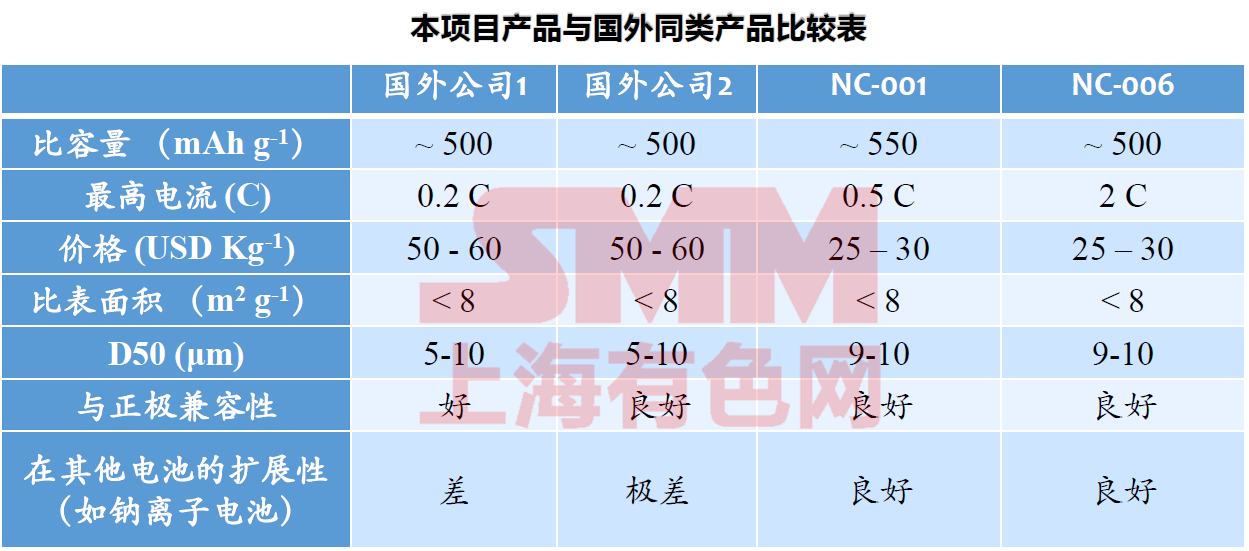
Product features
Hard carbon as a negative electrode material can significantly improve the performance of batteries, and can meet the requirements of high power, high rate, wide temperature range, especially in cold areas for automotive batteries and military industry.
The main results are as follows: (1) using lattice defect technology, through multi-stage high temperature and mixed atmosphere treatment, controllable crystal structure process parameters can be realized, and multi-uses such as dynamic hard carbon anode material and capacitive hard carbon anode material can be realized. HC-006, a dynamic hard carbon anode material, has excellent low temperature performance and can maintain more than 80% of its electrochemical performance at room temperature at-30 degrees Celsius.
(2) the gas drilling technology is adopted to realize the micro-nano-hole structure with low specific surface area, which can accept high current charge and discharge to meet the needs of power vehicles, such as power hard carbon anode material HC-006, which has excellent high-rate performance, because of its unique characteristics of short-range order and long-range disorder, it can realize the charge-discharge ability of 5C.
(3) Nano-porous lithium storage technology is used to double the energy density of existing lithium-ion batteries by increasing the specific capacity of the materials.
Conclusion
1. Lithium ferromanganese phosphate cathode material was prepared by solution ao method using iron oxide scale of iron and steel plant as raw material. the process is simple, the product stability is high and the electrochemical performance is excellent.
2. Phenolic resin organic compound was used as raw material to prepare hard carbon as anode material for low temperature lithium ion battery. the first efficiency was ≥ 90%, wide working temperature and excellent high current performance.
3. In the next step, the whole battery is used to systematize the performance parameters of positive and negative materials to form a cryogenic battery system.

Scan the code and apply to join the SMM metal exchange group.
![[SMM Stainless Steel Flash] US Delays Preliminary CVD Ruling on Stainless Steel Pipes from India and Turkey](https://imgqn.smm.cn/usercenter/vSdFt20251217171732.jpg)
![[SMM Stainless Steel Flash] India Extends Anti-Subsidy Duties on Stainless Steel Pipes from China and Vietnam](https://imgqn.smm.cn/usercenter/JjbtE20251217171732.jpeg)