The Minister of South Africa renews the conjecture of mine-end supply at the peak of the epidemic.

Published: Jul 10, 2020 11:06

On 9 July, the Government of South Africa released a speech by Minister Zwerimhertz (Zweli Mkhize) to brief Parliament on the latest situation of the COVID-19 pandemic of the coronavirus.

According to Mhertz's report, since the release of the latest scientific model results in May 2020, the government has synchronously updated the national COVID Epi model, used South African hospitalization data to estimate virus reproduction and adjust detection methods, and re-modeled COVID-19 in areas with different infection levels. The latest model predicts that the country is expected to reach its peak in mid-August, which is close to the previous forecast, but the expected number of infections during the peak period will be lower than previously expected. This means that in an optimistic scenario, the number of infections from May to June is also lower than previously expected. At the same time, it was indicated that it was expected that the currently planned hospital beds in the Eastern Cape and Gauteng provinces would not be sufficient to meet the demand for non-ICU beds and overflow when ICU capacity was insufficient. It is expected that there will be a shortage of beds in the next four weeks (including all currently committed public and private sector beds).
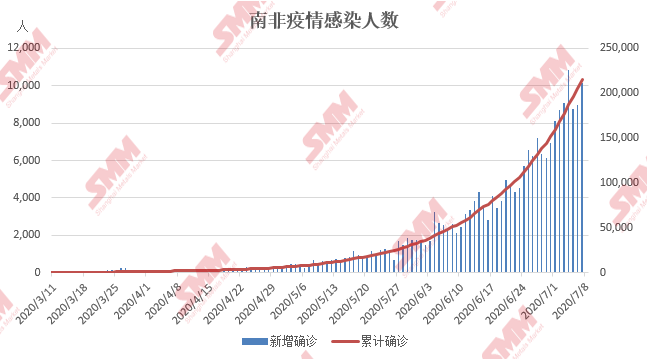
When the blockade was imposed in South Africa on March 24, the South African government predicted the outbreak period for the first time in June. Judging from the actual infection situation, the prediction was too accurate and scientific, and the number of new infections continued to break through the new high. After adjusting the national COVID Epi model in May, the outbreak peak was changed from the end of August to early September. Although the government has re-regionally raised the blockade level, it abandoned the blockade again in view of the difficulty of re-implementation and the sharp decline in exports, which is an "unbearable burden" on the South African economy.

The latest outbreak forecast released by the South African government is about half a month ahead of the second forecast. Judging from the current public statement by the government and relevant reports from South Africa, it is less likely that the government will upgrade the blockade level again in mid-August to deal with the epidemic, but it is very worrying whether the actual outbreak of infection in major ports and the shortage of beds will once again drag down the country's transport and production efficiency. According to industry estimates, the efficiency of port Elizabeth is still only 70% of what it was before the outbreak since the blockade was downgraded to phase 3 in June.
Data Source Statement: Except for publicly available information, all other data are processed by SMM based on publicly available information, market communication, and relying on SMM‘s internal database model. They are for reference only and do not constitute decision-making recommendations.

For any inquiries or to learn more information, please contact: lemonzhao@smm.cn
For more information on how to access our research reports, please contact:service.en@smm.cn
Related News
High-Grade NPI Smelter Profits Squeezed as Ore Prices Rise and Sales Prices Dip
Feb 7, 2026 16:41
High-Grade NPI Smelter Profits Squeezed as Ore Prices Rise and Sales Prices Dip
Read More
High-Grade NPI Smelter Profits Squeezed as Ore Prices Rise and Sales Prices Dip
[SMM Nickel Flash] Based on nickel ore prices from 25 days ago, smelter profits for high-grade NPI remained high this week. However, from the current raw material side, ore prices from both the Philippines and Indonesia increased, while auxiliary material prices saw a slight pullback, leading to an increase in the cash cost of producing high-grade NPI from spot ore. At the same time, high-grade NPI prices experienced some pullback, making it difficult for smelter profits to see sustained improvement.
Feb 7, 2026 16:41
High-Grade NPI Prices Fall, Expected to Stabilize as Chinese New Year Approaches
Feb 7, 2026 16:40
High-Grade NPI Prices Fall, Expected to Stabilize as Chinese New Year Approaches
Read More
High-Grade NPI Prices Fall, Expected to Stabilize as Chinese New Year Approaches
[SMM Nickel Flash] This week, due to a sharp decline in futures triggering arbitrage selling, high-grade NPI prices fell significantly. However, after the selling activity subsided, upstream quotations and the market center gradually returned to normal levels, supported by cost factors. Looking ahead, as the Chinese New Year holiday approaches, market activity is expected to remain subdued, and high-grade NPI prices are projected to hover at highs with limited fluctuations.
Feb 7, 2026 16:40
Nickel Prices Drop: SMM 10-12% High-Grade NPI Down 17.2 Yuan, Indonesia NPI FOB Index Falls 2.06 $/mtu
Feb 7, 2026 16:39
Nickel Prices Drop: SMM 10-12% High-Grade NPI Down 17.2 Yuan, Indonesia NPI FOB Index Falls 2.06 $/mtu
Read More
Nickel Prices Drop: SMM 10-12% High-Grade NPI Down 17.2 Yuan, Indonesia NPI FOB Index Falls 2.06 $/mtu
[SMM Nickel Flash] The SMM average price of 10-12% high-grade NPI fell 17.2 yuan/mtu WoW to 1,035.8 yuan/mtu (ex-factory, tax included), while the Indonesia NPI FOB index average price dropped 2.06 $/mtu WoW to 131.2 $/mtu. At the beginning of the week, futures hit limit-down, and nickel prices fell sharply WoW, driving the emergence of arbitrage supplies sold at low prices, leading to a significant decline in high-grade NPI prices.
Feb 7, 2026 16:39