Only 2 Out of Global 10 Copper Mining Giants Report Growth in Q1 Copper Output, SMM Reports 

Published: Jun 6, 2017 14:18
Copper output at global top ten copper mining firms fell drastically this year as a result of frequent strikes.

SHANGHAI, Jun. 6 (SMM) – Copper output at global top ten copper mining firms fell drastically this year as a result of frequent strikes. 

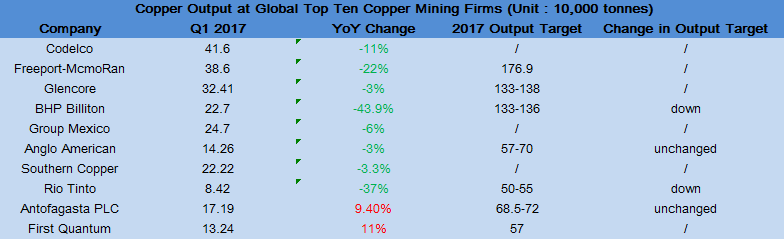
SMM statistics showed copper output at the world’s ten biggest copper mining firms tumbled 14.9% year-on-year in Q1, affected by strike at Cerro Verde, Escondida and Grasberg mines, etc. BHP Billiton and Rio Tinto registered big falls. Only First Quantum and Antofagasta PLC posted growth. 
Russia Aluminum, Nickel Exports Fall during January-April, But Copper Exports Grow

1. Codelco
Codelco’s copper output dropped 11% year-on-year to 416,000 tonnes in Q1, including 390,000 tonnes at its fully-owned mines. This is due to falling ore grade at old mines. Copper price recovery boosted its profitability, though. 

2. Freeport-McmoRan
Freeport-McmoRan’s copper output decreased 22% year-on-year to 386,000 tonnes in Q1, and fell just 11% year-on-year when factoring out impact from selloff of Tenke mine to China Molybdenum. Lower output at Grasberg mine in Indonesia was the main reason behind decline in total output. Besides, output at Cerro Verde mine in Peru also dropped. Production at Grasberg mine was suspended for one month due to dispute with Indonesian government over export license. Unfortunately, Grasberg mine suffered strike again in May shortly after obtaining export permit, and this strike will last till June. This means Grasberg mine is running at half capacity for the whole second quarter, with output expected to change little from Q1. Chances are small for Grasberg mine to achieve 100,000-tonne output growth target in 2017 if the mine does not raise daily output in H2.   

3. Glencore
Glencore’s copper output decreased 3% year-on-year to 324,100 tonnes in Q1. The decline was caused by bad weather, including hurricane in Australia, flood in Peru and higher-than-normal rains in the Democratic Republic of Congo, as well as lower ore grade at some mines. Glencore may adjust shareholdings in many mines this year. Glencore has realized 100% control over Mutunda copper-cobalt mine in Katanga province, the Democratic Republic of Congo, after raising its shareholdings in the mine in January. Glencore’s branch in Zambia, Mopani Copper Mines, plans to expand annual copper ore output from current 3.9 million tonnes to 9 million tonnes.     

4. BHP Billiton
BHP Billiton’s copper output plunged 43.9% year-on-year to 227,000 tonnes in Q1, due mainly to 44-day strike at Escondida mine in Chile. BHP Billiton cut forecast for annual output at Escondida mine from 1.07 million tonnes to 780,000-800,000 tonnes after strike at the mine ended on March 24. Meanwhile, BHP Billiton lowered forecast for copper ore output in 2017 from 1.62 million tonnes to 1.33-1.36 million tonnes. BHP Billiton removed force majeure at Escondida mine more than one month after the strike ended, but said time is still needed before shipments return to normal.      

5. Group Mexico
Group Mexico’s copper output dropped 6% year-on-year to 247,000 tonnes in Q1. Copper output at Asarco fell 18% due to closure of its Hayden smelter, the main reason behind lower output at Group Mexico. 

6. Anglo American
Anglo American’s copper output was down 3% year-on-year to 142,600 tonnes in Q1. Output growth at Collahuasi mines was offset by lower-than-expected ore grade at Los Bronces mine. Mining business at El Soldado mine was suspended, reducing output by 3,000 tonnes. Output at Collahuasi mine increased 13% to 57,700 tonnes thanks to relatively high ore grade and improved factory performance. Although bad weather affected mining business, raw materials reserved sustained production at factory. Output at Los Bronces mine, though up 2% on a quarterly basis, fell 11% on a yearly basis to 75,800 tonnes, due to low ore grade and increased hardness. Besides, major maintenance at two copper processing plants also contributed to lower output.   

Output at El Soldado mine fell about 3,000 tonnes or 11% to 9,100 tonnes in Q1 as authority disapproved mine upgrade plan. Anglo American kept full-year copper output target unchanged at 570,000-600,000 tonnes, including 50,000-60,000 tonnes at El Soldado mine. 

7. Southern Copper
Southern Copper’s copper output slid 3.5% year-on-year to 222,000 tonnes in Q1. Like First Quantum, Southern Copper is worth close watching for potential growth in copper concentrate output in coming years. Expansion project at Toquepala mine is scheduled to enter production in Q2 2018 and add output by 100,000 tonnes per year. Southern Copper is committed to bringing total capacity to hit 1.2 million tonnes/year by 2021. 

8. Rio Tinto
Rio Tinto’s copper output slumped 37% year-on-year to 84,200 tonnes in Q1. Rio Tinto owns 30% stake at Escondida mine in Chile, which suffered 6-week strike that began in February. Rio Tinto cut full-year copper output goal from 525,000-665,000 tonnes to 500,000-550,000 tonnes. Escondida mine is expected to return to normal production in July 2017.

9. Antofagasta PLC
Antofagasta PLC’s copper output rose 9.4% year-on-year to 171,900 tonnes in Q1, but fell 16.4% from previous quarter because of falling ore grade. Antofagasta PLC kept output target for 2017 unchanged at 685,000-720,000 tonnes. 

10. First Quantum
First Quantum’s copper output rose 11% year-on-year to 132,400 tonnes in Q1. First Quantum plans to produce 570,000 tonnes of copper in 2017, up 5.6% from 2016.

It was reported that First Quantum’s Cobre Panama copper mine in Canada, with annual capacity at 320,000 tonnes, will enter operations soon, which is in line with First Quantum’s financial report. Cobre Panama mine is expected to add output by 100,000 tonnes in 2018. First Quantum’s Sentinel project in Zambia is scheduled to add annual output by 200,000 tonnes during 2018-2019, which will allow First Quantum to become another large copper mining company with annual capacity at 1 million tonnes following Freeport, BHP and Glencore. First Quantum will also become a major contributor to global copper concentrate output growth during 2018-2020.     

When compared with a year ago, copper output fell at Vale and Teck Resources, but increased at China Minmetals and Kazakhmys.   

SMM sees global copper concentrate output growth between 0-1% in 2017, citing possible production cuts in the second half of this year. 

For news cooperation, please contact us by email: sallyzhang@smm.cn or service.en@smm.cn.


Data Source Statement: Except for publicly available information, all other data are processed by SMM based on publicly available information, market communication, and relying on SMM's internal database model. They are for reference only and do not constitute decision-making recommendations.

For any inquiries or for more information, please contact: lemonzhao@smm.cn
For more information on how to access our research reports, please contact:service.en@smm.cn
Related News
Alchemy Resources Starts Drilling Copper-Gold Targets at Yellow Mountain
3 hours ago
Alchemy Resources Starts Drilling Copper-Gold Targets at Yellow Mountain
Read More
Alchemy Resources Starts Drilling Copper-Gold Targets at Yellow Mountain
Alchemy Resources announced on September 11 that reverse-circulation drilling has commenced across its Yellow Mountain and Overflow projects in New South Wales, Australia, with up to 15 holes planned during the latest exploration campaign.​ At the 80%-owned Yellow Mountain project, drilling will test extensions to previously identified copper-gold and polymetallic mineralisation, as well as two previously undrilled geophysical targets.​ Previous drilling at Yellow Mountain returned an intersection of 113 metres grading 1.17% copper equivalent, comprising 0.33% copper, 0.37 g/t gold, 24.3 g/t silver, 0.86% lead and 1.23% zinc. The latest drilling campaign is designed to test whether the known mineralised system extends into newly identified target areas.​ The program will also include drilling at the Overflow project, where Alchemy is targeting extensions to existing mineralisation along strike and at depth. Overflow currently hosts an inferred mineral resource of approximately 342,000 ounces of gold equivalent and contains gold, silver, copper, lead and zinc mineralisation.​ The commencement of drilling provides a near-term test of the scale and continuity of mineralisation at Yellow Mountain. The previously reported broad copper-gold-polymetallic intersection indicates potential for a sizeable mineralised system, while the newly defined geophysical targets provide additional exploration upside. Drilling results will be important in determining whether the mineralised footprint can be materially expanded.
3 hours ago
Freeport CEO Signals Likely Go-Ahead for $4.5 Billion Bagdad Copper Expansion
3 hours ago
Freeport CEO Signals Likely Go-Ahead for $4.5 Billion Bagdad Copper Expansion
Read More
Freeport CEO Signals Likely Go-Ahead for $4.5 Billion Bagdad Copper Expansion
Freeport-McMoRan Chief Executive Officer Kathleen Quirk has indicated that the company expects to move forward with the proposed expansion of its Bagdad copper mine in Arizona, marking a stronger commitment to the project ahead of a formal investment decision. Speaking at the Jefferies Global Industrials Conference on September 10, Quirk said the project still requires input from Freeport's board but that she expects the company will proceed. She described the expansion as a roughly three-year construction project and noted that no major permitting hurdles are expected. Freeport's latest project estimates put capital expenditure for the Bagdad expansion at approximately US$4.5 billion, around 30% above the previous US$3.5 billion estimate, reflecting cost escalation, scope changes and additional engineering. The project would more than double concentrator capacity at Bagdad and is expected to add approximately 200–250 million lb, or around 91,000–113,000 tonnes, of copper production annually, alongside an additional 10–12 million lb of molybdenum. Bagdad currently has a reserve life exceeding 80 years. Freeport's Q2 2026 regulatory filing had described the project as being prepared for a potential investment decision during the second half of 2026. The latest comments therefore represent a more positive signal from management on the likelihood of development, although formal board approval has not yet been announced. A decision to proceed with Bagdad would represent one of Freeport's most significant near-term copper growth investments in the US. The potential addition of more than 90,000 tonnes per year of copper would materially increase Freeport's US output, although first production would remain several years away given the expected construction period. Attention will now turn to formal board approval and a final investment decision.
3 hours ago
Chile July Copper Output Falls 9.4% YoY; Escondida Slumps 22.1%
3 hours ago
Chile July Copper Output Falls 9.4% YoY; Escondida Slumps 22.1%
Read More
Chile July Copper Output Falls 9.4% YoY; Escondida Slumps 22.1%
According to foreign media reports citing data from the Chilean Copper Commission (Cochilco), Chile's copper production fell 9.4% year on year in July 2026, as output declined sharply at several major operations in the world's largest copper-producing country. Copper production at state-owned Codelco fell 5% year on year to 112,800 tonnes in July, extending a period of weaker output for the company amid operational challenges at key mines. Production at BHP-controlled Escondida, the world's largest copper mine, dropped more sharply, falling 22.1% year on year to 89,400 tonnes. In contrast, output at Collahuasi, jointly owned by Anglo American and Glencore, increased 12.3% year on year to 38,400 tonnes. Chile's National Statistics Institute (INE) separately reported mine copper production of 403,424 tonnes in July. The country's Mining Production Index fell 7.2% year on year, while metallic mining activity declined 10.7%, mainly due to lower copper extraction and processing. Foreign media reports also cited severe weather in northern Chile and maintenance at major operations as factors weighing on July production. Cochilco currently forecasts Chilean copper production at approximately 5.27 million tonnes in 2026, down 2.6% year on year, before recovering 5.2% to around 5.55 million tonnes in 2027. The sharp July decline highlights continued pressure on Chilean mine supply. The 22.1% year-on-year drop at Escondida is particularly significant given the mine's scale, while lower Codelco production further weighs on national output. Although Collahuasi recorded higher production, the increase was insufficient to offset weakness elsewhere. A recovery in major operations during the remainder of the year will be important if Chile is to limit the full-year decline projected by Cochilco.
3 hours ago
Only 2 Out of Global 10 Copper Mining Giants Report Growth in Q1 Copper Output, SMM Reports  - Shanghai Metals Market (SMM)