Strong Nonfarm Payrolls Spark Rate Hike Expectations, Metals Broadly Fall; SHFE Tin Plunges Over 5%, LME Copper Drops More Than 2%, Gold and Silver Suffer Weekly Rout [Overnight Market Update]

Published: Jun 8, 2026 08:22

SMM June 8 News:

On the metals market front:

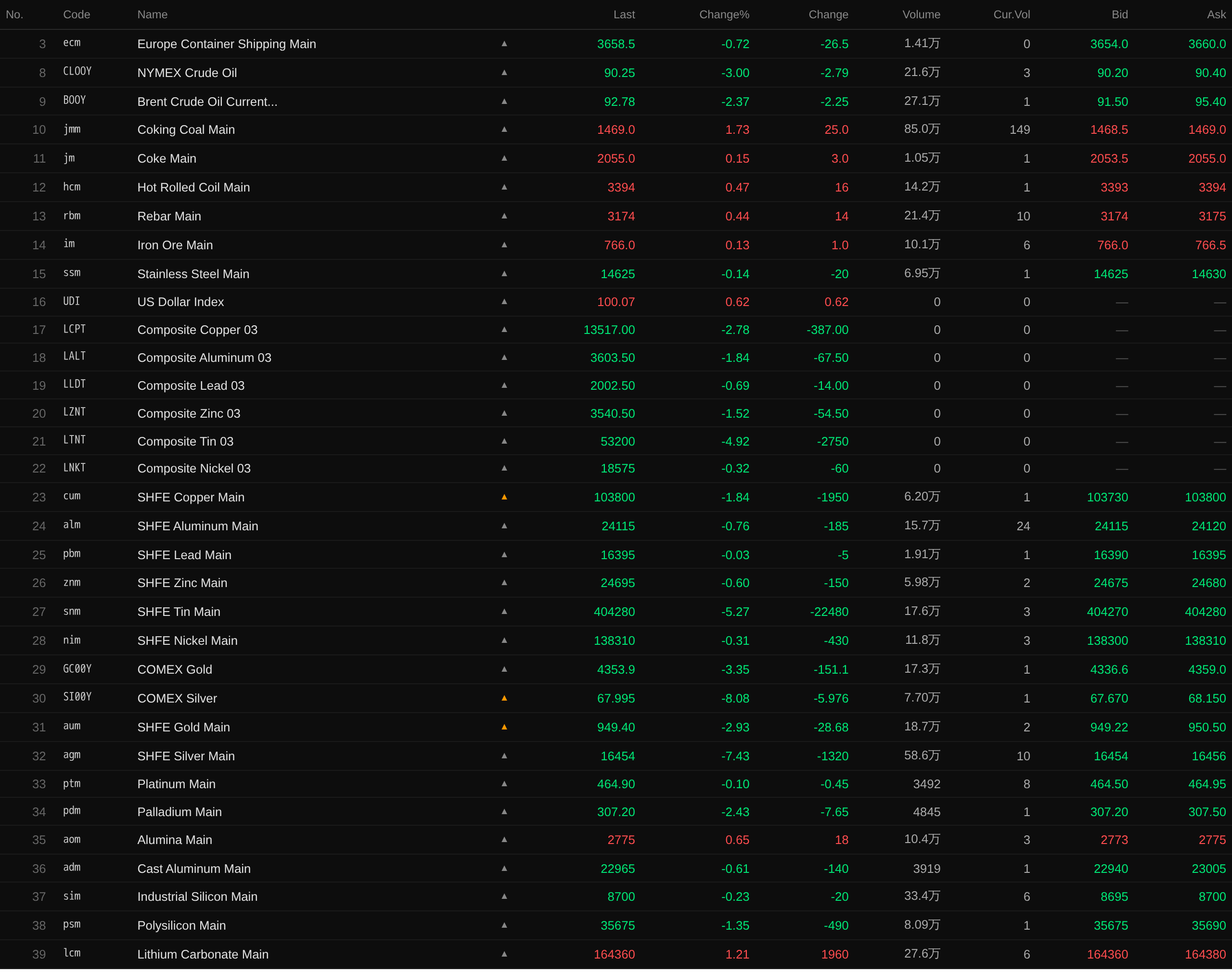
Overnight last Friday, base metals across domestic and overseas markets fell broadly. In the domestic market, SHFE tin led the decline with a drop of 5.27%, while LME tin fell 4.92%. LME copper dropped 2.78%. LME aluminum, LME zinc, and SHFE copper all fell over 1%, with LME aluminum down 1.84%, LME zinc down 1.52%, and SHFE copper down 1.84%. Declines for the remaining metals were all within 1%. The alumina main contract rose 0.65%, while the cast aluminum main contract fell 0.61%.

Overnight last Friday, ferrous metals generally rose. Only stainless steel fell, with a decline of 0.14%, while the remaining metals all increased. HRC and rebar saw gains of around 0.4%, with HRC up 0.47% and rebar up 0.44%. For coking coal and coke, coking coal rose 1.73%, and coke rose 0.15%.

In the precious metals market, overnight last Friday, COMEX gold fell 3.35%, recording a weekly decline of 5.21%. COMEX silver plunged 8.08%, with a weekly decline of 10.39%, marking its fourth consecutive weekly drop. Domestically, SHFE gold fell 2.93%, with a weekly decline of 0.66%. SHFE silver fell 7.43%, with a weekly decline of 3.72%. The US achieved another strong month of job growth in May, raising concerns about a potential interest rate hike later this year.

As of 8:27 on June 6, the closing market data from overnight last Friday:

Macro Front

[Foreign Ministry Introduces Arrangements for General Secretary Xi Jinping’s Visit to North Korea] At the invitation of Kim Jong Un, State Affairs Commission Chairman of the Democratic People's Republic of Korea, Xi Jinping, General Secretary of the Central Committee of the Communist Party of China and President of the People’s Republic of China, will pay a state visit to the Democratic People’s Republic of Korea from June 8 to 9. Foreign Ministry Spokesperson Mao Ning stated during a regular press conference on the 5th that this visit marks General Secretary Xi Jinping’s first state visit to North Korea in seven years. During the visit, the top leaders of the two Parties and two countries will exchange views on bilateral relations and issues of common concern. In recent years, under the strategic guidance of General Secretary Xi Jinping and General Secretary Kim Jong Un, the traditional friendly and cooperative relationship between China and the DPRK has maintained sustained, healthy, and stable development, bringing tangible benefits to both countries and their peoples. This year marks the 65th anniversary of the signing of the Treaty of Friendship, Cooperation and Mutual Assistance Between the People’s Republic of China and the Democratic People’s Republic of Korea. The two sides will take this visit as an opportunity to push for greater progress in China-DPRK relations that keeps pace with the times, enhance the well-being of both peoples, and make greater contributions to peace, stability, development, and prosperity in the region and the world. (Xinhua News Agency)

Domestic front:

On June 5, Premier Li Qiang presided over a State Council executive meeting. The meeting pointed out the need to further strengthen forward-looking layout and increase promotion efforts based on the characteristics of future industries, to firmly grasp the initiative in development. It is necessary to solidify the technological foundation, continuously increase investment in basic research, and systematically deploy breakthroughs in original and disruptive technologies. Ecological construction must be emphasized, promoting the deep integration of industry, academia, research, and application, encouraging close cooperation between upstream and downstream segments of the industry chain, and fostering more startups and unicorn enterprises in key tracks.

[Ministry of Housing and Urban-Rural Development Seeks Public Comments on the Regulations on the Administration of Housing Provident Fund (Revised Draft for Comments)] The Ministry of Housing and Urban-Rural Development issued a notice to solicit public comments on the Regulations on the Administration of Housing Provident Fund (Revised Draft for Comments). Under any of the following circumstances, an employee may withdraw the balance stored in their housing provident fund account: (1) Paying rent; (2) Purchasing, constructing, renovating, or overhauling a self-occupied dwelling; (3) Repaying the principal and interest of a housing purchase loan; (4) Decorating a self-occupied dwelling, up to a certain limit; (5) Paying property management fees for a self-occupied dwelling; (6) Retiring or leaving their post; (7) Completely losing the ability to work and terminating the labor (personnel) relationship with their employer; (8) Emigrating and settling abroad; (9) Other housing consumption circumstances approved by the State Council. (Wall Street CN)

The Ministry of Transport and ten other departments issued the Three-Year Action Plan for Promoting High-Quality Development of Small and Mini Passenger Vehicle Rental (2026–2028). The plan proposes accelerating the construction of electric vehicle charging facilities in expressway service areas, with 30,000 EV charging facilities (charging guns) of 60 kW power or above to be newly built or renovated in expressway service areas (including parking areas) by year-end 2028. The plan proposes accelerating the construction of electric vehicle charging facilities in expressway service areas, with 30,000 EV charging facilities (charging guns) of 60 kW power or above to be newly built or renovated in expressway service areas (including parking areas) by year-end 2028.

US Dollar front:

As of overnight closing last Friday, the US dollar index rose 0.62% to 100.07. Previously released data showed strong US employment data for May. The US Bureau of Labor Statistics disclosed that non-farm payrolls added 172,000 jobs in May. Employment data for the previous two months were revised upwards, and job gains over the last three months marked the best performance in more than two years. The unemployment rate held steady at 4.3%, with labour market resilience significantly exceeding overall market forecasts.

Nick Timiraos, the Fed mouthpiece, noted that the re-acceleration of spring hiring this year will provide more ammunition for Fed officials who worry about inflation and believe current interest rates are too low to contain a new round of price pressures. Some officials recently hinted that the Fed should be ready to raise interest rates later this year, at least clawing back some of the three 25-basis-point cuts implemented in H2 last year. Those cuts were implemented to stabilize the labour market, which now looks much healthier. This jobs report will not entirely settle the debate over how much the Fed should consider raising rates later this year, but it does further suggest the case for near-term cuts has largely evaporated. The stronger argument for raising rates now comes from the inflation outlook. Multiple overlapping shocks—from AI infrastructure build-out, tariffs, and energy—could keep inflation persistently above the Fed’s 2% target, even if progress is made in restoring commercial shipping traffic through the Strait of Hormuz. If the Fed holds steady as inflation rises, inflation-adjusted real rates would fall. Even if the labour market is not the primary driver, this mechanism could become a key factor driving rate hike discussions. (Jin10 Data APP)

Fed official Hammack stated that with the labour market appearing to be roughly balanced, a rate hike may be appropriate soon. Hammack said that while she never over-emphasizes any single data point, today’s employment report confirms again that the labour market appears to be mostly in balance. She noted the unemployment rate remains at 4.3%, which is basically consistent with what I define as maximum employment. “Given the uncertainty in the economic outlook, holding rates steady is appropriate for now. But if recent trends continue, action may soon be needed.” This essentially repeats remarks she made on June 2. (Jin10 Data APP)

According to foreign media reports, May non-farm payrolls data far exceeded market expectations, and the US interest rate futures market significantly increased bets on a Fed rate hike at the December meeting. Based on data from LSEG, the rate futures market now prices in a 65% probability of a Fed rate hike in December, up from 48% before the jobs report. For the June meeting, the market still broadly expects the Fed to keep rates unchanged in the 3.50% to 3.75% range. The stronger-than-expected jobs data indicates the US labour market remains resilient, further weakening market expectations for near-term rate cuts while strengthening investor assessment that the Fed may need to resume rate hikes later to counter inflationary pressures. (Jin10 Data APP)

According to CME FedWatch: The probability of the Fed keeping rates unchanged in June is 96.6% (compared to 96.4% before the non-farm payrolls release), with a 3.4% probability of a cumulative 25-basis-point cut. The probability of the Fed keeping rates unchanged through July is 90.6%, with a 6.2% probability of a cumulative 25-basis-point hike and a 3.2% probability of a cumulative 25-basis-point cut. (Jin10 Data APP)

Macro front:

This week, in China, data releases include the China May CPI year-over-year rate, China May PPI year-over-year rate, China May trade balance (TBD), and China May M2 money supply year-over-year rate (TBD), among others. In the US, data releases include the US May New York Fed 1-year inflation expectations, US May NFIB Small Business Optimism Index, US weekly change in ADP employment for the week ending May 23, US April trade balance, US May existing home sales annualized rate, US April wholesale sales month-over-month rate, US May unadjusted CPI year-over-year rate, US May seasonally adjusted CPI month-over-month rate, US May seasonally adjusted core CPI month-over-month rate, US May unadjusted core CPI year-over-year rate, US 10-year note auction yield for June 10, US 10-year note auction bid-to-cover ratio for June 10, US initial jobless claims for the week ending June 6, US May PPI year-over-year rate, US May PPI month-over-month rate, US June preliminary one-year inflation expectations, and US June preliminary University of Michigan Consumer Sentiment Index, among others. In Germany, data releases include the German April seasonally adjusted industrial output month-over-month rate, German April seasonally adjusted trade balance, and German May final CPI month-over-month rate, among others. In the Eurozone, data releases include the Eurozone June Sentix Investor Confidence Index, Eurozone ECB deposit facility rate for June 11, and Eurozone ECB main refinancing rate for June 11, among others. In the UK, data releases include the UK April three-month GDP month-over-month rate, UK April manufacturing output month-over-month rate, UK April seasonally adjusted goods trade balance, and UK April industrial output month-over-month rate, among others. Data including the Bank of Canada interest rate decision for June 10, French May final CPI month-over-month rate, Japan April trade balance, and Switzerland May Consumer Confidence Index will also be released.

Furthermore, the Bank of Canada will announce its interest rate decision, and BoC Governor Macklem and Senior Deputy Governor Rogers will hold a monetary policy press conference. The European Central Bank will announce its interest rate decision, and ECB President Lagarde will hold a monetary policy press conference.

Crude Oil front:

As of overnight closing last Friday, oil prices in both markets fell together, with WTI oil down 3% and Brent oil down 2.37%. However, both recorded weekly gains, with WTI oil up 3.31% weekly and Brent oil up 1.82% weekly. The decline in crude oil prices overnight last Friday was primarily due to reduced market perceptions of a renewed US-Iran conflict.

US President Trump stated at a campaign event in Wisconsin on the 5th that the war with Iran would be ended quickly, thus removing a significant factor contributing to high prices. With the midterm elections approaching, US public opinion widely believes the US-Iran war has driven up oil prices and the cost of living, putting pressure on Republican election prospects. (CCTV)

Fitch stated in a new report that the closure of the Strait of Hormuz created a logistical supply shock but did not alter the market trend. The agency expects a rapid recovery in regional production, strong supply growth from non-OPEC countries, and potentially more aggressive OPEC policies to re-trigger an oversupply situation in Q4 2026, pushing oil prices downward once the Strait reopens. Based on an assumption that the Strait of Hormuz reopens around month-end July (implying an effective closure period of five months), our baseline expectation is that Brent crude will average $87 per barrel in 2026. Significant uncertainty remains regarding the exact timing of the Strait's reopening, and the risks facing oil prices are binary. The current price increase reflects a transitory logistical supply shock rather than a permanent loss of production capacity. We expect the Strait to reopen around end-July and anticipate a significant decline in Brent prices from the highs seen between March and July. (Jin10 Data APP)

According to a Bloomberg survey, OPEC crude oil production fell to its lowest level in decades in May, as the US blockade on Iran and turmoil in the Persian Gulf region continued to suppress output. OPEC oil production dropped by 1.22 million barrels per day in May (half of which came from Iran), falling to 16.33 million barrels per day, its lowest level in at least 37 years. This figure excludes the UAE, which withdrew from OPEC last month. The survey indicated Iran’s oil production plunged last month by 710,000 barrels per day to 2.34 million barrels per day, a five-year low. US Central Command continues to enforce a blockade on all maritime traffic to and from Iranian ports. (Jin10 Data APP)

Notably, however, the UK government has raised its domestic crude oil price forecast, believing that even if the US and Iran reach a peace deal, crude oil prices could remain around $100 per barrel through 2028, as it now anticipates energy supply recovery in the Gulf region will take longer. A new analysis warns that pressure on energy prices is higher than previously expected, amid a deteriorating global economic outlook. The UK government previously estimated Persian Gulf supply could recover about six months after the end of the war, but it now believes recovery could take as long as 14 months. (Jin10 Data APP)

Data Source Statement: Except for publicly available information, all other data are processed by SMM based on publicly available information, market communication, and relying on SMM's internal database model. They are for reference only and do not constitute decision-making recommendations.

Images in this article contain AI-translated captions for reference only.

For any inquiries or for more information, please contact: lemonzhao@smm.cn
For more information on how to access our research reports, please contact:service.en@smm.cn