SHANGHAI, Mar 9 (SMM) - Macro front:
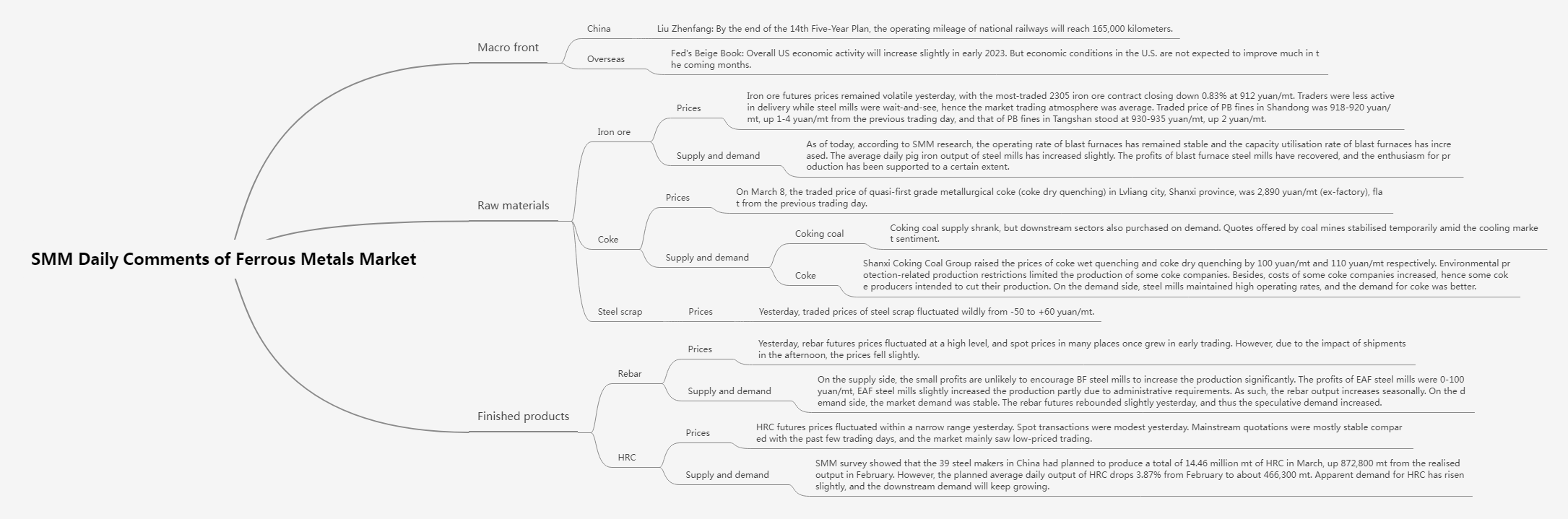
Liu Zhenfang: By the end of the 14th Five-Year Plan, the operating mileage of national railways will reach 165,000 kilometers.
Fed's Beige Book: Overall US economic activity will increase slightly in early 2023. But economic conditions in the U.S. are not expected to improve much in the coming months.
Iron ore:
Iron ore futures prices remained volatile yesterday, with the most-traded 2305 iron ore contract closing down 0.83% at 912 yuan/mt. Traders were less active in delivery while steel mills were wait-and-see, hence the market trading atmosphere was average. Traded price of PB fines in Shandong was 918-920 yuan/mt, up 1-4 yuan/mt from the previous trading day, and that of PB fines in Tangshan stood at 930-935 yuan/mt, up 2 yuan/mt.
As of today, according to SMM research, the operating rate of blast furnaces has remained stable and the capacity utilisation rate of blast furnaces has increased. The average daily pig iron output of steel mills has increased slightly. The profits of blast furnace steel mills have recovered, and the enthusiasm for production has been supported to a certain extent.
Coke:
On March 8, the traded price of quasi-first grade metallurgical coke (coke dry quenching) in Lvliang city, Shanxi province, was 2,890 yuan/mt (ex-factory), flat from the previous trading day.
Coking coal supply shrank, but downstream sectors also purchased on demand. Quotes offered by coal mines stabilised temporarily amid the cooling market sentiment.
Shanxi Coking Coal Group raised the prices of coke wet quenching and coke dry quenching by 100 yuan/mt and 110 yuan/mt respectively. Environmental protection-related production restrictions limited the production of some coke companies. Besides, costs of some coke companies increased, hence some coke producers intended to cut their production. On the demand side, steel mills maintained high operating rates, and the demand for coke was better.
Steel scrap
Yesterday, traded prices of steel scrap fluctuated wildly from -50 to +60 yuan/mt.
Rebar
Yesterday, rebar futures prices fluctuated at a high level, and spot prices in many places once grew in early trading. However, due to the impact of shipments in the afternoon, the prices fell slightly.
On the supply side, steel mills maintained high operating rates to gain some profits, but the output of some mills was limited by the environmental protection inspections. The overall capacity utilisation rates of steel mills still stood high, weighing on the market supply. On the demand side, the overall market trading has improved significantly in the past two weeks, but agents have reported that the actual downstream demand is average. The short-term actual downstream demand still needs to be verified.
HRC
HRC futures prices fluctuated within a narrow range yesterday. Spot transactions were modest yesterday. Mainstream quotations were mostly stable compared with the past few trading days, and the market mainly saw low-priced trading.
SMM survey showed that the 39 steel makers in China had planned to produce a total of 14.46 million mt of HRC in March, up 872,800 mt from the realised output in February. However, the planned average daily output of HRC drops 3.87% from February to about 466,300 mt. Apparent demand for HRC has risen slightly, and the downstream demand will keep growing.
![[남아프리카공화국, 중국산 컬러강판에 최대 28.11% 잠정 반덤핑 관세 부과 제안]](https://imgqn.smm.cn/usercenter/FFFrV20251217171719.jpg)
![[시리아, 사우디아라비아와 하마 제철소 재가동 합의]](https://imgqn.smm.cn/usercenter/ntiFA20251217171719.jpg)
![[SMM 분석] EU 용해·주조 규정 도래: 탄소강 공급망, 세대교체급 재편 직면](https://imgqn.smm.cn/usercenter/LSkpO20251217171720.jpg)