


The price of polysilicon has climbed to a high level again, causing a new round of attention in the market.
According to the average polysilicon recharge price of SMM, on June 9, 217 yuan / kg, the price has increased by 134% since the beginning of February.
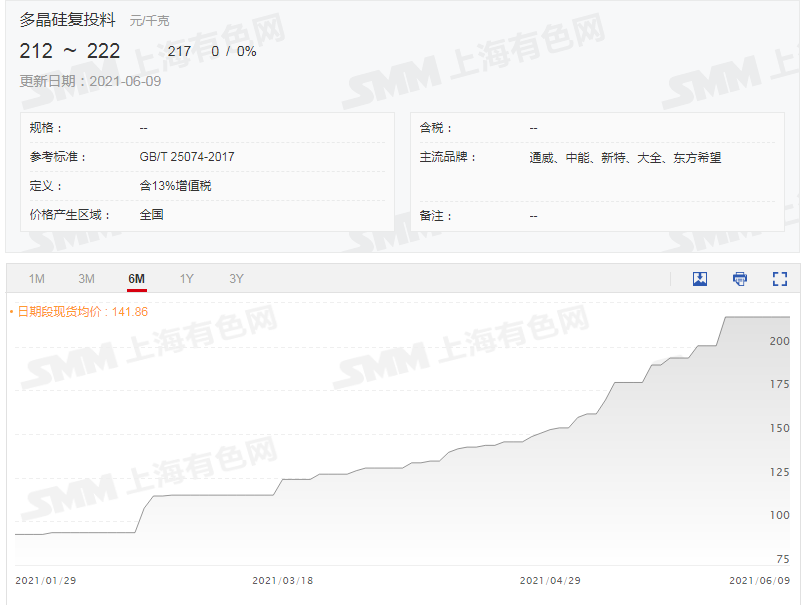
"Click to view metal quotation
The mood of "lack of materials" continues to heat up, which stimulates the trend of photovoltaic concept in the secondary market. After the news of the rise in polysilicon prices, the share prices of many photovoltaic leaders once fell sharply. Under this upsurge of rising prices, how should the whole photovoltaic industry carry out "cold thinking"?
Photovoltaic expansion drives up the price of raw materials
Recently, the production expansion of the whole photovoltaic industry has been carried out frequently.
Among them, Jingao Science and Technology announced on May 28 that its subsidiary and Jiangsu Zhongneng Silicon Industry Science and Technology Development Co., Ltd. signed a "polysilicon purchase and sale framework cooperation agreement", which agreed to purchase a total of 145800 tons of granular silicon from the latter from July 1, 2021 to June 30, 2026, with a total contract value of more than 20.45 billion yuan.
According to incomplete statistics, this is the largest order for granular silicon in the industry.
Feng Xiaoting, a researcher in the photovoltaic industry of Gefei Capital, told reporters: "the rise in silicon prices is mainly due to the imbalance between supply and demand, that is, less supply and increased demand."
"the rise in silicon prices is mainly due to the long production expansion cycle of silicon materials, which can not keep up with the rate of production expansion at the end of the silicon wafer, resulting in a temporary shortage of supply." "it is expected that this situation will continue until next year's Q2, silicon production capacity will be gradually released and prices will return to normal," a senior practitioner of Suntech in Wuxi, an expert at the Whale platform think tank, told Science and Technology Innovation Board Daily.
In addition, some photovoltaic industry analysts told reporters, "at present, due to the tight supply and demand of silicon materials and rising prices, the cost end pressure will be further transmitted to the downstream silicon wafers, battery wafers, and components." this makes the downstream have to jointly raise prices or profits are suppressed, and ultimately intensify the game between the entire industry chain. "
Expand production on a large scale and guard against the crisis of overcapacity
Under the competition of "silicon is king", the crisis of overcapacity can not be ignored.
According to incomplete statistics, in 2020, 13 leading enterprises, such as Longji shares, Tongwei shares, Jing'ao Technology, Trina Solar Energy, and so on, announced a total of 40 production expansion projects, with a total investment of more than 210 billion yuan. Among them, the investment scale of 9 projects is more than 10 billion yuan, and the planned investment of 3 projects is as high as 20 billion yuan.
According to the analysis of the first Securities Research report, in 2021, the global photovoltaic new installed demand will exceed 170GW, corresponding to the silicon demand will reach 576500 tons / year. In 2021, the effective production capacity of silicon material is about 585000 tons. It is expected that the price of silicon material will remain high throughout this year, and the shortage of silicon material supply will continue into the first half of 2022.
Whale platform think tank expert, Wuxi Suntech a senior practitioner told reporters, "tight supply and demand is the current industry situation, overcapacity may become the future trend." He further explained, "from supply falling short of demand to overcapacity, I think this is an inevitable trend in the industry. By the end of next year, there may be a surplus of silicon."
"the problem of overcapacity is bound to cause accelerated depreciation of eliminated capacity and impact on corporate profits." So said the above-mentioned industry insiders.
"Cold thinking" on the rise of Silicon Price
Under the background of carbon neutralization, the photovoltaic industry ushered in more imagination space.
Recently, at the 15th (2021) International Conference on Solar Photovoltaic and Smart Energy, Zhu Gongshan, president of the Asian Photovoltaic Industry Association and chairman of Xiexin Group, believed that "in the next 30 years, the compound growth rate of global photovoltaic installed capacity will be maintained at more than 10%. The total installed capacity will reach more than 20 times that of the present. When China achieves' carbon neutralization'in 2060, China's installed photovoltaic capacity is expected to reach more than 70 times or more. "
The reporter noted that the "rising price of silicon" has also become a hot topic in the international conference on solar photovoltaic and smart energy.
In this regard, Liu Hanyuan, executive chairman of the Asian Photovoltaic Industry Association and chairman of the Tongwei Group, said, "the fluctuation of silicon prices is a response to the laws of the market and the performance of the normal cycle of the industry."
In his view, in the past 10 years, the investment income of the polysilicon industry is relatively limited, so there is a gap between supply and demand at this time. "in the context of the current price signal, there are enterprises to expand the scale of investment and new capital to enter, which will support the next round of industrial development with larger scale and lower cost, so as to support the long-term development of cheap access to the Internet." Liu Hanyuan said so.
In addition, Zhong Baoshen, chairman of Longji Co., Ltd., said that due to the rapid rise in prices of glass last year and silicon this year, the safety of the industrial chain has aroused concern from all parties. "from the point of view of the enterprise itself, it is necessary to make strategic planning from a long-term perspective, accurately grasp the trend and rhythm of industrial development, and ensure the balance and stability of enterprise production and management." Zhong Baoshen said.
![선물 시장 돌파, 중심 상승, ADC12 시세 인상, 상승 모멘텀은 여전히 수요 확인 대기 [ADC12 가격 일일 리뷰]](https://imgqn.smm.cn/usercenter/cgspx20251217171725.jpg)
![[속보 | 칠레 광업생산지수, 7월 전년 대비 7.2% 하락… 금속광업 10.7% 감소]](https://imgqn.smm.cn/usercenter/bFzkj20251217171724.jpg)
![[SMM 크로뮴 플래시] 짐바브웨, 광물 밀수 단속으로 크롬 정광 1,500톤 비축분 압류](https://imgqn.smm.cn/usercenter/pAOxy20251217171725.jpg)