SMM4 March 14: yesterday, most of the outer plate metals were red, Lun copper and lun lead rose nearly 0.3%, Lun aluminum rose nearly 1.6%, Lun zinc rose nearly 1%, Lunxi fell nearly 0.6%, Lunxi fell nearly 0.1%, Lunxi copper rebounded on Tuesday, boosted by industrial buyers, but speculators remained cautious after China, a major consumer of metals, warned that it might control commodity prices. Analysts pointed out that the markets will be seasonally strong in the second quarter, the peak demand season in the northern hemisphere is approaching, and China has also entered the construction season in an all-round way. Domestically, international copper is up nearly 0.4%, Shanghai copper is up nearly 0.3%, Shanghai aluminum is up nearly 1.5%, Shanghai lead is up nearly 1%, Shanghai zinc is up nearly 0.5%, Shanghai nickel is down nearly 0.4%, and Shanghai tin is down nearly 0.1%.
The dollar index fell 0.28% to 91.84, its lowest level since March 23. As Treasury yields fell after strong demand at a 30-year auction, the labour department reported on Tuesday that US CPI rose 0.6 per cent in March, the biggest increase since August 2012 and 0.4 per cent in February. Excluding volatile food and energy, core CPI rose 0.3 per cent in March, the biggest increase in seven months, after edging up 0.1 per cent in February. After the release of the data, the dollar soared at one point, then reversed the trend and fell to a three-week low.
U. S. stocks closed mixed on Tuesday, with the S & P 500 hitting an intraday and closing record high. Us CPI rose 2.6 per cent in March from a year earlier, the biggest increase since 2012. The US Centers for Disease Control and Prevention and FDA recommended that the use of Johnson and novel coronavirus vaccine be suspended immediately, curbing optimism. The Dow fell 68.13 points, or 0.20%, to 33677.27; the Nasdaq rose 146.10 points, or 1.05%, to 13996.10; and the Standard & Poor's 500 Index rose 13.60 points, or 0.33%, to 4141.59.
In crude oil, NYMEX crude oil futures closed higher on Tuesday, boosted by strong Chinese import data, but the gains were limited on concerns that suspending Johnson vaccination could delay economic recovery and limit oil demand growth. The Organization of Petroleum Exporting countries ((OPEC)) on Tuesday raised its forecast for global oil demand growth this year in anticipation that the epidemic will subside, boosting efforts by the OPEC and its allies to support the market.
In precious metals, COMEX gold futures closed higher on Tuesday after data showed a sharp rise in US inflation, boosting the attractiveness of gold as a hedge against inflation and depressing the dollar. The US consumer price index ((CPI)) rose the most in more than eight and a half years in March as pent-up demand was unleashed by a boost in vaccination and massive fiscal stimulus, marking the start of what most economists expect to be a brief period of higher inflation.
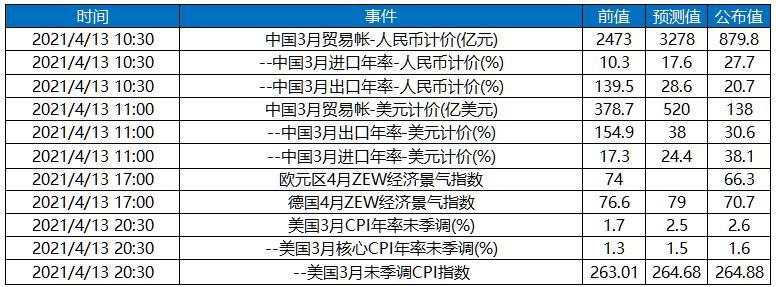
In terms of data, according to customs statistics, in the first quarter, the total value of China's imports and exports of goods was 8.47 trillion yuan, an increase of 29.2 percent over the same period last year. Of this total, exports totaled 4.61 trillion yuan, up 38.7 percent; imports totaled 3.86 trillion yuan, up 19.3 percent; and the trade surplus was 759.29 billion yuan, an increase of 690.6 percent.
Li Kuiwen, spokesman for the General Administration of Customs and director of the Department of Statistics and Analysis, today introduced the import and export situation in the first quarter of 2021, saying that imports of major commodities increased. In the first quarter, China imported 283 million tons of iron ore, an increase of 8 percent, 139 million tons of crude oil, an increase of 9.5 percent, and 29.388 million tons of natural gas, an increase of 19.6 percent. In the same period, imports of soybeans were 21.178 million tons, up 19 percent; corn was 6.727 million tons, up 437.8 percent; and wheat was 2.925 million tons, an increase of 131.2 percent.
In the first quarter of this year, under the strong leadership of the CPC Central Committee with Comrade Xi Jinping at the core, China's overall epidemic prevention and control and economic and social development continued to show results, and foreign trade imports and exports got off to a good start. According to customs statistics, in the first quarter, the total value of China's imports and exports of goods was 8.47 trillion yuan, an increase of 29.2 percent over the same period last year. Of this total, exports totaled 4.61 trillion yuan, up 38.7 percent; imports totaled 3.86 trillion yuan, up 19.3 percent; and the trade surplus was 759.29 billion yuan, an increase of 690.6 percent.
The euro zone's ZEW economic climate index for April released 66.3, with a previous reading of 74.
Germany's ZEW economic climate index for April released 70.7, with a previous value of 76.6 and a forecast of 79.
Forexlive comments on Germany's ZEW economic sentiment index for April: in the current situation, the data is better than expected, but the expected reading is lower than the March survey and down from the March survey, indicating that optimism has waned since then. ZEW, a German think-tank, pointed out that investor optimism has declined, and fears of stricter blockades have led to a drop in private consumption expectations.
The US released a quarterly CPI annual rate of 2.6% in March, the highest since August 2018, with a previous value of 1.7% and an expected 2.5%. After the quarterly adjustment in March, the monthly rate of CPI in the United States recorded 0.6%, the highest since July last year. After the quarterly adjustment in the United States in March, the monthly rate of CPI is 0.6%, the previous value is 0.4%, and the expected rate is 0.5%. After the quarterly adjustment in March, the monthly rate of CPI in the United States recorded 0.6%, the highest since July last year. In the United States, the annual rate of quarterly CPI in March was 2.6%, the highest since August 2018.
Institutional review of the US quarterly CPI annual rate in March: the US CPI recorded the biggest increase since 2012 in March, further evidence that inflationary pressures are increasing as the economy recovers and demand strengthens. Excluding food and energy with volatile prices, core CPI rose 0.3 per cent month-on-month, the biggest increase in seven months, reflecting rising rents and car insurance costs. CPI data, like many other economic data, declined due to blockades and widespread corporate closures at the start of the outbreak, and the year-on-year increase in CPI data from March to May will be particularly large compared with other data.