SMM3 March 1: last Friday, the outer disk metal fell nearly 4.4%, Lun Zinc fell nearly 3.8%, Lun Aluminum fell nearly 3.5%, Lenny Nickel fell nearly 3.4%, Lunxi fell nearly 6.6%, Lun lead fell nearly 4.2%. The price of (LME) copper futures on the London Metal Exchange fell on Friday after hitting multi-year highs for many days in a row, as risk aversion appeared in the wider financial markets after a sharp rise in bond yields. Other base metals such as aluminium and nickel were also hit, with a sharp fall in global bond markets leading to a sharp rise in yields, dragging Asian stock markets to their biggest decline in nine months. On the domestic side, international copper fell nearly 3.7%, Shanghai copper fell nearly 3.2%, Shanghai aluminum fell nearly 1.9%, Shanghai lead fell nearly 2.9%, Shanghai zinc fell nearly 2.7%, Shanghai nickel nearly 2.8%, Shanghai tin fell close to in3.3%.
The dollar outperformed all other Gmur10 currencies on Friday, its best weekly performance in nearly six weeks, with US bond yields falling sharply but remaining near year-high levels. The dollar was also supported by stops and month-end cash flows in the afternoon in the US, a New York trader said. The dollar index rose 0.78% to 90.91, its highest level in a week. Data released on Friday showed that US consumer spending rose at its fastest pace in seven months in January, but inflation remained moderate.
U. S. stocks closed mixed on Friday, with a rebound in technology stocks pushing the Nasdaq higher. All three major indexes of U. S. stocks fell in the last week of February, but all recorded gains in February. The recent surge in US bond yields has led some investors to worry that the Fed may be forced to cut QE or raise interest rates earlier. The personal consumption expenditure index shows that inflationary pressures are moderating. The Dow closed down 469.64 points, or 1.50%, at 30932.37; the Nasdaq rose 72.91 points, or 0.56%, at 13192.34; and the S & P 500 fell 18.19 points, or 0.48%, at 3811.15.
In terms of crude oil, US crude oil futures prices fell on Friday as the dollar rose and forecasts show that crude oil supply will increase after oil prices climb to pre-pandemic levels. The dollar rose and U. S. Treasury yields remained near one-year highs, making dollar-denominated oil more expensive for holders of other currencies. The fall in oil prices also reflected profit-taking, with crude oil both expected to rise nearly 20 per cent monthly, helped by supply disruptions in the US and optimism that vaccination programmes would boost demand recovery.
In terms of precious metals, gold futures closed down for the fourth consecutive session, the lowest closing level since June 2020, and the biggest monthly decline in four years in February, as the attractiveness of non-sinister gold was hit by a stronger dollar and rising US bond yields. Analysts point out that 10-year bond yields are rising, the dollar is higher and risk appetite is on the rise again. All these are very bad factors for gold.
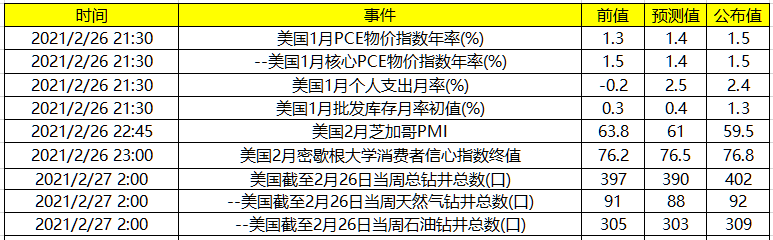
In terms of data, the monthly rate of the US core PCE price index in January, the previous value of 0.3%, is expected to be 0.2%, and 0.3% is announced. Us core PCE price index annual rate in January, previous value 1.5%, expected 1.4%, published 1.5%, revised 1.4% (previous value). The monthly rate of personal expenditure in the United States in January, previous value-0.2%, expected 2.5%, announced 2.4%, revised-0.4% (previous value).
CNBC comments on the annualized rate of the core PCE price index in January: the new US stimulus package has led to the biggest monthly increase in personal income since April 2020, and inflation remains moderate. Personal income increased by 10 per cent, higher than the 9.5 per cent increase expected by institutions. Congress approved $600 in personal financial aid for millions of Americans, which consumers spent soon after they got the money, prompting a surge in retail sales that month, with personal spending rising 2.4 per cent in January from minus 0.2 per cent. In the United States, the core PCE price index recorded an annual rate of 1.5% in January, which is close to institutional forecasts, and inflation is still relatively moderate.
Analyst Jeffry: US core PCE price index rose at a monthly rate of 0.3 per cent in January, while the core PCE price index gradually climbed from 1.3 per cent to 1.5 per cent, closer to the Fed's 2 per cent inflation target. Us household spending rose 2.4 per cent in January and incomes soared by 10 per cent after a new round of personal checks was received and household spending is expected to continue to rise. In addition, Congress will pass an additional stimulus package of up to $1.9 trillion in March, including $1400 for families.
Chicago PMI, in February before the value of 63.8, expected to be 61.1, announced 59.5.
The final value of the University of Michigan Consumer confidence Index in February, the previous value of 76.2, is expected to be 76.5, released 76.8.
Richard Curtin:, chief economist of consumer research at the University of Michigan, despite a slight rise in consumer confidence at the end of February, consumer confidence for the whole month was still slightly lower than in January. The February decline was due to a bearish economic outlook for the future with incomes below $75000. The worst of the novel coronavirus epidemic may be coming to an end, but few consumers expect sustained and strong economic growth to return employment to pre-outbreak levels.
The total number of oil drilling in the United States in the week to February 26, with a previous value of 305, is expected to be 303, and 309 was announced.
In the week of ICE (ICE):, speculators' net long positions in Brent crude increased by 1252 contracts to 348784 contracts.