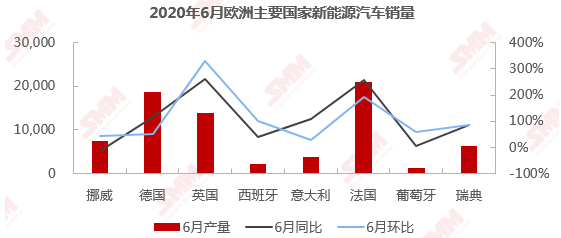
SMM7 March 21: with the global epidemic gradually improving, the European new energy vehicle market recovered more than expected in June, with sales in major countries reaching the highest level in a single month in the first half of 2020. A total of 81000 new energy vehicles were registered in 10 European countries in June, an increase of 96 per cent over the same period last year. Of these, Germany sold 19000 electric cars in June, up 115% from a year earlier, up 51% from a month earlier; France sold 21000 vehicles in June, up 259% from a year earlier, up 193% from a month earlier; and the UK sold 14000 vehicles in June, up 261% from a year earlier and 33.1% from a month earlier.
In addition, the penetration rate of new energy vehicles in Europe increased in June compared with 19 years, such as Germany, from 3% in 19 years to 8% in June 20, France from 3% to 9%, and the UK from 3% to 10%.
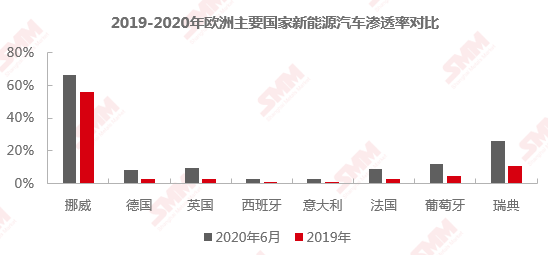
The rapid recovery of new energy vehicle sales in the European market in June 2020 is mainly due to the following two reasons:
EU:
On May 19, the European Union proposed to include electric vehicles in the green economy recovery plan, including:
1) promote a 20 billion euro clean energy vehicle procurement plan in the next 2 years
2) establish a clean energy vehicle investment fund of 400-60 billion euros
3) 2 million new public charging piles will be built by 2025
4) zero-emission cars are exempted from VAT.
France:
On May 26th, France announced that it would spend 8 billion euros to revive the automobile industry. From June to December 2020, the subsidies for car purchase and replacement will be increased by 1000 euros respectively. Individuals who buy electric cars will receive 7000 euros. Companies that buy electric cars receive a subsidy of 5000 euros, while the subsidy for hybrid rechargeable cars is 2000 euros.
Germany:
In June, Germany also approved a 130 billion yuan European recovery plan, including:
1) EV models with a price of no more than 40000 euros will receive a subsidy of 9000 euros;
EV models with a price of more than 40000 euros but no more than 65000 euros will receive a subsidy of 7500 euros.
PHEV models with a price of no more than 40000 euros will receive a subsidy of 6750 euros.
PHEV models that sell for more than 40000 euros but no more than 65000 euros receive a subsidy of 5625 euros.
The amount of subsidy was increased by 50%, exceeding expectations, and the time point exceeded expectations as of December 31, 2021.
2) VAT fell by 3 percentage points to 16%, with a deadline of December 31, 2020;
3) 50 billion euros will be used for electric vehicles, hydrogen energy, intelligence and other technical directions.
Netherlands:
From June 2020 to 2025, personal EV models priced between 1.2 and 45000 euros will receive a subsidy of 0.2 to 4000 euros.
Greece:
In early June 2020, the Greek authorities announced plans to vigorously promote electric cars:
1. The government will provide 100m euros to subsidize electric car buyers within 18 months and is expected to be able to reimburse 14000 electric vehicles for 25 per cent. Consumers of electric vehicles and electric light commercial vehicles in Greece can get a 15% subsidy on car prices. Consumers who buy electric taxis can get a 25% subsidy on the price. Together with the related dividends and tax exemptions, each car will be reduced by nearly 10000 euros.
2. Buildings that have obtained construction permits after March 2021 must be cabled in parking spaces and equipped with charging piles.
UK:
In order to encourage fuel truck drivers to switch to electric vehicles, the British government is considering a subsidy of up to 6000 pounds to encourage drivers to switch to electric vehicles.
The subsidy policies of various countries basically began to be implemented in June, which can also prove that the strong electric vehicle subsidies can effectively promote the European new energy vehicle market to quickly repair from the epidemic and speed up the electrification process.
Greece, as the least active country in Europe to buy electric cars, has a penetration rate of less than 1% in 2019. The newly announced new energy policy not only heavily subsidizes electric vehicles, but also forces the installation of charging piles. It is believed that in the later stage, it will increase consumer demand and increase the penetration of its new energy vehicles.
Norway, as the country with the highest degree of electrification in Europe, currently has an electric vehicle penetration rate of 66%, while Britain, France and Germany, the three countries with the highest sales of new energy vehicles in Europe, have a penetration rate of only close to 10%. New energy vehicle sales in the three countries have a lot of room for growth, and are expected to lead the rise in electric vehicle sales in Europe in the second half of the year, with sales in Europe reaching 1 million units for the whole year.
At present, the European car market is recovering rapidly, but as car companies and battery factories are still destocking, the demand for upstream materials has not yet warmed up. According to industry customer feedback, material procurement demand is expected to increase significantly in August. Domestic ternary precursors and ternary materials enterprises mostly export Korean material factories and battery factories, and most of the terminals are the European car market. The increase in sales in the European market will gradually be transmitted to domestic material enterprises and increase the total output of the industry.
In addition, in addition to the head battery factories such as Ningde Times and BYD cooperating with overseas car companies to export batteries, more domestic battery companies began to cooperate with foreign car companies this year. Such as Volkswagen and Guoxuan Hi-Tech, Daimler and Funeng, Renault Nissan and Xinwanda, Yiwei LiNeng and brilliance BMW and so on. With the gradual expansion of the new energy market in Europe, the demand for domestic power batteries has increased accordingly, which will also promote the further development of domestic power battery enterprises.
SMM battery materials research team
Qin Jingjing 021 Murray 51666828
Mei Wang Qin 021 Mui 51666759
Huo Yuan 021 Murray 51666898