SMM4, April 21: on the evening of April 20, the price of US crude oil was negative for the first time in history. The May futures of US WTI crude oil tumbled 55.90 US dollars to close at-37.63 US dollars per barrel, down 305.97 percent. Since WTI futures began trading on the New York Stock Exchange in April 1983, the previous low for the US crude oil benchmark was $9.75 a barrel in April 1986.
For the negative value of oil prices, market participants said that they have been taught another lesson, have a new understanding of the futures market, originally thought that futures fell to the limit may also be 0, did not expect that the imagination is not rich enough! Of course, will this phenomenon go down in history in the metals market? Many investors came to consult SMM in panic. Here SMM first give you a reassurance, this phenomenon will not appear in the metal market, please rest assured! Let's take a closer look at why not!
First of all, let's take a look at the reasons behind the fall in crude oil to negative values.
General environmental degradation:
Affected by the global spread of the new crown epidemic, many countries around the world have adopted customs closure, home restrictions or local restrictions, the global industry, transportation and other sectors have been severely hit, and the demand for crude oil has been severely reduced. To make matters worse, Russia launched an oil war, pushing the international price of crude oil into the abyss.
Global crude oil storage capacity emergency:
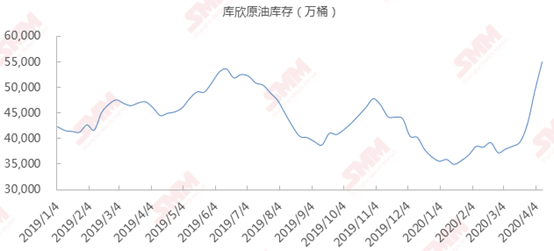
It is understood that at present, some areas of crude oil stocks around the world have been filled. Since 2020, crude oil inventories in Cushing (Cushing), a major US oil storage hub and WTI crude delivery site, have soared to about 55 million barrels, accounting for nearly 70 per cent of Cushing's total inventory, according to the data. As of Sept. 30 last year, Cushing had effective storage capacity of 76 million barrels, according to the U.S. Energy Information Administration. As a result, the remaining capacity of Cushing is only 21 million barrels. Industry insiders say that Cushing is an inland city and that crude oil storage capacity is likely to be filled within three weeks. Once filled, physical delivery of WTI crude oil futures contracts will be more difficult.
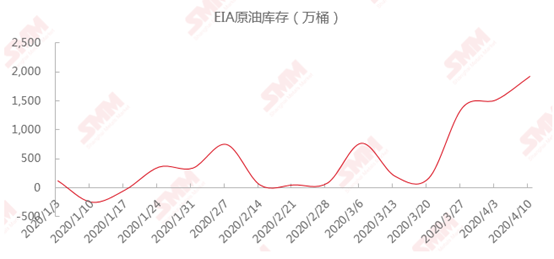
EIA inventories are also under pressure, with EIA crude oil stocks rising 19.248 million barrels in the week to April 10, compared with a previous increase of 15.177 million barrels and expected to increase by 11.676 million barrels. U. S. crude oil inventories rose for 12 weeks in a row, continuing to hit a record high.
She Jianyue, assistant general manager and crude oil expert of Yide Futures, said: "WTI crude oil futures has a particularity. It is delivered inland (Cushing region), and the market balance is mainly affected by upstream supply, tank capacity, pipeline transportation capacity and consumption of surrounding refineries. Us refineries reduced crude oil processing by about 5 million barrels based on last week's operating rate, while crude oil production fell by only about 700000 barrels, as did export data, resulting in large inventories in the Cushing region. At present, short sellers theoretically have a lot of resources to deliver, and those who make long deliveries in the market will face a lot of problems: first, they must have storage capacity, second, they must have pipeline transport capacity, and third, they must have downstream refineries to pick up oil. These things have to be arranged two months in advance. To sum up, the bulls are unable to pick up and deliver goods on the futures disk, and the market has formed the phenomenon of 'empty and bullish'. "
High warehousing costs:
In addition, many oil tankers are used to store excess crude oil, which also leads to the low absolute price of crude oil, but the freight of oil tankers remains at a high level, which greatly increases the storage cost of crude oil. In view of the current situation that oil is cheaper than water, the warehousing cost is likely to be higher than the value of the oil itself.
WTI crude oil May futures contract delivery factors:
According to cheese merchants, the May contract will be delivered on April 21 (02:30 Beijing time on the 22nd), and most brokers will extend it from April 16 to 20. In order to avoid being forced to close their positions, some traders will close the May contract ahead of schedule and re-establish the next June contract, resulting in a lot of selling in the May contract and a sharp fall in prices.
Taken together:
At a time when demand is falling and supply is not reducing the world is full of problems such as ship warehousing, the bulls are unintentionally unable to receive the goods. While bulls are unlikely to dump crude oil, the penalties are even higher. BP (BP.N) paid a $65 billion fine for the oil spill in 2010 as a warning. Helplessly, the near-delivery WTI bulls had to flee crazily regardless of cost, even if they paid twice as much as the oil price to take away the crude oil.
Why will metal futures prices not repeat the tragedy of the oil market?
The difference between the form of trading and the rules of the exchange:
Zhang Shunqing, a senior industry analyst, said: crude oil is an extreme phenomenon in the commodity market this time. Because a large number of positions are held by ETF, do not enter the final delivery, that can only close out. In addition, as a result of the exchange trading rules, the American oil market does not rise and fall, but also has a negative value, breaking the traditional ideas and ideas. The metal market is a rational norm, the second is that speculative positions are not so concentrated, forced position risk exchanges will do some risk control measures in advance to intervene. This time the negative oil price also raises questions about the rules of the exchange.
Differences in warehousing costs:
The recent collapse in crude oil prices has led to a significant reduction in the ratio of absolute crude oil prices to warehousing costs, and the purchase of crude oil has to pay huge warehousing costs in the case of tight warehousing. However, the ratio of metal to warehousing cost is very large, far greater than the ratio of crude oil to warehousing cost, so there is no such impact.
Commodity attributes and warehousing requirements are different:
Crude oil warehousing is the service process of receiving and unloading crude oil into storage, transit, custody or transfer to the operation link of transportation system through oil pipeline, oil port wharf, railway special line, waterway transportation or road transportation.
The transportation and storage of crude oil need to have specific storage conditions, such as crude oil depots need to have oil storage tanks and oil pipelines, railway special lines or water terminals and other supporting facilities for receiving, receiving and storing crude oil storage facilities. And in terms of security, it is necessary to have strict conditions. As a result, once the crude oil warehouse appears the phenomenon of expansion, it is impossible to increase the storage capacity in a short period of time. In particular, the United States oil, through pipeline transportation, the oil depot is full, there is no place to put, but the oil well can not stop, the follow-up disposal problem has become an urgent event.
The difference is that the condition of metal storage is low, as long as there is space to ensure the basic requirements.
The risk of shutting down oil wells is more worrying:
Well shutdown can pose a risk to oil wells, which is likely to lead to geological changes, affect the quality of oil produced, and even lead to inability to produce oil.
Industry experts said that the oil field is affected and restricted by a variety of factors, can not simply be said to close or stop. The crude oil underground is not tap water. When the benefit is not good, turn off the tap and unscrew it when needed. It is necessary to consider not only the current benefits of this well block, but also the overall and long-term benefits. To the layman, it seems that everything is all right when the oil well is shut down, the power supply is disconnected and the personnel withdraw. After the shutdown of oil wells, the relevant management is not closed, but more need to be strengthened.
Although the metal market also has the problem of shutdown cost, but it is still far from the cost of crude oil mining shutdown.
To sum up, there are great differences between the crude oil market and the metal market, no matter from the trading form, trading rules or from the warehousing attributes and requirements, so we do not have to worry too much, the metal market will not appear negative!
"Click to participate in the second China (Yingtan) Copper Industry Summit and the 15th China International Copper Industry chain Summit."
"these enterprises have signed up! (with part of the list of participants)

To sign up for the summit or apply to enter the SMM industry exchange group, please scan the code:

![백금 선물 소폭 상승; 현물 시장 거래는 보통 [SMM 일일 리뷰]](https://imgqn.smm.cn/usercenter/QnbfL20251217171735.jpeg)
![미국 8월 CPI 발표, 은 시장 관망세 짙어지며 선물 횡보 [SMM 데일리 리뷰]](https://imgqn.smm.cn/usercenter/LVqfJ20251217171736.jpg)