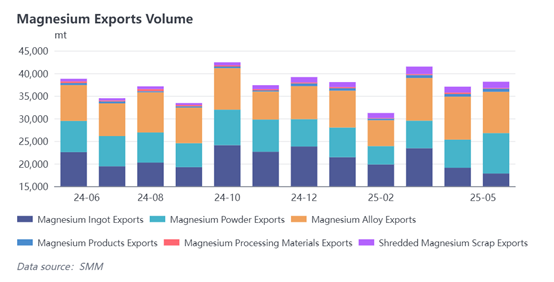
Selon les données d'exportation des produits du magnésium en mai, les volumes d'exportation globaux ont montré une tendance à la hausse d'un mois à l'autre. Toutefois, lorsqu'on examine la structure spécifique des produits, le paysage du marché a subi des changements importants : les exportations de poudre de magnésium et d'alliages de magnésium ont augmenté de manière significative, les alliages de magnésium représentant actuellement la plus grande part des exportations ; en même temps, les exportations de lingots de magnésium ont chuté à leur plus bas niveau depuis près d'un an. Ce phénomène est étroitement lié à l'évolution des prix des lingots de magnésium en mai. Au cours du mois, les prix des lingots de magnésium ont atteint un pic annuel, ce qui a incité certains clients en aval à adopter une attitude d'attente et à reporter leurs achats, entraînant ainsi une contraction importante de l'échelle des exportations de magnésium brut.
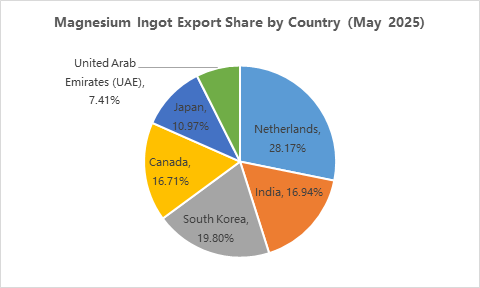
D'après la répartition régionale des exportations de lingots de magnésium en mai, il est évident que la position traditionnelle de l'Europe en tant que principal marché d'importation s'est considérablement affaiblie, sa part d'importation ayant chuté à 28 %. Ce changement est principalement attribuable à deux facteurs : premièrement, les fluctuations importantes des prix des lingots de magnésium en mai ont rendu difficile la prise de décisions éclairées par les acheteurs ; deuxièmement, la contraction continue du secteur automobile en aval en Europe a conduit à une réduction progressive des commandes des utilisateurs finals. En revanche, la part d'importation de la Corée du Sud et de l'Inde a augmenté, ce qui indique que le marché asiatique reste la principale région de circulation des lingots de magnésium, tandis que l'Amérique du Nord maintient également une demande stable. On prévoit qu'avec la réentrée progressive des négociants européens sur le marché en juin, les importations de lingots de magnésium aux Pays-Bas pourraient connaître une légère reprise.
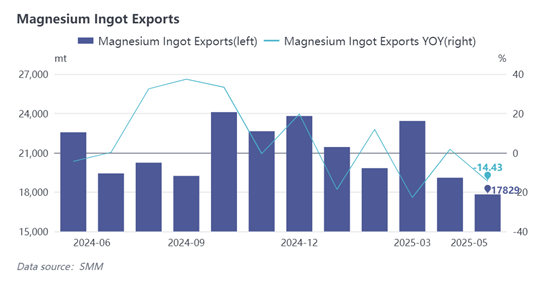
En examinant les données d'exportation en volume d'un an à l'autre, les exportations de lingots de magnésium ont diminué de 14,43 % en mai, ce qui reflète une réduction importante du volume des commandes à l'étranger. Dans le même temps, les modes d'achat ont également connu de nouveaux changements en juin : les clients à l'étranger n'ont plus adopté le modèle traditionnel de commande un à un, mais se sont tournés vers les appels d'offres électroniques pour solliciter des devis, ce qui leur a permis de mieux comprendre les tendances des prix du marché et de rechercher les offres les plus favorables. Notamment, les grandes entreprises ont mis en place des modèles complets d'analyse des coûts et de prévision de l'offre et de la demande afin d'améliorer leurs capacités de négociation des prix avec les fournisseurs de lingots de magnésium.
L'analyse de SMM suggère que les exportations de produits du magnésium en juin devraient augmenter avec la hausse des commandes. Il recommande également aux négociants de donner la priorité aux marchés émergents tels que la Corée du Sud, l'Inde et le Moyen-Orient, en se concentrant non seulement sur la concurrence des prix, mais également sur le maintien de la qualité des produits et de la réputation de la marque.

![Marché du magnésium en mai : bras de fer entre haussiers et baissiers ; support de plancher bien défini, rebond limité [Analyse SMM]](https://imgqn.smm.cn/usercenter/XUnxM20251217171723.jpeg)