The freight rate fell for 12 weeks in a row! Shanghai blockade and global port congestion impact on the gathering market

Publié: Apr 13, 2022 09:09
[freight rates have fallen for 12 weeks in a row! With the severe epidemic situation in Shanghai and the continuous impact on the container shipping market by the global port blockage, the SCFI index fell 12 times to the lowest level since August last year. On April 8, the Shanghai Shipping Exchange announced that the latest Shanghai export container freight index (SCFI) fell to 4263.66 points, a weekly decline of 1.96%, a record decline for 12 consecutive weeks. Freight rates on both the European line and the western line fell, with the European line at a 10-month low, but the eastern line rebounded.
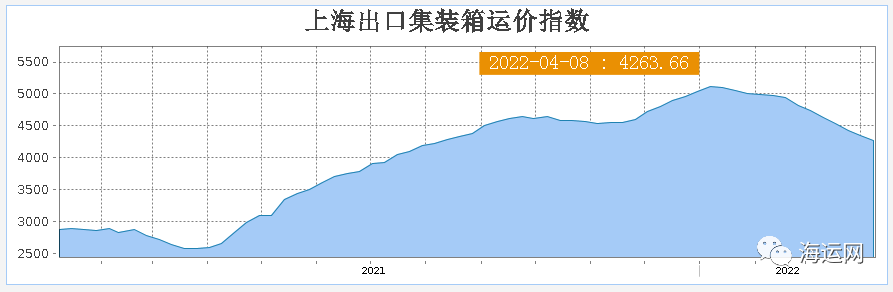
With the severe epidemic situation in Shanghai and the continued impact of global congestion on the container shipping market, the SCFI index fell 12 times to its lowest level since August last year.

On April 8, the Shanghai Shipping Exchange announced that the latest Shanghai export container freight index (SCFI) fell to 4263.66 points, a weekly decline of 1.96%, a record decline for 12 consecutive weeks. Freight rates on both the European line and the western line fell, with the European line at a 10-month low, but the eastern line rebounded.

Among them, the freight rate per FEU of the far East to the US West Line fell by 56 US dollars, or 0.7%, to US $7860, falling for five consecutive weeks and setting a new low so far this year; the freight rate per TEU of the far East to the US East Line rebounded by US $186 to US $10581, an increase of 1.8%; and the freight rate per TEU of the far East to Europe line fell to US $6157 in a row, the lowest since June last year.

People in the industry pointed out that recently, in order to prevent a strike by dock workers in the United States and the West, manufacturers began to transfer goods to the East of the United States, but the shipping space in the East of the United States is already less than that of the United States and West, and the problem of blocking the port has not been solved, so the freight rate of the East Line of the United States has risen.

In terms of the overall trend of freight rates, it is expected that freight rates will still fall slightly in mid-April, and freight rates, which were originally expected to recover in the second half of April, may have to wait until early May before they begin to rise. The main reason is that the collection and transportation companies began to draw boats on the western line of the United States, and after the release of the epidemic in Shanghai and other places, the tide of shipments is expected, which will be able to push up freight rates.

Despite the continuous decline in the SCFI index, freight rates are actually still at historic highs. However, people in the industry also believe that it may be difficult for freight rates to reach new highs, and freight rates this year are unlikely to increase as much as last year, but will not decline too much, but will remain volatile at high levels.

On the other hand, although the current shortage of space has eased somewhat, the slightly loose space and the ease of congestion will help to improve ship turnover, even if freight rates decline slightly, as long as cargo volume remains high and freight rates remain relatively high, the performance of container carriers this year is unlikely to be lower than that of last year.

About 10 per cent of the world's container ships are unable to move because of port jams in China and other parts of the world, according to ONE.

ONE CEO Jeremy Nixon said at the Marine Money conference in Singapore on April 5 that container ships are stuck in congested areas and consume a lot of fuel, and if the bottleneck can be solved, the service will be on time again.

Last year, there were 5587 ships carrying 24.7 million containers in the global container fleet, according to USDA data, which means about 500 ships are now queuing up to load and unload goods, according to Bloomberg estimates.

The COVID-19 epidemic has entered its third year, and the global supply chain is still hit by manpower shortages and outbreaks. Industry insiders say that although congestion at ports on the west coast of the United States has finally eased after several months of delays, cities such as Shanghai and Shenzhen have been blocked, resulting in an increase in queues for ships off the coast of China, which could worsen cargo delays in the coming months and push up freight rates.

Déclaration sur la source des données : À l'exception des informations publiques, toutes les autres données sont traitées par SMM sur la base d'informations publiques, d'échanges avec le marché et en s'appuyant sur le modèle de base de données interne de SMM. Ils sont fournis à titre indicatif uniquement et ne constituent pas des recommandations décisionnelles.

Pour toute demande d'information ou pour en savoir plus, veuillez contacter : lemonzhao@smm.cn
Pour plus d'informations sur l'accès à nos rapports de recherche, veuillez contacter :service.en@smm.cn
Actualités Connexes
Les prix de l'argent fluctuent fortement, le centre se déplaçant vers le haut ; l'argent au comptant passe d'une décote à une prime [Revue hebdomadaire de l'argent SMM]
il y a 6 heures
Les prix de l'argent fluctuent fortement, le centre se déplaçant vers le haut ; l'argent au comptant passe d'une décote à une prime [Revue hebdomadaire de l'argent SMM]
Lire la suite
Les prix de l'argent fluctuent fortement, le centre se déplaçant vers le haut ; l'argent au comptant passe d'une décote à une prime [Revue hebdomadaire de l'argent SMM]
[SMM Revue hebdomadaire de l'argent : les prix de l'argent fluctuent fortement avec un centre en hausse ; le spot passe de la décote à la prime] Cette semaine, les prix de l'argent ont fortement fluctué, le centre se déplaçant légèrement à la hausse. Des chiffres de l'emploi non agricole plus solides que prévu ont d'abord exercé une pression sur les prix de l'argent, mais l'affaiblissement continu du dollar américain a ensuite entraîné un rebond, et les cotations au comptant sont passées de décotes à des primes. Les facteurs macroéconomiques étaient mitigés, et le marché attendait des indications de l'IPC et de la réunion de la Fed, avec de fortes fluctuations attendues à court terme. Les stocks ont légèrement augmenté de 6 tonnes, les avoirs des ETF ont légèrement progressé, et le sentiment d'attentisme s'est renforcé.
il y a 6 heures
WPIC révise le marché du platine 2026 à un excédent de 265 000 oz en raison de la faiblesse de la demande d'investissement
il y a 7 heures
WPIC révise le marché du platine 2026 à un excédent de 265 000 oz en raison de la faiblesse de la demande d'investissement
Lire la suite
WPIC révise le marché du platine 2026 à un excédent de 265 000 oz en raison de la faiblesse de la demande d'investissement
[SMM Flash] Le World Platinum Investment Council (WPIC) a révisé son bilan du marché du platine pour 2026 à un excédent de 265 000 onces, inversant sa précédente prévision d'un déficit de 297 000 onces. Le dernier Platinum Quarterly, publié le 9 septembre, fait état d'un excédent de 244 000 onces au deuxième trimestre, l'offre totale ayant augmenté de 1 % en glissement annuel pour atteindre 1,91 million d'onces, tandis que la demande a chuté de 16 % à 1,66 million d'onces. Cette révision reflète largement les sorties d'investissement au cours du premier semestre 2026 plutôt qu'une reprise significative de l'offre minière. Malgré la prévision d'un excédent sur l'ensemble de l'année, le WPIC indique que les stocks en surface restent limités après trois années consécutives de déficits substantiels. L'organisation s'attend à ce que le marché passe d'un excédent de 548 000 onces au premier semestre à un déficit de 283 000 onces au second semestre, à mesure que les ventes d'investissement se modèrent. Le bilan du second semestre demeure une prévision plutôt qu'un résultat confirmé.
il y a 7 heures
Le platine pourrait surperformer le prix de l'or alors que le commerce de débasement reprend de l'élan – WPIC
il y a 7 heures
Le platine pourrait surperformer le prix de l'or alors que le commerce de débasement reprend de l'élan – WPIC
Lire la suite
Le platine pourrait surperformer le prix de l'or alors que le commerce de débasement reprend de l'élan – WPIC
il y a 7 heures