[BYD pure electric bus blade battery operating in more than 300 cities around the world will be put into production next year] BYD is making great efforts to reap a lot with its leading technology and cost advantages. Abroad, BYD's third factory in Brazil has been officially put into production, and pure electric buses and taxis have been successfully operated in more than 300 cities around the world.
[Tesla explores the possibility of supplying electric cars in Germany] Tesla, owned by Iron Man Musk, has been granted a license to allow the company to provide power supply in Western Europe. Tesla has also been asking German consumers whether they will accept Tesla to provide power to their cars. In the view of many consultants and energy industry executives, Tesla is likely to set up power utilities in Germany through the above-mentioned series of actions and working with 1 or 2 institutions.
[Tianyuan Group's Yibin Libao New Materials are officially supplied to Ningde Times] recently, Libao New Materials Company officially supplied to Ningde Times! This time, Libao sent 90 tons of M515 products to CATL, which will continue to be supplied in the future. This official delivery marks the substantive stage of the cooperation between Yibin Libao and CATL, and the company will continue to carry out more in-depth and extensive cooperation with CATL. "View details
[Jianrui Wareng reported that 13.24 million yuan of cell and battery product income has restored 4GWh production capacity] recently, Jianrui Wareng released its semi-annual report for 2020. The company's revenue in the first half of the year was 16.6985 million yuan, down 92.86% from the same period last year. The net profit was a loss of 48.96 million yuan, compared with a loss of 1.829 billion yuan in the same period last year. The main product of Jianrui Woneng is 32700 small cylindrical lithium iron phosphate battery. Before reorganization, the company has 13GWh cell capacity, which is the largest small cylindrical iron phosphate cell production capacity in the country. After restructuring, the company has quickly resumed the production of high-quality 4GWh capacity in the two factories, and is still in a leading position in the small cylindrical phosphate cell manufacturers. Large-scale production can ensure the consistency and stability of product quality, at the same time, it can give full play to the advantages of scale and obtain lower material procurement cost and production cost. The small cylindrical battery has a high degree of standardization, a more mature process, a high degree of automation of production equipment and fewer personnel, and the scale effect in mass production will be more obvious.
[sales exceed 140000 SAIC GM Wuling for five consecutive months] SAIC GM Wuling released official figures that SAIC GM Wuling sold 148000 vehicles in August, up 17% from the same period last year, and achieved positive sales growth for five consecutive months compared with the same period last year. Among them, the Wuling brand sold 109000 vehicles in August, up 39% from the same period last year; the new Baojun brand 20672, up 53% from the previous month; the sales of new energy products reached 18312, up 110% from the same period last year; and overseas exports increased by 37% over the same period last year. Among these brands, Wuling, as a national brand, accounts for 73.65% of SAIC GM Wuling's overall sales, with cumulative sales exceeding 18.27 million vehicles, and in the 2020 China Automobile consumption Guide issued by the China Association of Automobile Manufacturers, ranking first in national automobile brand recognition.
[the fourth new car of Lulai Automobile EE7 may be mass produced in the fourth quarter of next year] on September 1, it is reported that United Zhihang, a subsidiary of Gunsheng Electronics, was designated for the 5G-V2X platform project of Lulai Automobile a few days ago, with a project amount of about 660 million yuan, and its products include V2X 5G-TBOX and 5G-VBOX. The above products will be available in December 2021 and will be first deployed on the EE7. At the same time, they will also involve ES6, ES8, EC6 and other models. The message, which is less than a hundred words, indicates the next product plan of Lulai: the EE7 may be the fourth model of Lulai. At the same time, a reporter from the Financial Associated Press learned from the Trademark Office of the State intellectual property Office that EE7 applied for registration on February 21, 2019 and has obtained the trademark right, which indirectly proves the existence of this car. Based on the above information and the statement of Qunsheng Electronics that "supply will start in December 2021", it is inferred that EE7 will start mass production in the fourth quarter of 2021 and is likely to continue production at the Jianghuai Weilai factory.
[about 300 ID3 arrived in Sweden to deliver the first batch of customers in September] about 300 22 electric vehicles arrived in the Swedish port of Sodetaye on Monday, preparing to deliver the first batch of customers in September. Together with the 700th Model 3 deployed in Norway a few days ago, Sweden and Norway will deliver 1000 vehicles.
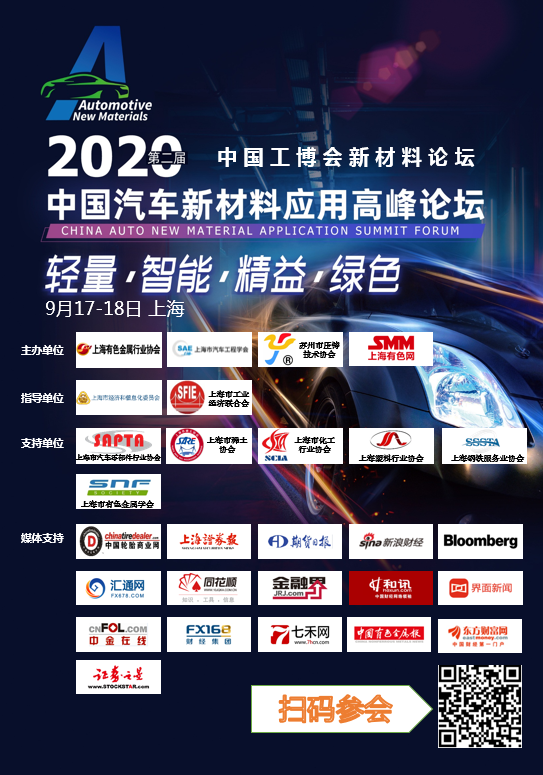
"2020 (second) China Automotive New Materials Application Summit Forum"
It was solemnly held in Shanghai from September 17 to 18.
During the reform period of the "four modernizations of the automobile", intelligent network connection, new energy, lightweight and intelligent manufacturing entered the field of the automobile industry, and the automobile era was reinterpreted. The surging changes require the industry to continue to integrate and innovate, and quickly promote the development rate of automobile enterprises. With the emergence of self-driving and intelligent cars, Internet companies, which are not active in the automotive field, have more opportunities to show their talents; the double points policy is becoming an important driving force for the development of China's new energy vehicle industry; in the face of environmental constraints, car companies speed up the application of advanced lightweight components and technologies to achieve vehicle weight loss. With the continuous promotion of the strategies of "Industrial 4.0" and "made in China 2025", intelligent manufacturing has become a new challenge of upgrading and transformation.
Under the guidance of the Shanghai Economic and Informatization Commission and the Shanghai Federation of Industrial economy, in order to accelerate the application of automobile lightweight and product lines, the Shanghai Nonferrous Metals Industry Association, together with Shanghai Automotive Engineering Society, Suzhou Die casting Technology Association and SMM, jointly held the "2020 (second) China Automotive New Materials Application Summit Forum". Jointly discuss material solutions, co-casting automobile industry chain green development closed loop, and strive to build an excellent communication and cooperation platform for the whole automobile industry chain, and lead the creation of advanced automobile industry clusters.
Click to understand and sign up for the 2020 China Automotive New Materials Application Summit Forum.
Please fill in your personal information on the last page and the meeting staff will contact you later!
![[SMM Bilan hebdomadaire du chrome] « Les stocks portuaires diminuent alors que les départs prolongent les gains, le Zimbabwe durcit les règles d'extraction du chrome »](https://imgqn.smm.cn/usercenter/qbMSp20251217171722.jpeg)
![[SMM Chrome Éclair] FS Mining détaille ses projets de fonderie de ferrochrome et de centrale électrique de 500 millions de dollars au Zimbabwe](https://imgqn.smm.cn/usercenter/TdoSs20251217171724.jpeg)