SMM July 24:
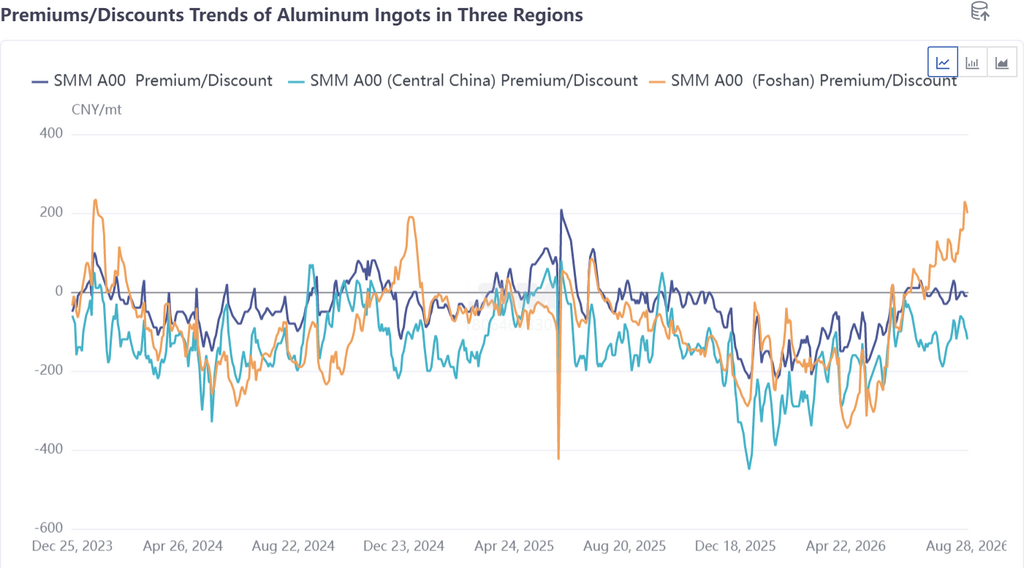
Since mid-August, domestic aluminum ingot spot premiums showed notable regional divergence: spot premiums in south China (Foshan) against the SHFE aluminum 2609 contract continued to widen, and by the week of August 27 they had expanded by 125 yuan/mt to a premium of 220 yuan/mt; east China (Wuxi) A00 spot premiums remained near a discount of 20 yuan/mt to parity against the 09 contract. The divergence between regional price centers constituted the most important structural feature of the spot market in late August.
In mid-August, the Guangdong-Shanghai spot price spread narrowed to around 40 yuan/mt at one point (August 17), then widened rapidly after entering late August, and stayed in the 210-240 yuan/mt range from August 26 to 28. The midpoint of the spread was more than 100 yuan higher than in mid-month. Apart from trucking, the spread already fully covered other conventional logistics costs for shipping from east China to south China; the cross-regional cargo diversion window substantially opened, and the volume of northern supply in transit increased notably.
Why the Guangdong-Shanghai Spread Widened: The Resonance of Three Logics
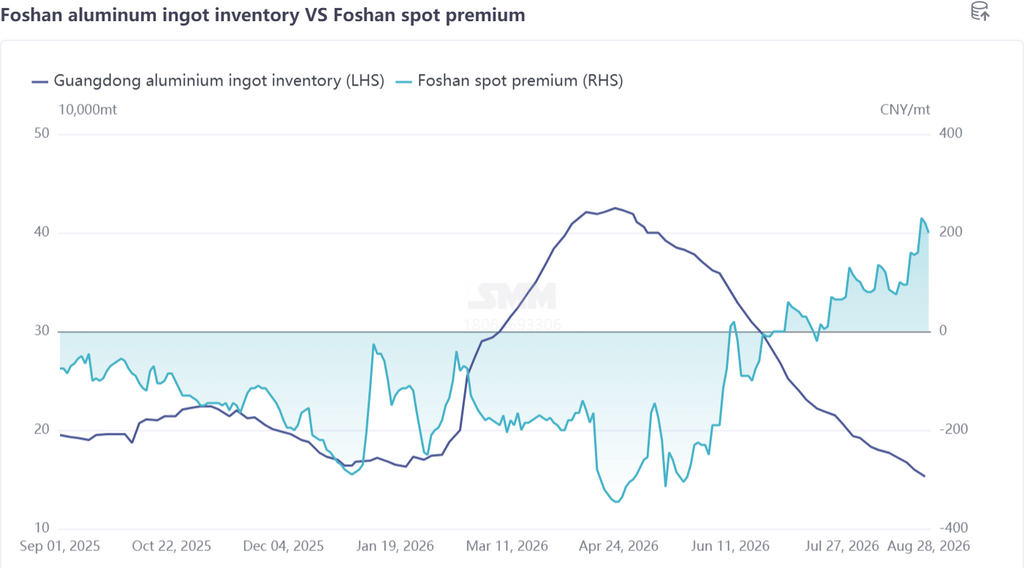
First, regional supply-side mismatch was the most fundamental driver. In August, the east China market experienced a short period of consecutive concentrated arrivals: some northern aluminum smelters increased casting ingot volume, and after aluminum prices retreated following a rapid rise, upstream enterprises generally accelerated shipment pace and stepped up selling, depressing Wuxi spot premiums. A00 spot premiums against the 09 contract hovered near a discount of 20 yuan/mt to parity. In contrast, in south China, because the proportion of liquid aluminum in south-west China stayed high, arrivals remained tight from August onward, and Foshan became the only one of the three major consumption regions to continue rapid destocking. According to SMM data, Foshan's social inventory of aluminum ingots fell from 219,000 mt on July 20 to 153,000 mt on August 27, destocking by 66,000 mt over five weeks, a decline of 30%. The widening spread was an inevitable result of supply-demand rebalancing on a regional basis.
Second, the microstructure of the south China spot market amplified price elasticity. Supplier concentration in the south China market was relatively high; with sustained destocking as confirmation, suppliers above designated size generally held a bullish outlook and showed firm willingness to hold prices firm and hold back from selling, with some even resorting to the extreme practice of withholding cargo from the market. At the same time, large players repeatedly raised purchase prices sharply to buy cargo and make markets; combined with rigid downstream restocking demand on price dips and traders' relatively strong rigid purchase willingness, multiple buying forces built considerable marginal pricing power over a tight circulating supply. The resonance between supply-side "lock-ups" and demand-side "market making" gave Foshan premiums the micro-level conditions for a rapid spike.
Third, the economics of cargo diversion already made sense. Taking shipments from Wuxi in east China to Foshan in south China as an example, per-mt logistics costs for water, rail, and rail-sea intermodal transport were already covered, but the whole journey took about two weeks. Trucking could arrive in two days, but per-mt freight was about twice that of conventional transport. The shipping distance from Gongyi in central China to south China was even longer, and costs were several dozen yuan higher on top of that. When the Guangdong-Shanghai price spread widened to 210-240 yuan/mt, even rush trucking remained unprofitable, while arbitrage space for conventional water and rail transport had to account for time costs—but with the cross-regional cargo diversion window substantially opened, the volume of northern supply in transit by rail increased notably. Interestingly, the diversion expectation itself reflexively accelerated the turn in south China spot: south China suppliers anticipated that arrival pressure would materialize intensively two weeks later, so at end-August they proactively increased price concessions to sell, and premiums began to narrow on their own. In addition, in the central China market, because shipping distances were longer and costs were higher, local downstream buying sentiment was subdued, and suppliers engaged in stampede-style selling, spot transaction discounts widened to 80-130 yuan/mt against the 09 contract. However, the high freight barrier still limited the scale of outflows to south China, and the main source of regional cargo diversion remained east China.
September Outlook: Return of South China Spot Premiums and Rebalancing of Nationwide Premiums
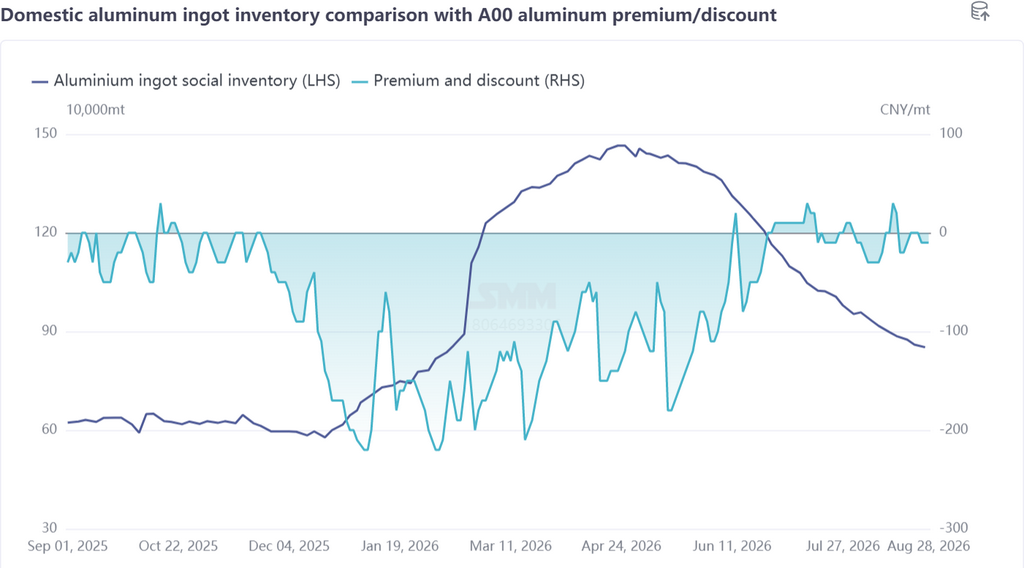
In mid-to-late August, the south China market went through a full cycle of “shifting from weakness to strength—a strong spike to a peak—and a reversal of expectations,” with a turning point emerging in the final stretch of late August (8/27-8/28). On August 27, the cross-regional arbitrage window opened and expectations that northern cargoes had already set off southward began to dominate the market. Combined with elevated absolute prices and spot-futures price spreads, along with a concentrated release of month-end cash-liquidation demand, suppliers stepped up selling at concessions. On August 28, expectations of incremental northern cargoes were further priced in. With the weekend coinciding with the month-end period, the double-high cash-liquidation accelerated and the circulation side showed signs of a glut. After spot premiums in south China shot up to 220 yuan/mt, the south China spot market was the first to begin pricing in expectations of incoming cargo transfers.
Looking ahead to September, the key words for China’s aluminum ingot spot premium market will be “convergence” and “rebalancing.” As transfer cargoes arrive at ports in a concentrated manner, south China spot premiums face mean reversion pressure. However, nationwide inventory destocking is continuing, and low inventory is still providing bottom support for premiums. Overall spot premiums are expected to follow a path of “south China pulling back and regional convergence.”
In south China, in-transit transfer cargoes are expected to arrive at ports in concentrated fashion in early-to-mid September. Combined with delivery and contract rollover in mid-September, the “tight arrivals + tight float” logic that previously supported Foshan premiums will be diluted at the margin. Spot premiums face mean reversion, and the center of quotes is likely to gradually retreat from current high premium levels. In east China, cargo outflows and the diversion of arrivals will marginally ease local arrival and spot pressure. Coupled with a rebound in downstream purchase willingness after aluminum prices retreat from highs, Wuxi spot discounts are expected to recover from low levels. From a nationwide perspective, price spreads among the three regions are tending to converge, and interregional arbitrage momentum will naturally fade as the price spreads fall back to within the logistics cost threshold.
In terms of overall premium direction, the destocking trend of China’s aluminum ingot inventory is expected to continue in September, and low inventory still serves as effective bottom support for spot premiums. However, the drag on consumption from aluminum prices fluctuating at highs and the constraint on demand elasticity from a sharply shrinking export window remain, and warehouse withdrawals are unlikely to see another volume-driven breakout above previous highs. On balance, once September begins, supplier quotes are expected to be relatively firm. The center of spot transaction prices in east China is still expected to operate near parity, and the Guangdong-Shanghai price spread will clearly converge from the structure seen at the most extreme regional divergence in late August. Market participants are advised to focus on the pace of price spread pullback among the three regions, the actual arrival pace of in-transit cargoes in south China, and the leading signal for ingot-side demand from the consecutive inventory buildup that aluminum billet social inventories are the first to show.
Data source: SMM
![Las tarifas de procesamiento de palanquilla de aluminio se desploman por debajo de la línea de costos; el mercado de Foshan se consolida débilmente en mínimos [Análisis de SMM]](https://imgqn.smm.cn/usercenter/ppauU20251217171651.jpg)
![En vísperas de la «temporada alta de septiembre»: las tarifas de procesamiento de palanquilla de aluminio se desploman por debajo de la línea de costos, el mercado de Foshan se consolida débilmente en mínimos [Análisis de SMM]](https://imgqn.smm.cn/usercenter/tkWbz20251217171654.jpg)