In January 2026, the sodium-ion battery industry entered a special operational cycle ahead of the Chinese New Year, with the industry chain exhibiting dual characteristics of "pre-holiday stocking demand support" and "the arrival of the traditional production off-season." Coupled with the rise in lithium carbonate prices at the beginning of the year, which pushed up lithium battery cell costs, market attention and substitution logic for sodium-ion battery products were further strengthened. In terms of production performance, all segments of the sodium-ion battery industry chain achieved significant YoY growth, confirming that the industry remains on a rapid upward trajectory toward commercialization. However, MoM performance showed significant divergence due to stockpiling pace, product characteristics, and off-season impacts. Shanghai Metals Market (SMM) comprehensively reviewed the operations of the entire sodium-ion battery industry chain in January, including cathode materials, hard carbon anodes, electrolytes, and end-user battery cells, analyzing current industry characteristics and providing a short-term market outlook.
Cathode Materials: NFPP Production Remains Stable Amid Stockpiling, Layered Oxide Materials Continue to Underperform
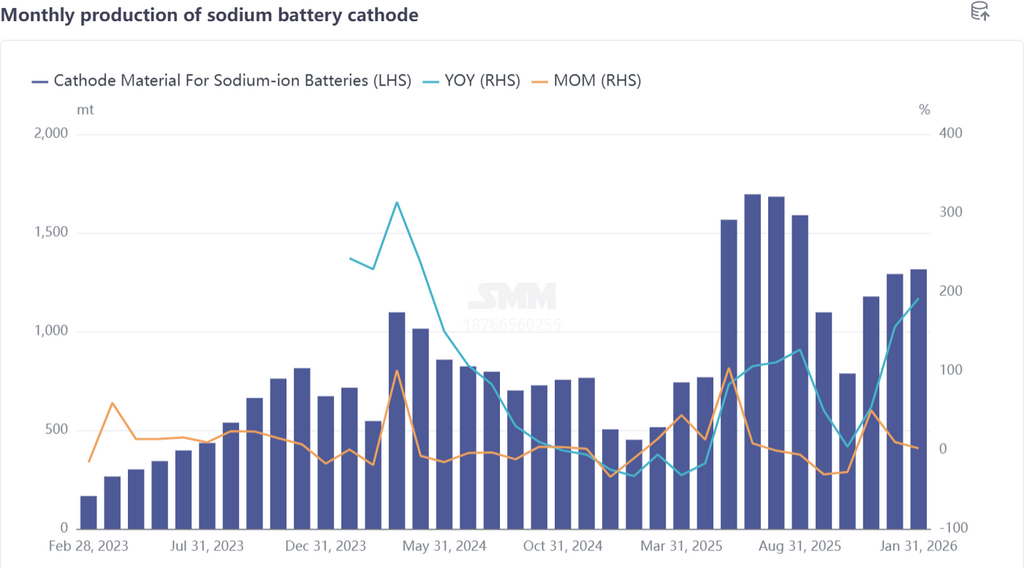 Sodium-ion battery cathode material production increased slightly by 2% MoM and surged 192% YoY in January, with product structure further concentrating on polyanion materials, accounting for 91% of the total. Among them, the share of NFPP increased by 10 percentage points MoM, making it the absolute mainstream in the market. In January, NFPP production focused on the delivery of existing orders, while most enterprises began pre-holiday stockpiling operations to secure supply for the transition period after the holiday, when temporary orders are expected. The industry's production schedule maintained a favorable trend. In stark contrast, layered oxide material production remained sluggish, accounting for only 6% in January, with order levels still at a low point and no signs of significant recovery in the near term. Looking ahead, due to the traditional Chinese New Year holiday in February, sodium-ion battery cathode enterprises will experience approximately half a month of holiday, with production largely coming to a halt. SMM expects sodium-ion battery cathode production to decrease significantly by 70% MoM and 23% YoY in February.
Hard carbon anode material: Orders produced based on demand, new capacity and overseas demand open up growth space
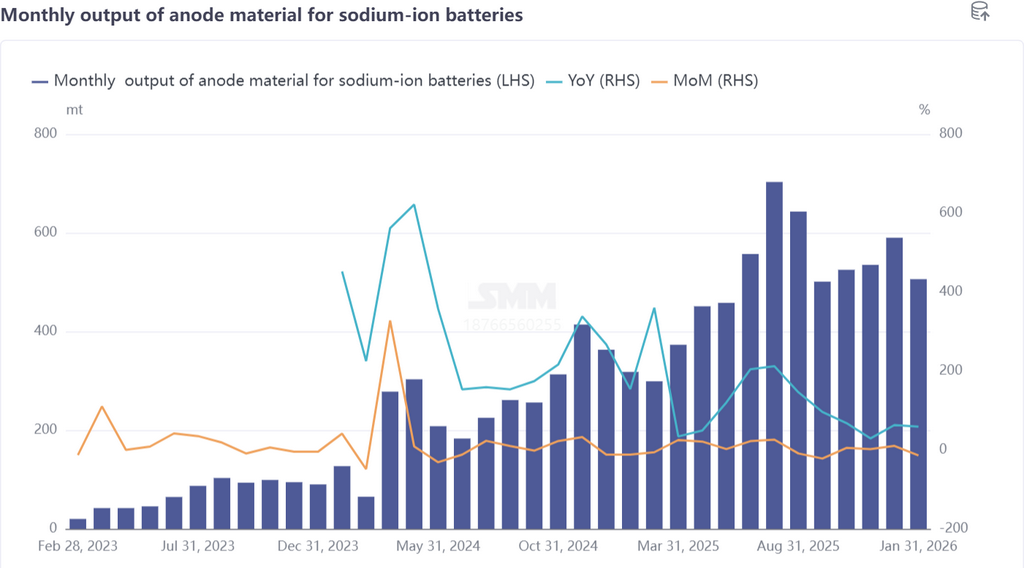
In January, sodium-ion battery anode material production decreased 14% MoM but surged 59% YoY, with the overall market maintaining a demand-based production pace. Currently, the hard carbon market shows steady order fulfillment, with ESS and start-stop power supply as core demand areas; some enterprises even face tight delivery situations. While completing existing orders, companies are simultaneously conducting minor pre-holiday stockpiling. Capacity side, new capacity launched by the end of 2025 saw partial shipments in January. If subsequent production stabilizes gradually, it will effectively alleviate the tight supply of sodium-ion hard carbon in the industry.Demand side also welcomes new growth points, as overseas clients' demand for hard carbon anode gradually releases, and the overseas expansion of sodium-ion batteries shows a positive trend. Affected by the Chinese New Year holiday, hard carbon anode production is expected to drop significantly in February. SMM forecasts February production to decrease 47% MoM, while still maintaining 10% positive growth YoY.
Sodium-ion battery electrolyte: Raw material price hikes drive up prices, off-season demand suppresses production performance
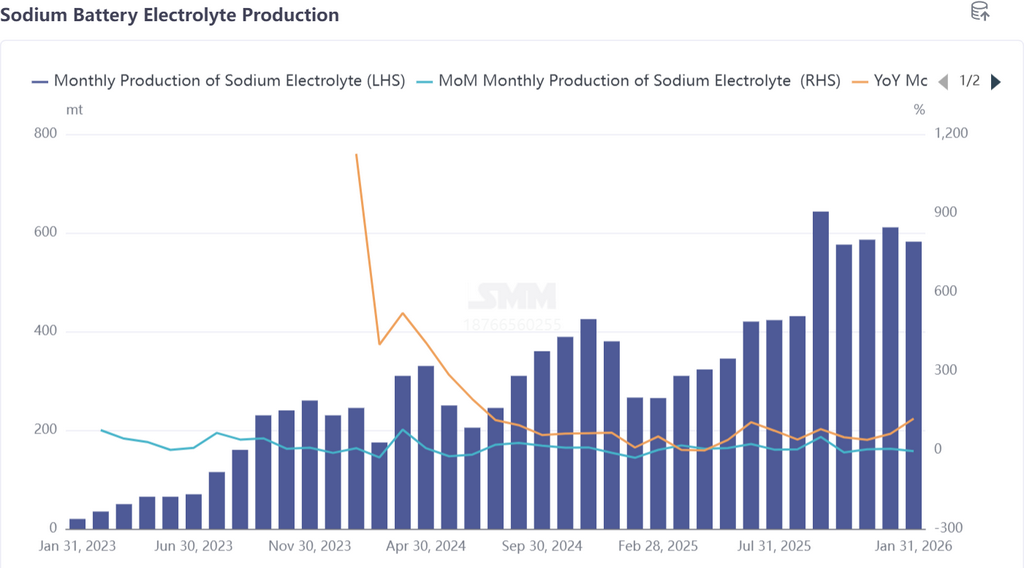
In January, sodium-ion battery electrolyte production fell 5% MoM but rose 119% YoY. The market continues its core logic of producing based on demand; as electrolyte products are unsuitable for long-term storage, companies'willingness for pre-holiday stockpiling is much lower than for cathode/anode materials. Prices saw minor adjustments: influenced by earlier price increases of key raw materials such as NaPF6 and NaFSi, sodium-ion electrolyte prices edged up slightly. However, price changes are not the core factor affecting production; downstream sodium-ion battery cells entering the production off-season directly led to shrinking electrolyte demand, becoming the main reason for the MoM decline in output. In February, industry production will face further pressure. Due to fewer orders combined with the Chinese New Year holiday, some sodium-ion electrolyte production line manpower may be shifted to lithium battery production lines. SMM expects February electrolyte production to decrease 43% MoM but increase 26% YoY.
Battery Cells and End-Users: Off-Season Production Declines, Lithium Carbonate Price Rise Boosts Sodium-Ion Battery Market Expectations
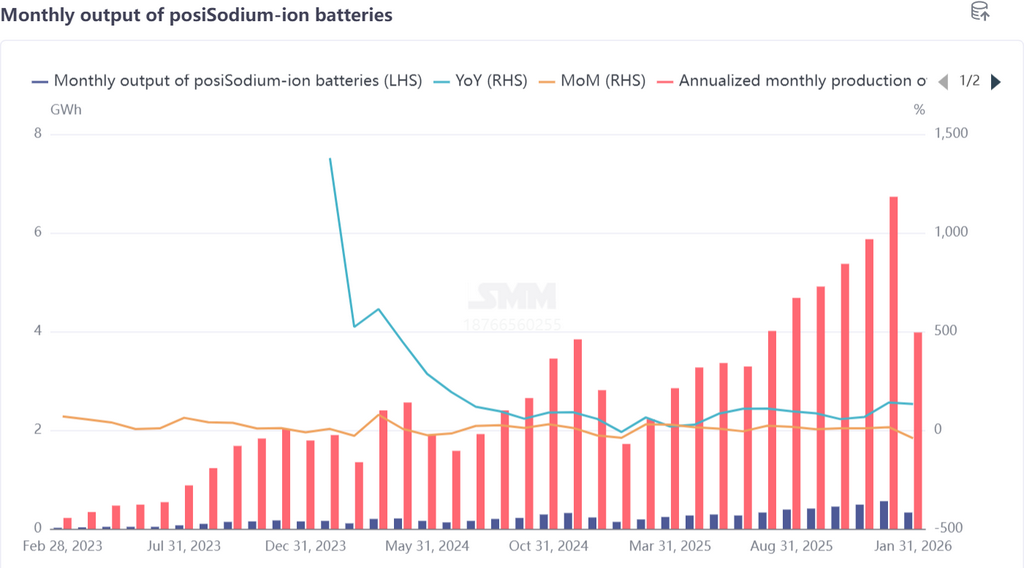
In January, sodium-ion battery cell production decreased 41% MoM but increased 132% YoY, as the industry officially entered the production off-season. Only some ESS projects maintained deliveries as planned, with few new confirmed orders, which is a normal phenomenon during the industry's transition between peak and off-seasons. However, the off-season brought positive signals: rising lithium carbonate prices at the beginning of the year pushed up lithium battery cell costs, coupled with the latest sodium-ion battery product releases from top-tier battery enterprises.Market inquiries and expected orders for sodium-ion battery cells increased significantly, and market sentiment turned optimistic at the start of the year. Long-term, a large amount of sodium-ion battery cell capacity will commence production in 2026. SMM expects sodium-ion battery cell production will gradually increase after Q2, and product costs are expected to further decline due to economies of scale, laying the foundation for sodium-ion battery market expansion in core markets such as ESS. Short-term, the sodium-ion battery market will remain sluggish in February, as battery cell enterprises will arrange for the Chinese New Year break. SMM estimates sodium-ion battery cell production in February will decrease 40% MoM but increase 8% YoY.
Summary: Industry Showed Divergence in January, Long-Term Growth Momentum Sufficient
Overall, in January 2026, the operational pace of the sodium-ion battery industry chain aligned with pre-holiday market characteristics. Significant YoY production growth across the entire industry chain fully demonstrated the strong development vitality of the sodium-ion battery industry in its commercialization process. The divergence in MoM performance primarily stemmed from segment differences in pre-holiday stocking demand, demand suppression during the traditional production off-season, and constraints due to the product characteristic that electrolyte is not suitable for long-term storage.
Short-term, affected by the Chinese New Year holiday, all segments of the sodium-ion battery industry chain will experience significant production declines in February, entering a phased consolidation period. However, long-term industry development expectations are positive. Rising lithium carbonate prices at the beginning of the year further strengthened sodium-ion battery's role as a supplement to lithium batteries. Product layouts and technological breakthroughs by top-tier enterprises continue to boost market confidence, coupled with the concentrated commissioning of sodium-ion battery cell capacity in 2026, which will further accelerate the industry's scale development process. As sodium-ion battery cell production gradually increases after Q2, cost reductions and market expansion will form a positive cycle. The competitiveness of sodium-ion batteries in fields such as ESS and start-stop power supplies will continue to improve, and the pace of industry commercialization is expected to accelerate further.