Conclusiones clave: Crecimiento rápido: los materiales catódicos LFP (+60%), el fosfato de hierro (+67%) y el LiPF6 (+38%) experimentaron una expansión significativa de la producción, reflejando la fuerte demanda de baterías de potencia y almacenamiento de energía. Los materiales de nuevo tipo como el LMFP y el fosfato de hierro y sodio compuesto crecieron más del 90%, entrando en la fase de comercialización. Retraso en baterías de estado sólido: la producción de P₂S₅ se mantuvo estable en 60.000 t, con un aumento de solo el 11,62%, lo que indica que las baterías de estado sólido de sulfuro aún se encuentran en fase de I+D y la industrialización a gran escala llevará tiempo. La transformación hacia nuevas energías de los productos químicos de fósforo se está acelerando, pero los avances en volumen de los materiales de próxima generación aún están por llegar.
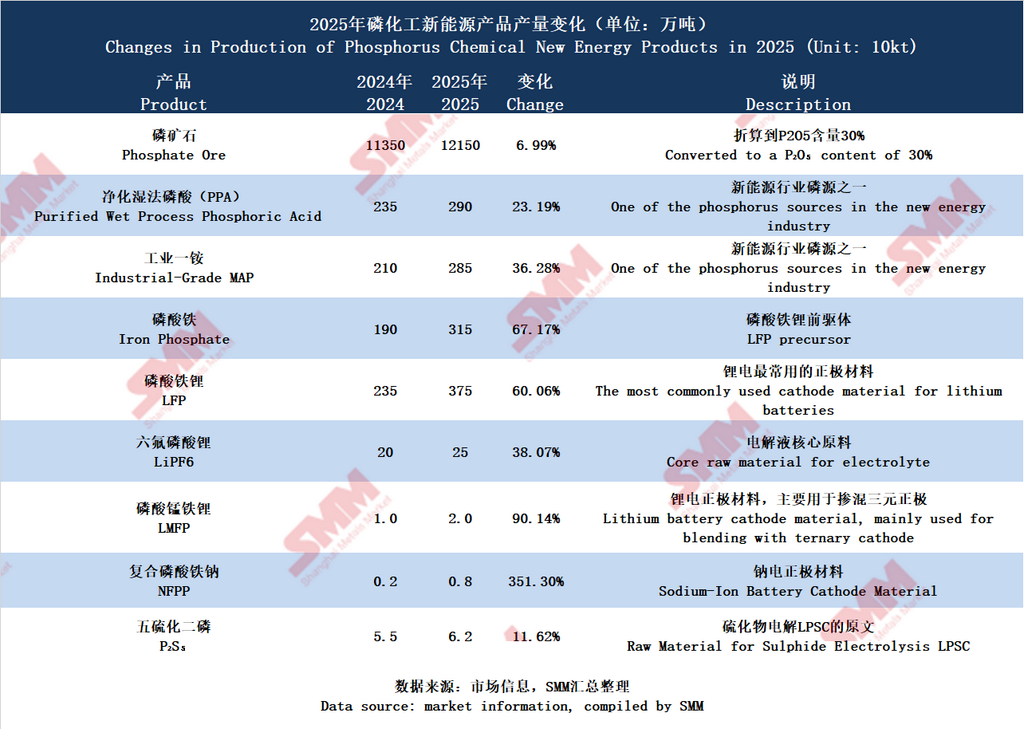
De 2024 a 2025, los productos químicos a base de fósforo estrechamente vinculados a la industria de nuevas energías mostraron en general un crecimiento rápido.
Entre ellos, el material catódico y su precursor fosfato de hierro (+67,17%) y el LFP (+60,06%) registraron los aumentos más significativos, reflejando directamente la fuerte demanda de materiales catódicos LFP por parte de los sectores de baterías de potencia y almacenamiento de energía. Las materias primas MAP de grado industrial y el ácido fosfórico purificado por vía húmeda crecieron un 36,28% y un 23,19% respectivamente. Como fuentes clave de fósforo para el LFP, su crecimiento estuvo en línea con el ritmo de expansión aguas abajo. El LiPF6 creció un 38,07%, en correspondencia con la expansión continua del mercado de electrolitos. Aunque el LMFP y el fosfato de hierro y sodio compuesto tenían bases relativamente pequeñas, sus tasas de crecimiento fueron extremadamente altas (superando el 90% y el 350% respectivamente), lo que indica que los materiales catódicos de nuevo tipo (ternarios mezclados, baterías de iones de sodio) están entrando en la fase de comercialización. En cuanto a las baterías de estado sólido, la producción de P₂S₅ se mantuvo estable en torno a 60.000 t durante los dos años, con un aumento de solo el 11,62%. Como materia prima clave para los electrolitos sólidos de sulfuro (p. ej., LPSC), la producción de P₂S₅ no experimentó un crecimiento explosivo, lo que sugiere que las baterías totalmente sólidas de sulfuro aún se encuentran en fase de I+D o escala piloto y todavía no han generado una demanda de industrialización a gran escala. Además, el crecimiento de las aplicaciones de P₂S₅ en industrias tradicionales fue limitado. En general, los productos químicos de fósforo están acelerando su transición hacia el sector de nuevas energías, mientras que el aumento de volumen a gran escala de los materiales de baterías de próxima generación aún llevará tiempo.
Nota: Si tiene alguna adición o corrección sobre los detalles mencionados en este artículo, no dude en contactarnos en cualquier momento. La información de contacto es la siguiente:
Tel: 021-20707860 (o agregue WeChat 13585549799) Yang Chaoxing, ¡gracias!
![[Batería de litio: CATL y Octopus Energy establecerán una empresa conjunta]](https://imgqn.smm.cn/usercenter/olwlF20251217171731.jpg)
![[Análisis SMM] Las exportaciones de LFP alcanzaron un nuevo máximo mensual en mayo](https://imgqn.smm.cn/usercenter/HySQT20251217171731.png)