[SMM Analysis] What is a full-tab battery cell? How is the progress of enterprises?

Publicado: Nov 29, 2024 17:20
Fuente: SMM
A full-tab battery cell (also known as a tabless design) refers to a design that ingeniously uses the entire tail of the current collector as the tab. Through the cover plate (current collector plate) structure design, the tab conduction area and the connection area at the connection point are increased, and the tab conduction distance is shortened. The internal resistance of a full-tab battery is reduced by approximately 70% compared to traditional batteries, the high-current discharge temperature is reduced by 35%, and the cycle life is improved by 100% compared to traditional batteries. It also supports continuous discharge at a maximum current of 100A, pulse discharge at 200A, and the extremely low internal resistance supports superfast charging performance at a 5C charge/discharge rate, achieving 80% SOC superfast charging in 10 minutes.

Tabs are metal conductors that lead the positive and negative electrodes out of the battery cell. Simply put, they are the "ears" of the battery's positive and negative poles, serving as contact points during charging and discharging. This contact point is not the copper piece we see on the battery's exterior but an internal connection within the battery. Tabs play a crucial role in the battery system, with primary functions including current transmission and heat conduction. The positive tab of a battery usually uses aluminum (Al) material, while the negative tab uses nickel (Ni) material. Some negative tabs use nickel-plated copper (Ni-Cu) material. These tabs are composed of two parts: a film and a metal strip.

Single-tab battery cell
A single-tab battery cell refers to a configuration with only one positive tab and one negative tab in the battery. Single-tab technology is relatively mature, with many years of process accumulation, and the cost is relatively low. Under the same volume, single-tab batteries have higher energy density, resulting in longer endurance.

Double-tab battery cell
A double-tab battery cell refers to a configuration with two positive tabs and one negative tab in the battery. This design can form two circuits on one battery cell, distributing the large power fast charging current and voltage. Due to the dual charging design, double-tab battery cells have higher charging efficiency and are suitable for large power fast charging.

Full-tab battery cell
A full-tab battery cell (also known as a tabless design) refers to a design that ingeniously uses the entire tail of the current collector as the tab. Through the cover plate (current collector plate) structure design, the tab conduction area and the connection area at the connection point are increased, and the tab conduction distance is shortened. The internal resistance of a full-tab battery is reduced by approximately 70% compared to traditional batteries, the high-current discharge temperature is reduced by 35%, and the cycle life is improved by 100% compared to traditional batteries. It also supports continuous discharge at a maximum current of 100A, pulse discharge at 200A, and the extremely low internal resistance supports superfast charging performance at a 5C charge/discharge rate, achieving 80% SOC superfast charging in 10 minutes. Additionally, full-tab battery cells exhibit superior low-temperature performance and better safety, making them suitable for various harsh application environments. They are particularly advantageous in high-rate application scenarios such as power tools, garden tools, and household cleaning, providing high-performance, stable, and reliable power supplies.

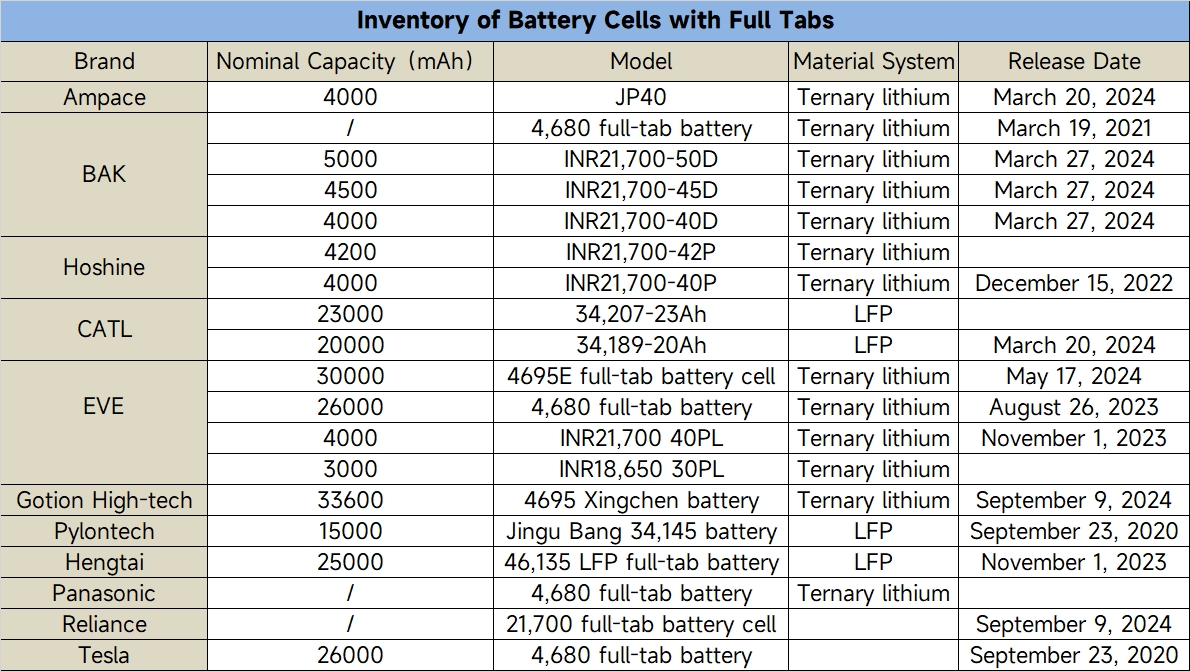
Currently, 11 companies have launched full-tab battery products, including Ampace, BAK, CATL, EVE, Hengtai, Reliance, Panasonic, and Tesla. In November 2024, Highstar also released its latest full-tab series battery cells at the Battery Experts Forum in Germany.


Declaración de Fuente de Datos: Excepto la información disponible públicamente, todos los demás datos son procesados por SMM basándose en información pública, comunicación de mercado y confiando en el modelo de base de datos interna de SMM. Son solo para referencia y no constituyen recomendaciones para la toma de decisiones.

Para cualquier consulta o para obtener más información, por favor contacte: lemonzhao@smm.cn
Para más información sobre cómo acceder a nuestros informes de investigación, contacte con:service.en@smm.cn
Noticias relacionadas
Los precios del magnesio suben por tercera sesión consecutiva: el lado de los costos sigue "ardiendo" mientras la demanda lucha por tomar el relevo [Comentario de SMM]
hace 1 hora
Los precios del magnesio suben por tercera sesión consecutiva: el lado de los costos sigue "ardiendo" mientras la demanda lucha por tomar el relevo [Comentario de SMM]
Leer más
Los precios del magnesio suben por tercera sesión consecutiva: el lado de los costos sigue "ardiendo" mientras la demanda lucha por tomar el relevo [Comentario de SMM]
hace 1 hora
Reseña diaria de SMM: Los precios spot del carbonato de litio bajaron levemente el 2 de septiembre
hace 15 horas
Reseña diaria de SMM: Los precios spot del carbonato de litio bajaron levemente el 2 de septiembre
Leer más
Reseña diaria de SMM: Los precios spot del carbonato de litio bajaron levemente el 2 de septiembre
Hoy, los precios spot de carbonato de litio de grado batería de SMM bajaron ligeramente en comparación con la jornada anterior. El contrato de carbonato de litio 2701 abrió a la baja en 157.000 yuanes/tm hoy y luego fluctuó a la baja tras la apertura. En la sesión matinal, operó débilmente en el rango de 156.000-157.000 yuanes, con un máximo intradía de 157.800 yuanes/tm. Cerca del mediodía, cayó rápidamente a 153.200 yuanes/tm, marcando un nuevo mínimo intradía. Alrededor del mediodía, los precios oscilaron repetidamente en el rango de 154.000-156.000 yuanes. Por la tarde, los alcistas impulsaron brevemente los precios al alza, pero no lograron superar la línea del precio medio. Los precios se debilitaron nuevamente al final de la sesión y finalmente cerraron con una caída del 3,2% en 154.800 yuanes/tm, con el interés abierto disminuyendo en 9.123 lotes. En el mercado spot, los compradores intermedios adquirieron en las caídas según sus necesidades. A 155.000 yuanes/tm e inferiores, la disposición de compra de pedidos spot intermedios continuó recuperándose. Por el lado de la oferta, a medida que los precios bajaban, la disposición a vender pedidos spot siguió siendo débil, y algunas plantas químicas de litio mantuvieron los precios firmes y retuvieron las ventas. En general, las consultas del mercado y las transacciones reales fueron relativamente activas.
hace 15 horas
Sulfuro de litio de grado batería: ¿habrá un repunte en el cuarto trimestre?
hace 16 horas
Sulfuro de litio de grado batería: ¿habrá un repunte en el cuarto trimestre?
Leer más
Sulfuro de litio de grado batería: ¿habrá un repunte en el cuarto trimestre?
Conclusión clave desde el principio: es poco probable que se produzca un repunte en el cuarto trimestre, pero sí esperamos un crecimiento moderado continuado. Es probable que la producción mensual se sitúe en el rango de 9 a 10 toneladas, un modesto avance respecto al tercer trimestre, no un salto explosivo.
hace 16 horas