PrNd oxide traced a full peak-to-retreat pattern in October: prices held firm after the holiday, eased from a mid-month high as additional supply materialised and demand failed to absorb it, and the decline ran into early November. After breaking below 700,000 yuan/t, prices quickly recovered the 710,000 yuan/t level today, but this move has not changed the supply-demand picture.
October was, in short, a rally that faded. Prices plateaued for several sessions after the holiday, edged to the month's high on a round of buying by leading players, then declined steadily, with losses widening in the final third of the month. The weakness carried into November: prices fell to 697,000-700,000 yuan/t before rebounding to 710,000-714,000 yuan/t today.
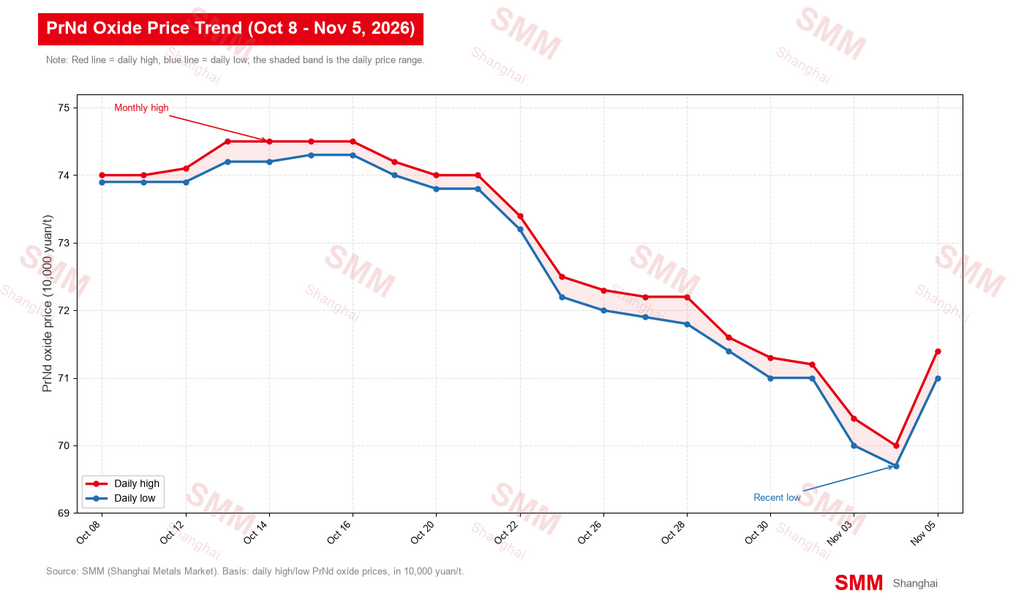
The slide was driven mainly by weaker cost support as supply expanded, compounded by reduced feedstock buying from metal smelters and a softer futures board. Crucially, lower offers never generated a pick-up in concluded business, leaving the decline without confirmation from the demand side.
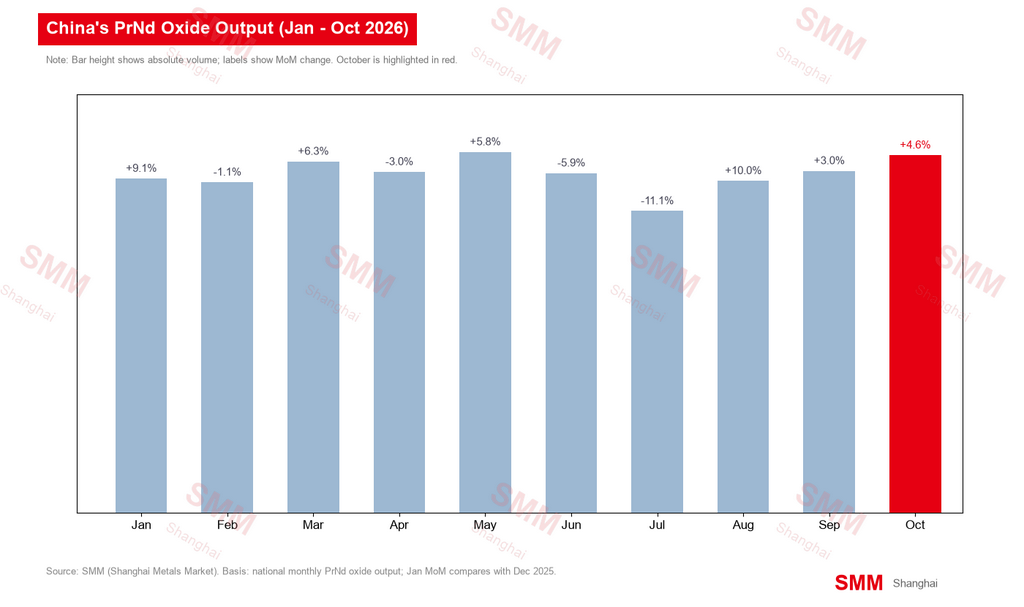
Looking ahead, the early-November rebound is attributed largely to news flow rather than to any improvement in fundamentals. Expectations of ample supply remain in place, buyers are resisting higher offers, and demand is still soft, so the November outlook for PrNd oxide stays decidedly weak. On the supply side, capacity at restarted separation plants has yet to be fully released, leaving room for further output growth, while the cost line continues to shift lower with feedstock prices. On the demand side, metal smelters are negotiating purchases order by order, replenishing only against current orders and showing no appetite for restocking; without a clear pick-up in orders, the rebound lacks real buying support. As the cost inversion narrows, the constraint that once kept smelters from selling cheap has weakened, and more flexible offers to move material could in turn weigh on the raw material. Holders had withdrawn offers in large numbers in early November and low-priced material became scarce, and this thinner offer side amplified the price response to the news. Even so, a move driven by sentiment and thin quoting, without concluded volumes to validate it, looks more like a temporary disruption than a trend reversal. Prices are therefore more likely to stay range-bound with a downward bias: further headlines could prompt another push higher, but once sentiment fades — particularly if supply from restarts outpaces demand — downside risks remain and a retest of the recent lows cannot be ruled out.