|
SMM Shanghai Metals Market |
AFRICA CHROMIUM MARKET |
Chrome Ore Export Market | September 2026 Trade Data
A Second Monthly Decline Takes Exports to a Six-Month Low
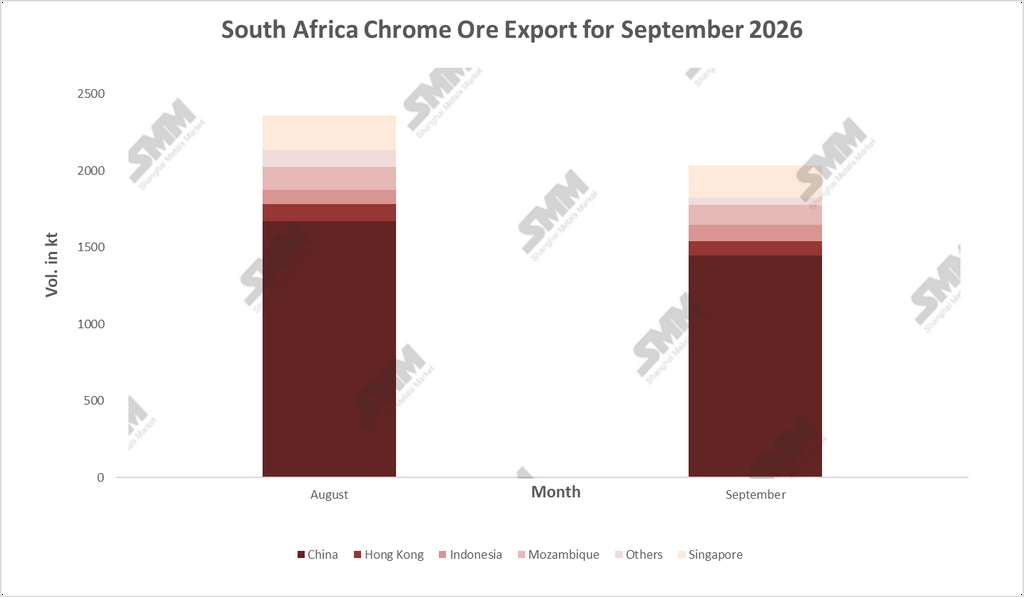
South Africa's chrome ore exports fell to 2.04 million tonnes (2,035.0 kt) in September 2026, down 13.77% month-on-month from August's 2,360.1 kt, a drop of 325.1 kt. It is the second consecutive decline and a deeper one than August's 10.75%. Together the two months have removed 613.5 kt, or 23.2%, from July's 2,648.5 kt. September is the weakest month of the April–September series, about 15% below the six-month average of roughly 2.39 million tonnes. Third-quarter exports of about 7.04 million tonnes finished 3.5% below the second quarter's 7.30 million tonnes. August's dip therefore did not mark the trough.
China's Retreat Drives the Decline
China took 1,446.1 kt, down 13.52% (226.2 kt) from August and accounting for about 70% of the total fall. Its share edged up from 70.85% to 71.06%, the highest of the June–September period, because exports to all other destinations fell at almost the same rate, 14.38%, from 687.9 kt to 589.0 kt. In August the contraction was concentrated outside China. In September Chinese buying itself retreated. SMM's analysis of China Customs data points the same way: South Africa supplied about 1.74 million tonnes of China's roughly 2.28 million tonnes of September ore imports, a 76.4% share, down from 80.1% in August as Turkey and other origins gained ground.
Indonesia Recovers While Trading Hubs Retreat
Indonesia was the only destination to grow, rising 22.58% to 110.3 kt and lifting its share from 3.8% to 5.4%. That recovers part of August's fall but leaves volumes below July's 150.0 kt and well above June's 77.8 kt, consistent with lumpy buying from Indonesia's expanding ferrochrome and stainless capacity. Singapore fell 6.90% to 209.0 kt, yet its share rose from 9.5% to 10.3% and it remains the largest destination outside China. Mozambique eased 13.82% to 128.3 kt and Hong Kong fell 17.18% to 93.1 kt. The “Others” grouping, which includes the UAE, fell 56.98% to 48.2 kt. That drop of 63.9 kt accounts for about 20% of the total decline and is consistent with smaller-market and trading-hub buying thinning as Chinese demand softened.
Chinese Demand, Not South African Supply, Set the Pace
SMM's reports show Chinese buyers staying cautious in September because both ore and ferrochrome were ample. Port stocks ended the month at 4.882 Mt, only about 2.9% below the 5.028 Mt recorded on August 28, and smelters made only small restocking purchases while some traders offered concessions. China's HC FeCr output fell 3.17% month-on-month, with capacity utilization at about 56%, and Tsingshan, TIS and other major mills cut October tender prices by RMB 200/50 mtu. Record Chinese port inventories, which the International Chromium Development Association has noted strengthen buyers' negotiating position, and Merafe's August warning of a ferrochrome glut from rising Chinese output and weak stainless demand explain why shipments adjusted. South African 40–42% fines at Tianjin (in-warehouse, including 13% VAT) were quoted at 52.5–53 yuan/mtu on September 24, from 58.5–59.5 yuan/mtu in late April, while CIF offers eased from $318/t to $275/t. Supply was not the constraint: Glencore's attributable chrome ore output was 906,000 mt and Valterra's chrome concentrate output 277,000 mt in the third quarter. The restarts of Boshoek in September and Wonderkop in October will draw only a small share of ore into domestic smelting.
|
Outlook: September confirms that July's peak has passed. SMM's tracking shows loadings firming, with global departures at 624,900–660,600 mt a week for the three weeks to October 2 and 849,100 mt in the week ended October 9. Restocking appetite remains limited, however: port stocks stood at 4.9712 Mt on October 16 and 5.182 Mt on October 23, and ore prices face further downside risk. Fourth-quarter exports are therefore more likely to be set by how quickly Chinese stocks clear than by South African supply, with China's share likely to stay above two-thirds and Indonesia and the trading hubs continuing to swing month to month. The proposed ITAC export-permit system and export tax remained unimplemented as of October 13, so regulation is not shaping volumes. |