SMM, October 13:
In the metals market:
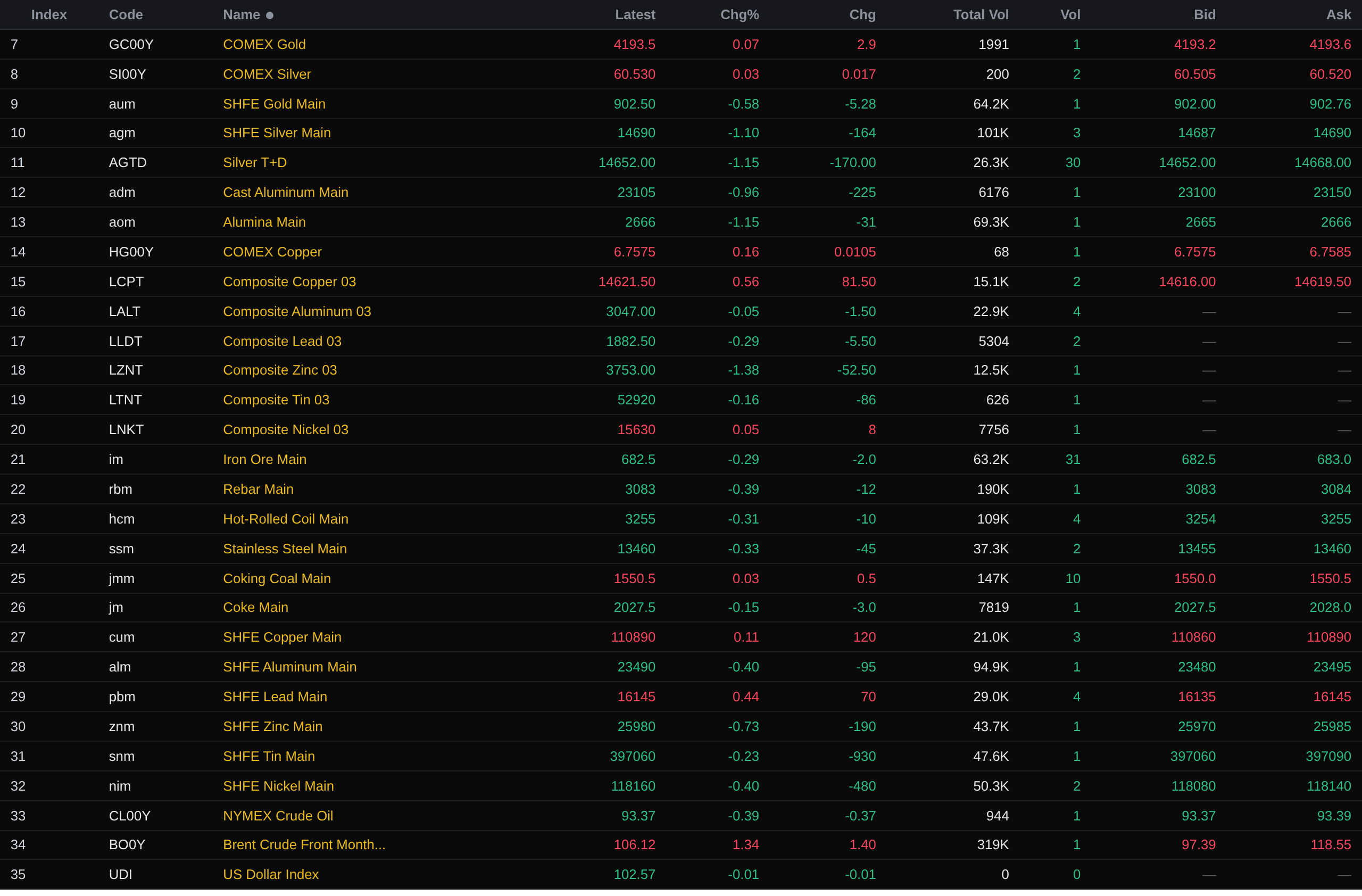
Overnight, base metals on the domestic market mostly weakened. SHFE copper rose 0.11%, SHFE aluminum fell 0.4%, and SHFE lead rose 0.44%. SHFE zinc fell 0.73%, and SHFE tin fell 0.23%. SHFE nickel fell 0.4%. In addition, the most-traded alumina futures contract fell 1.15%, and the most-traded cast aluminum contract fell 0.96%.
Overnight, ferrous metals mostly fell. Stainless steel fell 0.33%. Iron ore fell 0.29%, and rebar fell 0.39%. Hot-rolled coil fell 0.31%. For coking coal and coke: the most-traded coking coal contract edged up, while the most-traded coke contract fell 0.15%.
Overnight on the overseas market, LME base metals mostly fell. LME copper rose 0.56%, and LME aluminum edged down. LME lead fell 0.29%. LME zinc fell 1.38%. LME tin fell 0.16%. LME nickel edged up 0.05%.
Overnight in precious metals: COMEX gold fell 0.48% to $4,195.9/oz; COMEX silver fell 0.78%. Overnight, the most-traded SHFE gold contract fell 0.58%, and the most-traded SHFE silver contract fell 1.1%.
As of 7:12 on October 13, overnight closing prices:
Macro front
Domestic:
[Ministry of Finance: Starting April 1 next year, the VAT export rebate rate for NEVs will be reduced from 13% to 9%] On October 13, the Ministry of Finance issued the Announcement on Adjusting Export Tax Rebate Policies for Certain Products, which mentioned that starting April 1, 2027, the VAT export rebate rate for NEVs will be reduced from 13% to 9%. Starting April 1, 2027, VAT export rebates for products such as e-cigarette devices and apparatus will be canceled. For the above products that are subject to consumption tax, the export consumption tax policy will remain unchanged, and the consumption tax refund (exemption) policy will continue to apply. (Ministry of Finance)
[CAAM: Looking ahead to Q4, the industry is expected to maintain stable operations] According to analysis by the China Association of Automobile Manufacturers, in the first three quarters, China's automobile production and sales edged down, with the market overall showing a pattern of "cold at home, hot abroad." Due to multiple factors, the domestic auto market remained under pressure and has yet to see effective improvement; despite a complex and challenging external environment, exports continued to grow rapidly, demonstrating strong resilience; new domestic momentum continued to be released, and the share of NEV sales rose steadily. Looking ahead to Q4, the industry is expected to maintain stable operations. Exports are expected to continue growing, with full-year volume likely to exceed 10 million units; the 250 billion yuan in trade-in funds for consumer goods has been fully allocated, and existing policies will further enhance implementation effectiveness. Combined with promotional activities by local governments and enterprises, the decline in domestic market sales is expected to narrow. (CAAM)
US dollar:
The US dollar index rose 0.34% overnight to 102.58. Cleveland Fed President Hammack said the US Fed needs to bring monetary policy to a restrictive level to push inflation back down to the 2% target. She said the current policy stance means inflation could take longer than acceptable to pull back, so "more tightening is needed." Hammack said further rate hikes may still be needed, but the timing is not yet set, and she favors a "smaller, more frequent" adjustment approach to help enterprises and households plan ahead. Hammack said input costs for enterprises are rising, and more enterprises are beginning to pass costs on to consumers. If prices are no longer constrained by demand, inflation could rise further or stay high. She noted the biggest inflation risk is that individuals and enterprises develop an "inflation mindset" and gradually accept higher inflation levels, which would make it harder for the US Fed to bring inflation back to target, and some signs of this have already emerged. On rising US Treasury yields, Hammack said they are mainly driven by growth expectations, market repricing of US Fed policy, fiscal pressures, and heavy bond issuance. She said the data center investment boom is driving growth, but financial conditions still need to tighten further to help bring inflation down. Hammack also stressed that US Fed independence "is always critical."
According to CME "FedWatch": the probability of the US Fed keeping rates unchanged through October is 79.5%, and the probability of a cumulative 25 bp hike is 20.5%. The probability of the US Fed keeping rates unchanged through December is 12.4%, the probability of a cumulative 25 bp hike is 70.3%, and the probability of a cumulative 50 bp hike is 17.3%. (Jin10 Data APP)
Data:
Today will see the release of Germany's final September CPI m/m, the US September NFIB Small Business Optimism Index, the US ADP employment change for the week ended September 26, and US September existing home sales annualized.
Also watch for: 2026 FOMC voter and Cleveland Fed President Hammack speaking; the Reserve Bank of Australia releasing the minutes of its September monetary policy meeting; the IMF releasing its October 2026 World Economic Outlook report; Fed Governor Waller speaking at the Bloomberg New Economy Forum in India; and Apple holding a smart home product launch event in New York.
Crude oil:
Both oil futures rose overnight, with WTI up 1.43% and Brent up 1.34%.
Crude oil rose, driven mainly by a series of Middle East tensions over the weekend. Oil price gains fell short of some market participants' expectations. Analysts believe the market to some extent viewed the Riyadh airport attack as part of the "routine conflict" between Saudi Arabia and Yemen, rather than a signal of further escalation in the Iran situation. During this period, Trump announced that sanctions on Russian diesel exports would be eased and declared an "immediate energy ceasefire" between Russia and Ukraine—covering a halt to attacks on refining facilities by both sides and potentially extending to the power grid and power plants. However, the actual implementation of the ceasefire agreement remains in doubt. Ukrainian President Zelensky said he knew nothing about the announcement, and Russia on Monday also refused to confirm the existence of any agreement. (Wall Street CN)
Saudi Energy Minister Abdulaziz said Saudi Arabia is studying plans to expand the daily pipeline capacity for oil exports beyond the Persian Gulf to 10 million barrels within the next two to three years. Facing continued Houthi attacks on energy and aviation infrastructure, Saudi Arabia is seeking to enhance the resilience of its energy supply. Abdulaziz said the relevant plans include upgrading pumping stations on the East-West Pipeline and converting a natural gas pipeline for crude oil transportation. Since the outbreak of the US-Iran war, the East-West Pipeline has become a critical channel for Saudi oil exports. Speaking at the World Petroleum Congress in Riyadh on Monday, he said: "Within the next two to three years, our transport capacity could reach 10 million barrels per day. We are currently upgrading the pumping stations on the East-West Pipeline." Abdulaziz said the converted natural gas pipeline could deliver about 1.2 million barrels of crude oil per day within seven to eight weeks, and with further investment, capacity is expected to rise to 3 million barrels per day. (Jin10 Data APP)
Neil Atkinson, former head of the oil markets division at the International Energy Agency (IEA), said it remains a mystery where the diesel required under the Russian diesel supply agreement announced by Trump would come from. If it can only come from Russia's domestic supply, this would deal a heavy blow to the Russian economy. Atkinson noted that the Group of Seven (G7) recently approved the release of 50 million barrels of diesel reserves, but because the scale, timing, and location of the release are all unclear, the move "has done little to ease the existing tight supply in the diesel market." The new agreement reached between the US and Russia will face the same situation. Even if the first 300,000 mt of diesel (equivalent to a daily average of about 70,000 barrels over a month) could arrive tomorrow, the impact would be negligible. The reason the impact is limited is that the US consumes 3.7 million barrels of diesel per day, while the world consumes 29 million barrels per day. (Jin10 Data APP)
![The most-traded SHFE tin SN2611 contract closed at 396,810 yuan/mt in the daytime session, up 1.44%, while LME tin edged up $200 to $53,209/mt [SMM Tin Morning Meeting Summary]](https://imgqn.smm.cn/usercenter/sRGMJ20251217171752.jpg)
![LME zinc ingot inventory grows notably, bulls reduce positions [SMM Zinc Morning Meeting Summary]](https://imgqn.smm.cn/usercenter/oTrxc20251217171755.jpg)
![Spot premiums firm & downstream trading mediocre, lead prices move sideways [SMM Lead Morning Meeting Minutes]](https://imgqn.smm.cn/usercenter/EhsCj20251217171721.jpeg)