Indian HRC prices firmed through September as stronger domestic realizations reduced mills’ incentive to discount export business. Europe offered the highest visible overseas prices, but restricted quota access continued to limit fresh orders. Asian buying interest provided less support, while billet surrendered its early-month gains. The resulting market favoured selective HRC sales rather than a broad expansion in Indian steel exports.
SMM’s latest price references stood at 730USD/tonne CFR Europe and 660USD/tonne FOB India for Europe-linked HRC exports. HRC into Vietnam was assessed at 567.5USD/tonne CFR, while billet stood at 467.5USD/tonne FOB India. Europe’s premium remained the main attraction for HRC sellers, although higher offers still needed buyer acceptance and a viable clearance window.
SMM’s September 4 weekly review recorded European HRC offers around 580USD/tonne FOB India, equivalent to 660–680USD/tonne CFR. By September 9, CFR discussions had advanced to 695–700USD/tonne, alongside an offer at 715USD/tonne. Offers reached 715–730USD/tonne CFR late on September 16, although sales at those levels had yet to be confirmed. The steady rise in asking prices reflected a firmer selling stance as the month progressed.
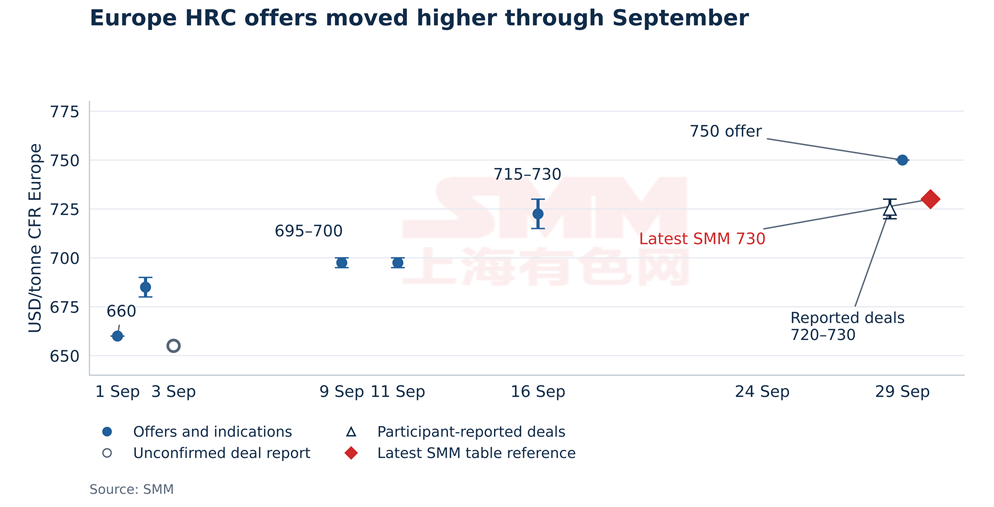
Late-month feedback placed earlier participant-reported European deals at 720–730USD/tonne CFR, broadly in line with SMM’s latest 730USD/tonne reference. By September 29, offers had reached as high as 750USD/tonne CFR. Securing fresh business at that higher level would establish whether buyers were prepared to follow the next increase.
Quota access gives Europe’s price premium a practical limit. According to the European Commission, the steel regime in force since July 1 provides around 18.3Mt of annual tariff-free access and imposes a 50% duty on imports outside quota. Commission Implementing Regulation (EU) 2026/1457 allocates India 149,318.61tonnes for Category 1.A hot-rolled flat products under order 09.9803 in October–December 2026, before applicable carry-over. A single eligible 40,000tonne parcel would absorb 26.8% of that base allocation, making the timing of large cargoes commercially significant.
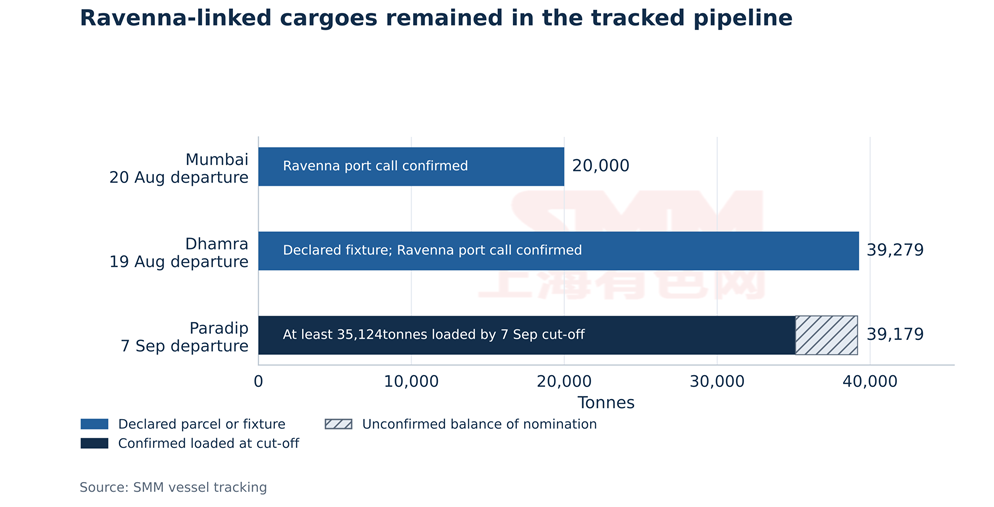
SMM vessel tracking on September 29 showed three Ravenna-linked coil and plate cargo programmes with combined declared or nominated quantities of approximately 98,458tonnes: 20,000tonnes from Mumbai, 39,279tonnes from Dhamra and 39,179tonnes from Paradip. The two August departures had confirmed Ravenna port calls. The Paradip cargo departed on September 7 with Ravenna declared as its destination and had loaded at least 35,124tonnes by the port report’s cut-off.
The Ravenna pipeline gives the October clearance window immediate commercial importance. Cargo classification and customs-entry timing will determine which shipments compete for each product quota. For mills and buyers, the value of Europe’s higher prices therefore rests partly on how quickly existing cargo can move through discharge and customs.
Missing quota can sharply alter the economics of a shipment. A cargo assessed at a customs value of 730USD/tonne would face 365USD/tonne in additional duty if it cleared outside quota. Storage and financing costs also build while steel waits in bond, making the clearance window and allocation of these costs central to negotiations.
From October 1, the EU also requires importers to declare where steel was melted and poured, supported by evidence identifying the country and heat number. The European Commission’s August 31 notice specifies a Mill Test Certificate and allows listed alternative documents during the initial period. Documentation readiness will consequently matter alongside vessel arrival in securing timely customs entry.
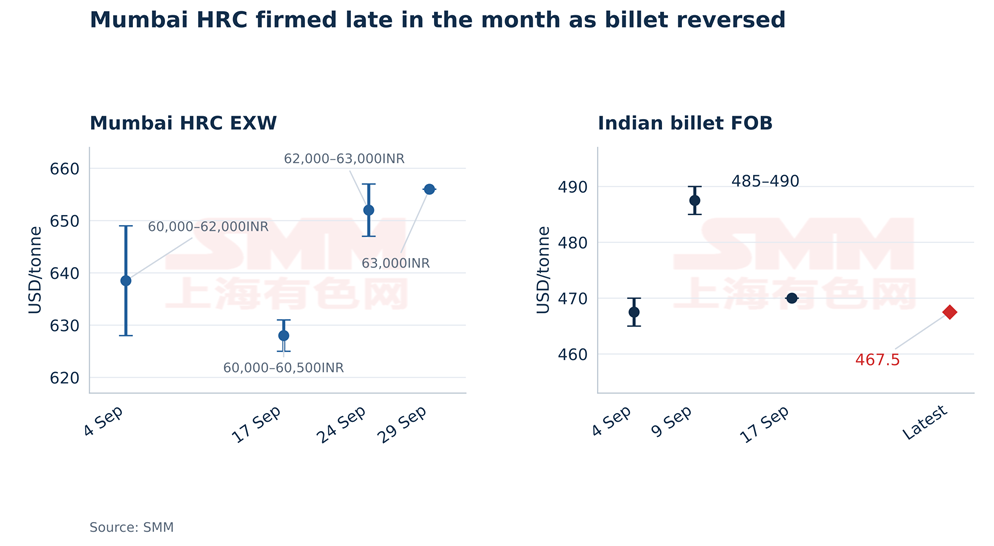
Domestic firmness strengthened mills’ alternative to export sales. SMM’s early-September Mumbai checks put HRC at 628–649USD/tonne (60,000–62,000INR/tonne) EXW. Mill indications were 625–631USD/tonne (60,000–60,500INR/tonne) EXW on September 17, before rising to 647–657USD/tonne (62,000–63,000INR/tonne) by September 24. Ex-yard Mumbai material moved from around 667USD/tonne (64,000INR/tonne) to 699USD/tonne (67,000INR/tonne) over the same period. Late-month participants regarded around 656USD/tonne (63,000INR/tonne) EXW Mumbai as realistic, excluding GST.
At around 656USD/tonne EXW Mumbai, domestic HRC is close to the 660USD/tonne FOB India reference for Europe-linked exports. The resulting 4USD/tonne spread leaves little room to absorb inland freight, port charges and financing, strengthening the appeal of domestic sales. Higher European CFR prices will translate into better export returns only where freight and clearance costs preserve an attractive realization at the mill. Any further domestic increase would tighten this comparison and reduce mills’ incentive to discount overseas.
Vietnam offered weaker support for Indian HRC sellers. SMM recorded 530USD/tonne CFR on September 4 and heard Indian offers at 550USD/tonne CFR on September 15, against Vietnamese domestic offers of 540–545USD/tonne CIF. Although SMM’s latest Vietnam reference rose to 567.5USD/tonne CFR, late-month feedback still described limited buying interest and an absence of firm Indian mill offers. That combination left Asia with less influence on mills’ selling decisions than the domestic market and Europe.
Billet also showed the limits of overseas demand. Export indications climbed from 465–470USD/tonne FOB India on September 4 to 485–490USD/tonne on September 9, then returned to around 470USD/tonne by September 17. SMM’s latest 467.5USD/tonne reference was 20USD/tonne below the midpoint of the early-month peak. Billet’s retreat, alongside the rise in European HRC offers, shows that September’s price strength depended on the product and destination.
National demand data provide a stronger foundation for domestic mill selectivity. Ministry of Steel and JPC figures released through PIB on September 3 showed finished-steel consumption of 70.3Mt in April–August 2026, up 7.0% year on year, while finished-steel production rose 3.8% to 68.1Mt. Crude-steel output increased 1.8% to 70.3Mt. Finished-steel imports totalled 3.4873Mt against exports of 2.9860Mt, leaving net imports of 501,300tonnes. In August alone, imports of 721,100tonnes exceeded exports of 693,700tonnes.
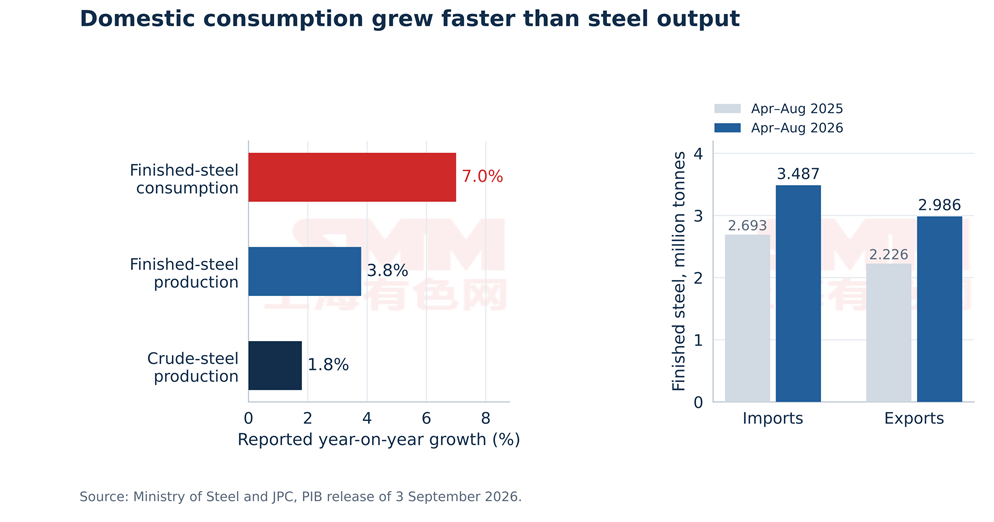
Consumption growth outpacing production supports mills’ preference for protecting domestic realizations. At the same time, the net import position shows that foreign steel continues to meet part of India’s demand. Domestic price increases will therefore need sustained buying support as well as discipline from local suppliers.
September closes with Indian HRC sellers holding firmer prices and a stronger domestic alternative, while Europe remains the most attractive visible export outlet. Fresh transactions at 750USD/tonne CFR would confirm the next step in European pricing. The benefit to mills will depend on freight, carrying costs and the ability to secure duty-free clearance for the cargo.
Domestic market participants were expecting a further increase of around 10USD/tonne (1,000INR/tonne) in the next review, with one contact anticipating a similar rise in November. If domestic prices move higher while the Europe-linked FOB reference stays at 660USD/tonne, export sales would face an even tighter cost allowance. Stronger buying in Vietnam or renewed billet transactions would be needed to broaden overseas support.
The European Commission’s consultation on the functioning of the steel regime, opened on September 28 and closing on October 11, will keep market access in focus. For October trading, the more immediate drivers are quota drawings, the clearance of existing cargo under the new documentation requirements and fresh European deals above the reported 720–730USD/tonne range. Until those develop, domestic strength is likely to keep Indian mills selective on export pricing.
![[SMM Analysis] UK Recognition of India's CCTS Opens a 2027 Relief Route but HRC Quota Remains the Binding Constraint](https://imgqn.smm.cn/usercenter/ENDOs20251217171718.jpg)