The UK's recognition of India's Carbon Credit Trading Scheme (CCTS) creates a route through which eligible carbon costs paid in India may reduce UK Carbon Border Adjustment Mechanism (CBAM) exposure from 2027. It does not exempt Indian steel from UK CBAM, establish a fixed carbon discount, or guarantee a higher Indian export price.
For near-term Indian hot-rolled coil (HRC) trade, the tighter constraint remains customs access. India's standard UK Category 1 quota was already 91.97% utilised on September 25, while the transitional contract exemption ends on September 30. The larger authorised-use route offers more potential volume, but it is a global pool subject to a 40% country cap and specific downstream-processing conditions; it is not a reserved Indian quota.
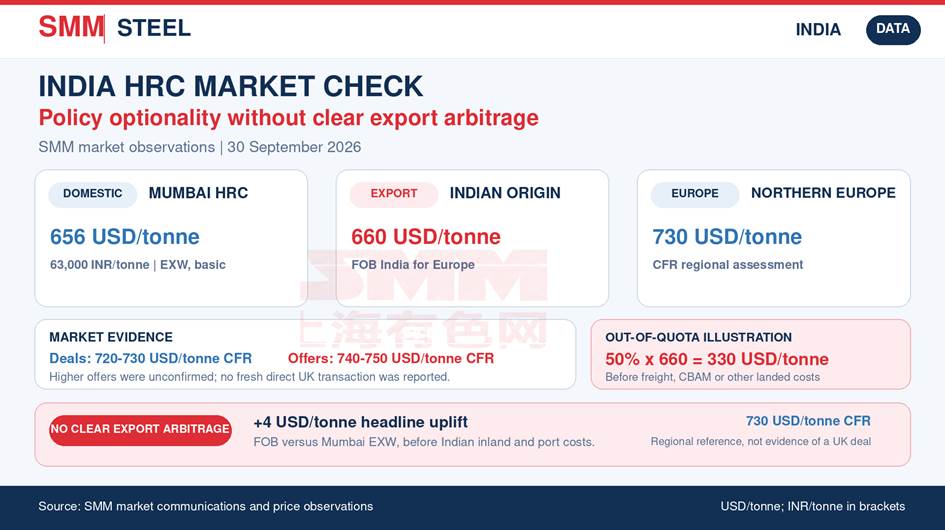
At current prices, the commercial signal is equally restrained. SMM's latest India-origin indication for Europe was 660USD/tonne FOB India, while Mumbai HRC was assessed at about 656USD/tonne (63,000INR/tonne) EXW, basic. A headline FOB premium of only 4USD/tonne does not cover inland movement, port handling, finance and other export costs. CCTS recognition therefore adds future policy optionality, but it does not presently create a clear export arbitrage capable of lifting domestic HRC prices.
Recognition Creates a Deduction Route Rather Than an Exemption
HMRC added India's CCTS to its list of qualifying carbon-pricing schemes on August 27. The practical benefit is carbon-price relief: an eligible UK importer may deduct a verified carbon price effectively borne in the country of production from its UK CBAM liability.
The wording is important. HMRC states that free allocations, refunds, rebates and other compensation can reduce the effective foreign carbon price, potentially to zero. The liable UK importer must substantiate the claim using the prescribed independent-verification process. Recognition of the scheme alone is therefore insufficient.
UK CBAM begins on January 1, 2027 and includes iron and steel. No country is currently exempt. UK CBAM rates are due to be published quarterly from 2027, and the carbon-price relief cannot exceed the related UK CBAM liability. A UK buyer cannot calculate a firm relief value for Indian HRC today without four missing inputs:
- the relevant Indian installation and its CCTS obligation for the production period;
- the net carbon cost actually borne after credits, allocations, rebates or compensation;
- independently verified product emissions under UK-compatible boundaries; and
- the applicable quarterly UK CBAM rate for iron and steel.
Accordingly, CCTS recognition should not yet be translated into a universal USD/tonne premium for Indian mills or an automatic discount for UK buyers.
India's Steel CCTS Framework Has Advanced but Costs Remain Installation Specific
Latest updates to the Bureau of Energy Efficiency's Greenhouse Gases Emission Intensity Target Rules, 2025, including the sector-specific amendment for iron and steel, confirm that India's CCTS framework has moved beyond the draft-notification stage. The rules assign greenhouse-gas emission-intensity targets to obligated steel installations. Facilities outperforming their targets may receive carbon credit certificates, while those falling short must acquire and surrender certificates to meet their compliance obligations.
The framework will not create a uniform carbon charge across Indian steel production. Each installation's compliance cost will depend on its assigned target, verified emissions performance, certificate position and the prevailing certificate price. The Central Electricity Regulatory Commission's trading regulations provide for exchange-based price discovery within regulatory price bands rather than a fixed universal price.
The resulting carbon position will be specific to each plant and compliance period. Two Indian mills producing similar HRC may therefore face different effective costs. India's CCTS cannot yet be translated into a single carbon cost, or a standard UK CBAM relief value, per tonne of Indian steel.
UK Category 1 Access Remains the Immediate Commercial Gate
The UK's replacement steel measure took effect on July 1, 2026. For India-origin Category 1 steel, including the relevant HRC products, the standard country quota is 33,456 tonnes/year, split into four quarterly tranches of 8,364 tonnes. Imports outside an applicable quota face a 50% additional duty.
|
UK route |
Applicable limit |
Position and commercial meaning |
|
Standard India Category 1 quota |
33,456 tonnes/year; 8,364 tonnes/quarter |
On September 25, HMRC showed 7,692.63 tonnes allocated and 671.37 tonnes remaining: 91.97% utilised. |
|
Authorised-use Category 1 route, October-December |
595,950 tonnes global pool; India capped at 238,380 tonnes |
First-come, first-served global access. The Indian cap is a ceiling, not a reservation. Goods must enter the specified customs procedure and be transformed into qualifying downstream products. |
|
Outside an available route |
No quota protection |
The additional duty is 50%; carbon-price relief under CBAM does not offset this separate trade-remedy duty. |
Unused standard quota can roll only into the immediately following quarter. The September 25 residual should not be treated as confirmed October carry-over because claims accepted through the September 30 quarter-end can still reduce it. HMRC's daily dataset also warns that published balances may lag claims under processing.
The temporary exemption for qualifying contracts concluded before March 14, 2026 applies only through September 30. From October 1, quota allocation or compliant use of the authorised-use route becomes more important for any new clearance.
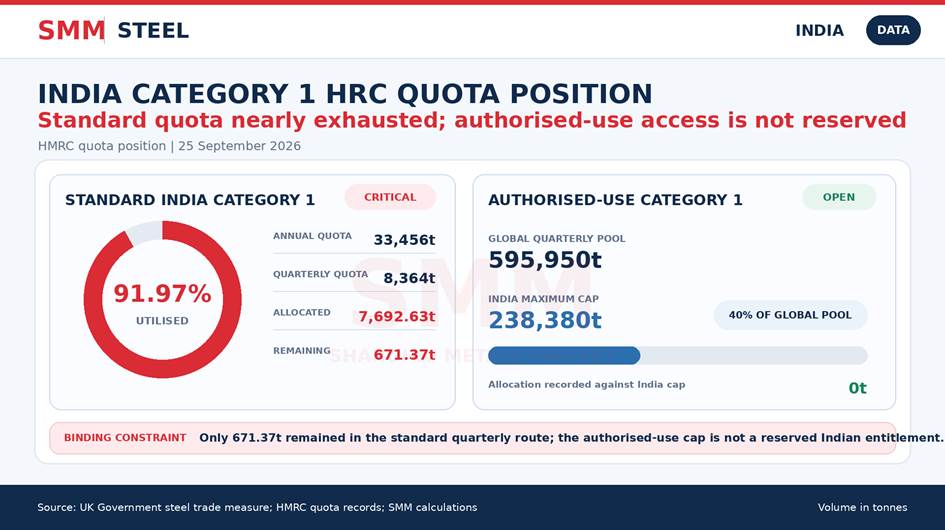
Figure 1. India Category 1 HRC quota position as of September 25, 2026. Source: HMRC; SMM calculation.
The Forty Percent Authorised Use Limit Is Not Reserved for India
An official Indian CETA backgrounder described India as having an "exclusive 40%" share of the authorised-use quota and derived potential access of about 945,000 tonnes/year. The UK implementing notice-the operational legal framework for customs clearance-defines a single global authorised-use pool with a 40% cap for goods originating in any one country.
The four quarterly global pools total 2,364,361 tonnes. Forty per cent is 945,744 tonnes, which is the approximate annual maximum India could theoretically use if Indian entries reached the cap in every quarter. It is not volume ring-fenced for India. Actual access depends on global first-come, first-served utilisation, the country cap, product eligibility, customs procedure and downstream transformation. Treating the theoretical ceiling as guaranteed market access would overstate export potential.
Customs Entries Confirm Trade Without Establishing a New Spot Export Wave
SMM's filtering of HMRC declared imports by Indian country of origin produced the following January-July 2026 volumes:
These are nested product scopes and must not be added together. The exact Category 1 HRC total is the relevant narrow measure, while the much larger semi-finished volume explains most of the broad HS72 flow.
The January-July period also spans different policy regimes: the former safeguard, the new measure from July 1, and July's transitional-contract window. The 26,351.740 tonnes customs total therefore cannot be compared directly with the new 8,364 tonnes quarterly standard quota as if all cargo entered under that route.
Most importantly, customs entries establish declared origin, commodity code, weight and clearance timing. They do not, by themselves, identify the end buyer, seller, contractual tenor, direct or trans-shipped routing, downstream use, or whether a shipment represented fresh spot business. The data support evidence of established India-UK steel trade, but not a claim that a new UK spot buying wave has begun.
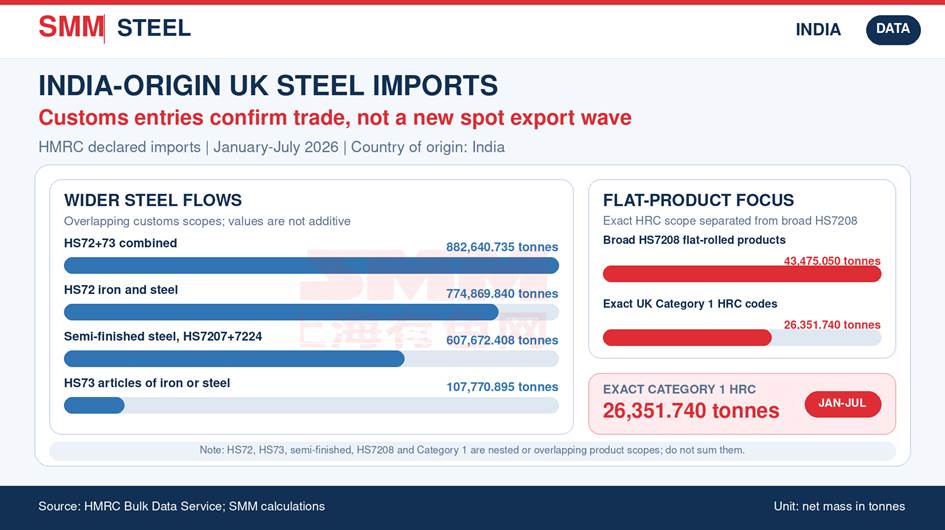
Figure 2. India-origin UK steel customs entries during January-July 2026. Product scopes overlap and must not be added. Source: HMRC; SMM calculation.
India Domestic Balance Does Not Support a Large Export Led Price Response
Official Indian data for April-July 2026 show finished-steel production of 54.7 million tonnes against consumption of 56.0 million tonnes. Imports were 2.7662 million tonnes and exports were 2.2923 million tonnes, leaving India a net finished-steel importer by 473,900 tonnes.
The HRC and strip balance points in the same direction. Imports reached 1.0152 million tonnes, compared with exports of 841,500 tonnes, leaving a net import position of 173,700 tonnes.
This does not prevent individual export bookings, particularly where mills need rolling continuity or product-specific demand is weak. It does, however, argue against treating UK CCTS recognition as the trigger for a broad diversion of Indian HRC away from the domestic market. A sustained export-led domestic price response would require export netbacks to improve materially and quota-compliant UK or European buying to be demonstrated through repeat transactions.
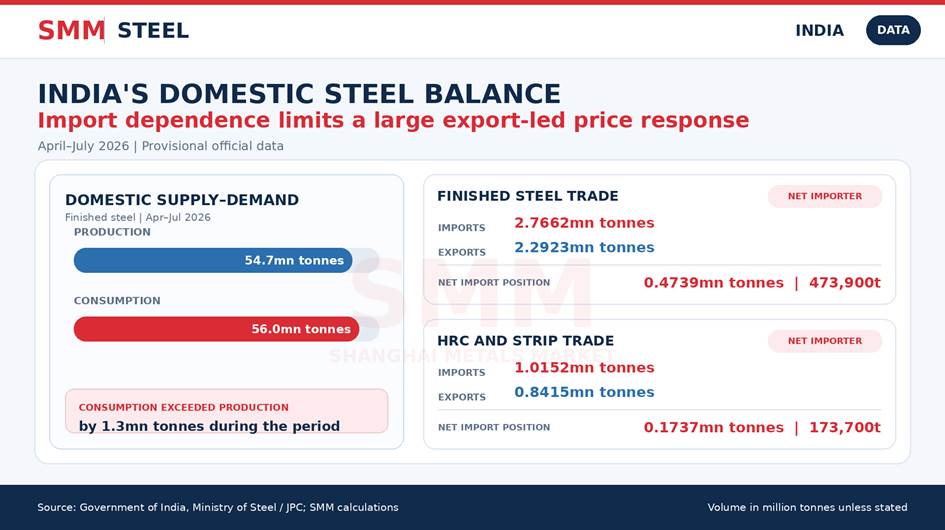
Figure 3. India's finished-steel and HRC balance during April-July 2026. Source: Government of India; SMM calculation.
Current Prices Show Policy Optionality Without Export Arbitrage
SMM's September 30 market work placed India-origin HRC for Europe at 660USD/tonne FOB India. Northern European HRC was assessed at 730USD/tonne CFR, with market communication indicating concluded levels around 720-730USD/tonne CFR. Offers at 740-750USD/tonne CFR had not been confirmed as fresh business. No new direct UK transaction was confirmed.
The Northern European CFR level is a regional reference, not proof of a UK deal or a UK-specific netback. Freight, port cost, finance, quota route, duty exposure, delivery terms and carbon documentation must be normalised before it can be compared with an Indian EXW price.
Against Mumbai HRC at about 656USD/tonne (63,000INR/tonne) EXW, basic, the 660USD/tonne FOB indication offers only a 4USD/tonne headline uplift before Indian inland and port costs. On that basis, there is no clear export arbitrage.
The quota penalty also remains commercially dominant. As a simplified illustration only, a 50% out-of-quota duty on a 660USD/tonne customs value would equal 330USD/tonne, before freight, CBAM or other landed costs. The exact customs base must be determined for each entry, but the scale shows why an uncertain future carbon-price deduction cannot compensate for unavailable quota access.
Market Repercussions
For Indian mills, CCTS recognition improves strategic positioning for 2027 because documentation-ready producers may be able to demonstrate a qualifying domestic carbon cost and reduce the UK importer's CBAM burden. That advantage will depend on plant-level performance and verification, not on Indian origin alone.
For UK buyers, the recognition reduces the risk of paying twice for the same verified emissions cost, but it does not remove the need to secure quota access. Any value created by carbon-price relief will also have to be negotiated commercially; HMRC recognition does not determine whether it is retained by the importer, shared with the seller or reflected in the transaction price.
For the Indian domestic market, the immediate effect is neutral. Current FOB indications do not produce a clear export netback over Mumbai EXW, India remains a net importer of both finished steel and HRC/strip in the official April-July balance, and no fresh UK spot transaction has been established.
The next decisive indicators are:
- HMRC's final September 30 standard-quota balance and any confirmed carry-over;
- October-December uptake of both the standard and authorised-use routes;
- the first verified UK-specific HRC transaction under the new access rules;
- the first published 2027 UK CBAM rate for iron and steel; and
- installation-level CCTS obligations, certificate prices and independently verified emissions data.
![[SMM Analysis] Indian HRC Firms in September as EU Access Restricts Export Options](https://imgqn.smm.cn/usercenter/ikbxI20251217171718.jpg)