Tantalum Ore Prices Climb as Supply Tightens and Downstream Demand Grows

Published: Sep 24, 2026 17:37 (GMT+8)
The price of tantalum ore has been on an upward trend recently. According to market feedback, affected by the convening of industry conferences, upstream miners have a strong reluctance to sell, and actively hold back tantalum ore to reduce external supply. The tightening of supply at the mine end supports the strengthening of prices.

The price of tantalum ore has been on an upward trend recently. According to market feedback, affected by the convening of industry conferences, upstream miners have a strong reluctance to sell, and actively hold back tantalum ore to reduce external supply. The tightening of supply at the mine end supports the strengthening of prices. At the same time, since the beginning of September, some downstream demands have gradually picked up. Under the dual effect of supply and demand, the tantalum price has shown a slow climbing trend.
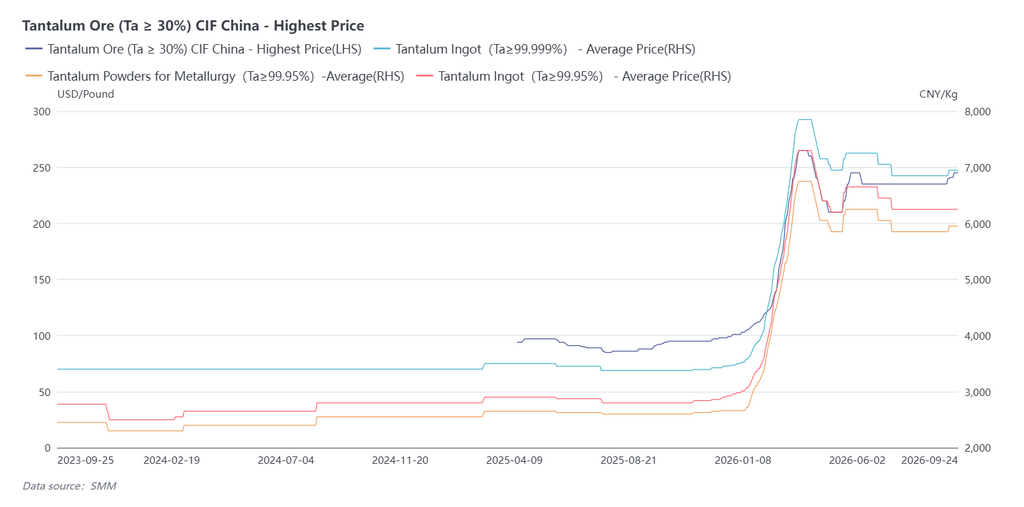
In terms of demand transmission from various downstream sectors, there is a clear divergence in the pace of price increases. Supply in high-end Application Areas is relatively tight, commodity premiums are prominent, and quotations for related products continue to rise. Among them, tantalum capacitors represent the largest downstream demand sector, accounting for approximately 40% of applications, with the industry market growth rate remaining above 15%, which directly drives the demand for upstream tantalum powder. Driven by the concentrated release of high-end orders and tight supply, the price of mainstream-grade tantalum powder is around RMB 6,000 per kilogram; grades targeting high-end Application Areas see significant premiums due to supply shortages, with prices about 50% higher than mainstream grades, and order backlogs are full with tight supply. Tantalum targets account for about 20% of applications, supporting the demand for high-purity tantalum ingots; currently, the transaction price of 99.999% high-purity tantalum ingots is in the range of RMB 6,900-7,000 per kilogram. In contrast, products in traditional and low-end Application Areas lack upward momentum in prices, with demand performing moderately and slightly shrinking; for other application directions, relevant enterprises have basically suspended order acceptance as some traders compete for orders at low prices.

Regarding the future trend of tantalum ore, market participants believe that the current overall supply and demand fundamentals of tantalum ore have not been substantially impacted. The tight market supply mainly stems from miners' reluctance to sell, as they generally expect to sell their tantalum ore at a higher price and thus proactively control the volume of shipments. In the short term, the price of tantalum ore remains bullish, and it cannot be ruled out that it will further test the annual high; however, the market also warns that once the price touches the annual high, concentrated shipments from miners may trigger a sharp drop in the price of tantalum ore.

Data Source Statement: Except for publicly available information, all other data are processed by SMM based on publicly available information, market communication, and relying on SMM's internal database model. They are for reference only and do not constitute decision-making recommendations.

For any inquiries or for more information, please contact: lemonzhao@smm.cn
For more information on how to access our research reports, please contact:service.en@smm.cn
Related News
[SMM Chromium Flash] Zimbabwe's New Ban on Single-Mineral Mining Licenses Could Reshape Its Chrome Sector
39 mins ago
[SMM Chromium Flash] Zimbabwe's New Ban on Single-Mineral Mining Licenses Could Reshape Its Chrome Sector
Read More
[SMM Chromium Flash] Zimbabwe's New Ban on Single-Mineral Mining Licenses Could Reshape Its Chrome Sector
[SMM Chromium Flash] Zimbabwe's New Ban on Single-Mineral Mining Licenses Could Reshape Its Chrome Sector
Zimbabwe will no longer issue mining licenses for isolated, single-mineral operations, Vice President Dr Constantino Chiwenga announced at the Zimbabwe-China Business Forum last week. Future mining investments will be required to demonstrate the capacity to identify, separate and process the full range of minerals embedded in a deposit, not just the primary target mineral, with operations unable to do so barred from operating in the country. Chiwenga framed the move as part of Zimbabwe's broader push to retain more value from its mineral resources rather than exporting them in raw form. For Zimbabwe's chrome sector, the policy lands directly on the country's geology. Chrome deposits along the Great Dyke frequently occur alongside platinum-group metals, nickel and other minerals in the same host rock, the same setting that has already driven the PGM-chrome co-production model at operations such as Zimplats, Mimosa, Unki and Karo. A chrome-focused mining investment with no capacity to also identify and process any co-located PGMs or other minerals would fall squarely into the category of operation the government says it will no longer license, effectively pushing new chrome projects toward integrated, multi-mineral processing from the outset rather than single-commodity extraction. The policy adds a further layer to Zimbabwe's chrome beneficiation drive, which has already moved from banning raw ore exports in February 2026 to signaling a possible extension of that ban to chrome concentrate. Where those earlier measures targeted what happens to chrome after it leaves the ground, this policy shapes what a mining operation must be capable of processing before it can be licensed in the first place, raising the entry bar for new chrome investment in the country. It also raises immediate questions for the many small-scale and artisanal chrome miners already navigating a separate regularization deadline: whether the new licensing standard applies only to new applications or could eventually be extended to existing single-mineral operations remains unclear, as does whether "beneficiation capacity" means processing the primary mineral into a refined product or specifically extends to separating out secondary minerals present in the same ore body. Zimbabwe's government has not yet published implementing regulations clarifying how the policy will be applied to chrome projects specifically.
39 mins ago
ADC12 Cost Support Continues, Pre-Holiday Demand Mildly Improves [Aluminum Scrap and Secondary Aluminum Weekly Review]
1 hour ago
ADC12 Cost Support Continues, Pre-Holiday Demand Mildly Improves [Aluminum Scrap and Secondary Aluminum Weekly Review]
Read More
ADC12 Cost Support Continues, Pre-Holiday Demand Mildly Improves [Aluminum Scrap and Secondary Aluminum Weekly Review]
[Secondary Aluminum Weekly Review: ADC12 Cost Support Persists, Pre-Holiday Demand Improves Mildly] This week, SMM ADC12 prices held steady at 24,500 yuan/mt. On the cost side, aluminum scrap raw material prices fluctuated within a limited range overall this week, but the impact of stricter tax invoice policy enforcement became more evident in the market. Compliance requirements for enterprise procurement increased, the supply of invoiced aluminum scrap remained relatively tight, and comprehensive raw material procurement costs for some enterprises stayed at elevated levels.
1 hour ago
Polysilicon sees small-volume high-price deals, centralized module prices decline further [SMM weekly review]
2 hours ago
Polysilicon sees small-volume high-price deals, centralized module prices decline further [SMM weekly review]
Read More
Polysilicon sees small-volume high-price deals, centralized module prices decline further [SMM weekly review]
[SMM Weekly Review: Polysilicon Sees Small Volume of High-Price Deals; Centralized Module Price Decline Widens] This week, China's module prices showed structural divergence, with distributed modules stopping falling and stabilizing while centralized modules saw a wider decline. On the distributed side, enterprise guidance prices remained unchanged, and average transaction prices for all specifications stayed basically flat this week, with only HJT modules edging down 0.0005 yuan/W. Supported by costs and industry self-discipline, module prices do not have much room for a sharp decline and are expected to consolidate in the short term. However, it is worth noting that low-efficiency modules have recently begun shipping rapidly, which to some extent affects the ability of conventional modules to hold prices firm. On the centralized demand side, marginal improvement continued: recent deliveries kept increasing, tenders for some large projects moved forward, and installations and orders both grew. Nevertheless, prices still lacked upward momentum, and the decline for the three specifications actually widened to 0.004 yuan/W this week.
2 hours ago