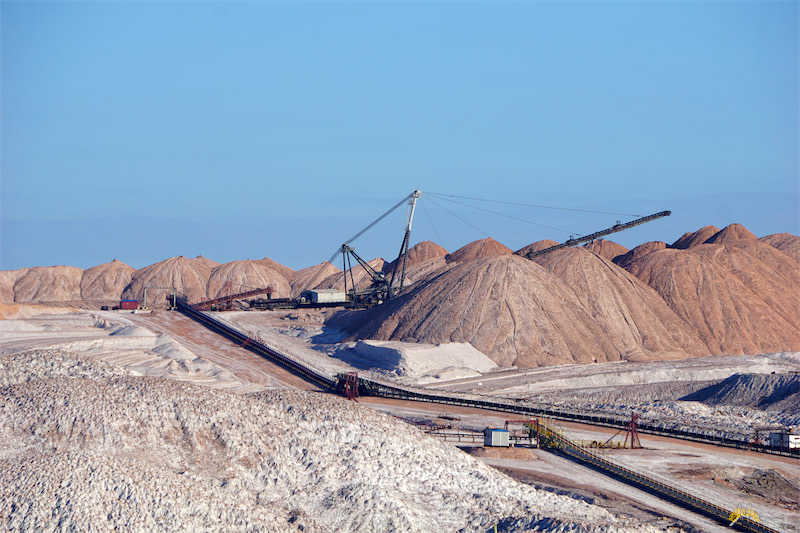
Zimbabwe will no longer issue mining licenses for isolated, single-mineral operations, Vice President Dr Constantino Chiwenga announced at the Zimbabwe-China Business Forum last week. Future mining investments will be required to demonstrate the capacity to identify, separate and process the full range of minerals embedded in a deposit, not just the primary target mineral, with operations unable to do so barred from operating in the country. Chiwenga framed the move as part of Zimbabwe's broader push to retain more value from its mineral resources rather than exporting them in raw form.
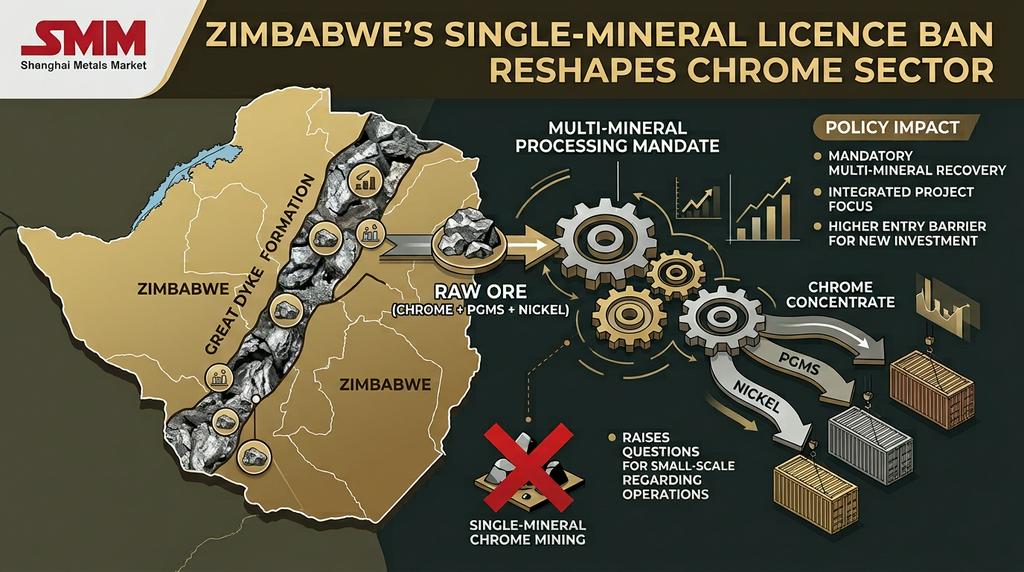
For Zimbabwe's chrome sector, the policy lands directly on the country's geology. Chrome deposits along the Great Dyke frequently occur alongside platinum-group metals, nickel and other minerals in the same host rock, the same setting that has already driven the PGM-chrome co-production model at operations such as Zimplats, Mimosa, Unki and Karo. A chrome-focused mining investment with no capacity to also identify and process any co-located PGMs or other minerals would fall squarely into the category of operation the government says it will no longer license, effectively pushing new chrome projects toward integrated, multi-mineral processing from the outset rather than single-commodity extraction.
The policy adds a further layer to Zimbabwe's chrome beneficiation drive, which has already moved from banning raw ore exports in February 2026 to signaling a possible extension of that ban to chrome concentrate. Where those earlier measures targeted what happens to chrome after it leaves the ground, this policy shapes what a mining operation must be capable of processing before it can be licensed in the first place, raising the entry bar for new chrome investment in the country. It also raises immediate questions for the many small-scale and artisanal chrome miners already navigating a separate regularization deadline: whether the new licensing standard applies only to new applications or could eventually be extended to existing single-mineral operations remains unclear, as does whether "beneficiation capacity" means processing the primary mineral into a refined product or specifically extends to separating out secondary minerals present in the same ore body. Zimbabwe's government has not yet published implementing regulations clarifying how the policy will be applied to chrome projects specifically.
![ADC12 Cost Support Continues, Pre-Holiday Demand Mildly Improves [Aluminum Scrap and Secondary Aluminum Weekly Review]](https://imgqn.smm.cn/usercenter/XUnxM20251217171723.jpeg)
![Polysilicon sees small-volume high-price deals, centralized module prices decline further [SMM weekly review]](https://imgqn.smm.cn/usercenter/EutUV20251217171724.jpeg)