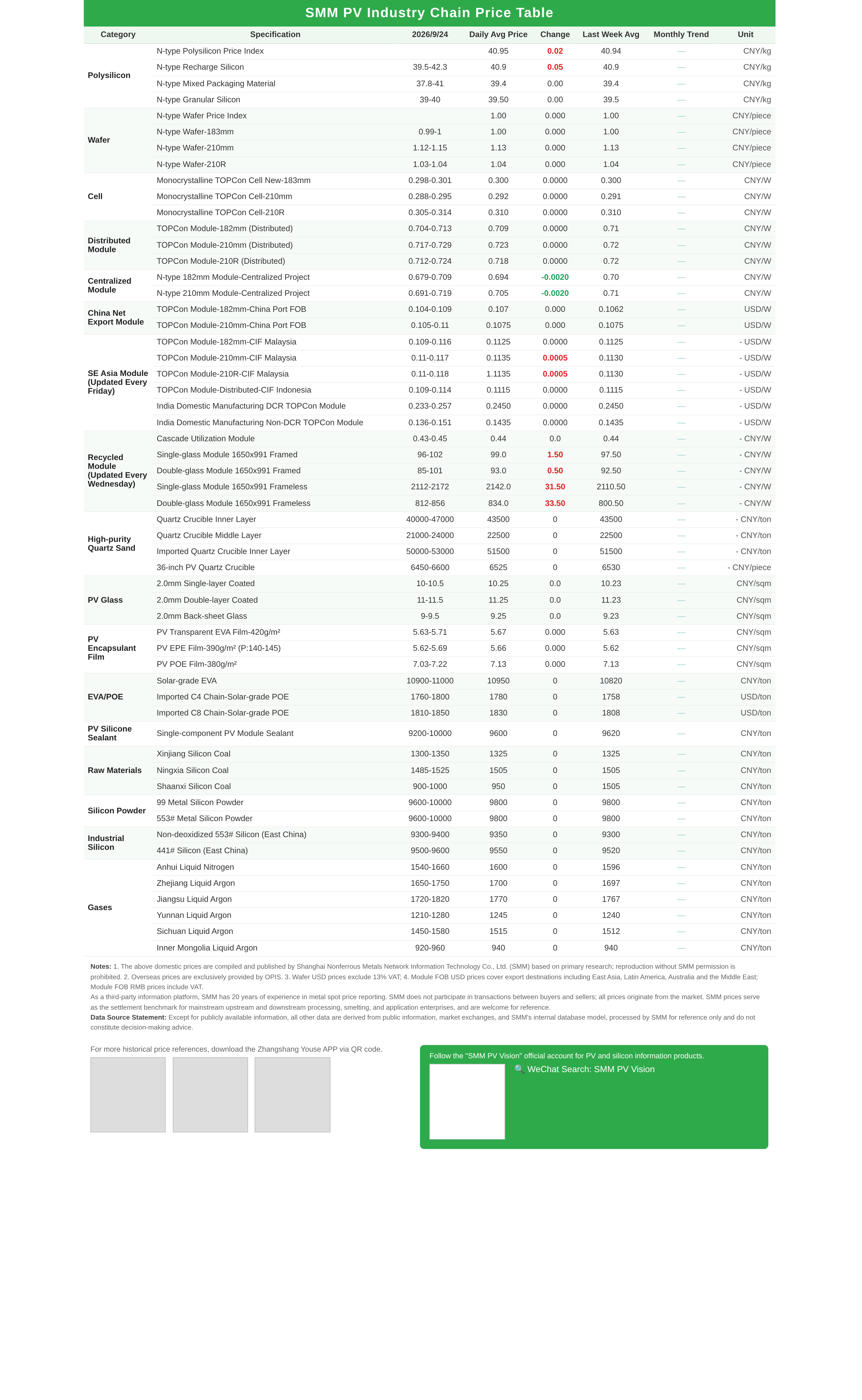
Polysilicon: This week, the polysilicon price index stood at 40.95 yuan/kg, with N-type recharging polysilicon quoted at 39.5-42.37 yuan/kg and granular polysilicon at 39-40 yuan/kg. Market quotes edged up slightly this week, mainly influenced by earlier production cut meetings. Current transaction volumes remain limited, with only a few high-priced deals concluded, while downstream buyers mostly opted for lower-priced cargoes from traders. October polysilicon production is expected to decline MoM.
Wafer: Wafer prices remained largely stable this week. N-type 183 wafers were priced at 0.994-1.002 yuan/piece, 210R wafers at 1.026-1.044 yuan/piece, and 210mm wafers at 1.119-1.145 yuan/piece. Upstream polysilicon quotes showed limited fluctuations overall, and combined with market expectations of further production cuts, cost support expectations persisted. After consecutive price declines in the prior period, the marginal effect of further wafer price cuts in stimulating shipments has gradually weakened, and wafer producers' pricing stance has shifted from proactive concessions to holding prices firm amid a wait-and-see approach. Meanwhile, pre-holiday downstream stockpiling demand provided some support to wafer prices, and the wafer market is expected to remain largely stable in the short term.
Solar cell: Solar cell prices across all sizes remained generally stable this week, with the market showing structural demand divergence and moderate pre-holiday destocking. The tug-of-war between upstream and downstream continued, with limited rigid demand release from the module side. Overall market conditions were stable, leaving little room for short-term price fluctuations. Solar cell quotes held steady across the board this week, with producers making virtually no price adjustments. The 183 size was priced at 0.298-0.31 yuan/W, 210R at 0.305-0.314 yuan/W, and 210N at 0.288-0.295 yuan/W. Demand-side performance varied notably: 210R prices remained relatively high, with weak acceptance from module producers, and only a small number of scattered orders were concluded in China, leaving overall demand subdued. 210N benefited from pre-holiday module stockpiling, with demand picking up and shipment pace improving MoM. Overall, downstream wait-and-see sentiment remained heavy and rigid demand was insufficient, with the upstream-downstream price tug-of-war persisting. Solar cell prices are likely to remain stable in the short term. Industry-wide production in September pulled back slightly from August, with the decline mainly attributable to production halts for technological transformation and production line maintenance at some specialized solar cell plants. Looking ahead to October, industry production schedules may continue to trend downward. On one hand, some producers plan to halt production for maintenance during the National Day holiday; on the other, some enterprises are gradually initiating production line technological transformation and upgrades, heightening expectations of phased supply contraction. Solar cell inventory pulled back overall this week, as pre-holiday stockpiling drove a phase of industry-wide destocking, with inventory patterns diverging significantly across sizes. 210R continued to be supported by sustained export orders, keeping producer inventory tight. 210N benefited from domestic pre-holiday restocking demand, showing solid inventory drawdown. 183 end-use demand was mediocre, with a slower shipment pace and relatively weaker destocking momentum. Overall, pre-holiday inventory pressure has eased somewhat, but the risk of renewed industry inventory buildup after the holiday, as end-user procurement returns to mediocre levels, still needs close monitoring.
China modules: This week, China module price trends showed structural divergence, with distributed modules stopping their decline and stabilizing while centralized modules saw a wider drop. On the distributed side, enterprise guidance prices remained unchanged, and average transaction prices for most specifications were basically flat this week, with only HJT modules edging down by 0.0005 yuan/W. With cost support and industry self-discipline constraints, module prices do not have much room for a sharp decline, and the short term is still expected to be dominated by consolidation. However, it is worth noting that low-efficiency modules have recently started selling rapidly, which to some extent affects the ability of conventional modules to hold prices firm. On the centralized side, demand continued to improve marginally: recent delivery volumes kept increasing, some large project tenders moved forward steadily, and installations and orders showed two-way growth. However, prices still have not gained upward momentum, and the decline for the three specifications actually widened to 0.004 yuan/W this week. As of now, the average price of China Topcon modules-182mm (distributed) is 0.7085 yuan/W; Topcon modules-210mm (distributed) average 0.723 yuan/W; Topcon modules-210R (distributed) average 0.718 yuan/W; Topcon modules-210R high-power (distributed) average 0.757 yuan/W; BC modules-210R (distributed) average 0.7635 yuan/W; HJT modules-210mm (distributed) average 0.732 yuan/W. On the centralized side, 182 modules are priced at 0.694 yuan/W, 210 modules at 0.705 yuan/W, and 210R modules at 0.700 yuan/W. In terms of inventory, China module inventory continued to edge down. The overall inventory level at China module producers currently still exceeds 25GW, but it is expected to continue declining as export orders come in and centralized delivery volumes rise.
Module FOB exports:
This week, module FOB prices were generally stable, with quotes for different products diverging slightly. Most producers still maintained last week's quotes, while a few top-tier players began to raise quotes for forward orders and conventional TOPCon and BC modules, and gradually withdrew earlier low prices. However, overseas demand has not yet improved significantly, and actual transaction prices have limited room to follow the increases. Meanwhile, some distributors are still clearing inventory at low prices, and combined with inventory digestion pressure for low-efficiency modules and competition for large centralized orders, a few extremely low quotes still appeared in the market. However, first-tier mainstream producers have not followed suit for now, and mainstream transaction centers remain near $0.107-0.108/W. At present, the market's willingness to take orders and adjust prices is at a low level, and short-term prices are expected to continue moving sideways.
Module CIF Southeast Asia:
This week, the Southeast Asian module market overall continued last week's trend, with prices for some specifications slightly raised or their ranges widened. Some distributors have begun clearing inventory of modules rated at 620W and below at low prices, with a strong atmosphere of low-priced sales for low-power products, though actual trading volume for standard and high-power modules remains limited.
As of today, CIF prices for TOPCon modules across Southeast Asian markets are as follows:
In Malaysia, CIF prices are $0.109–0.116/W for 182mm modules, $0.110–0.117/W for 210mm modules, and $0.110–0.117/W for 210R modules;
in Indonesia, CIF prices for distributed TOPCon modules are $0.109–0.114/W;
in Thailand, CIF prices are $0.108–0.115/W for 182mm modules, $0.109–0.116/W for 210mm modules, and $0.109–0.116/W for 210R modules;
in Vietnam, CIF prices are $0.106–0.113/W for 182mm modules, $0.107–0.114/W for 210mm modules, and $0.107–0.114/W for 210R modules.
By market, low-priced transactions remained the dominant feature in most markets, while demand in Indonesia continued to await project activity and an overall market recovery. In Thailand, the PDP 2026 draft was released earlier; if it is formally implemented, its specific installation plans and project arrangements will become a key focus for local module demand.
India modules: This week, the Indian module market continued to show a divergence between DCR and non-DCR segments, with prices for both product types remaining stable. As of today, India-made DCR TOPCon module prices were $0.233–0.257/W, while non-DCR TOPCon module prices were $0.136–0.151/W. Approaching year-end, domestic project demand in India provided some support for DCR modules, and market conditions improved slightly; non-DCR modules were supported by external demand, with prices relatively firm. On the inventory side, India's DCR module inventory edged up WoW to 13.52GW, while DCR solar cell inventory fell to 3.85GW. On the policy front, the US "Section 232 policy" introduced new rules on September 22, further tightening controls on concentrated stockpiling ahead of the implementation of tariffs and minimum import prices. The new rules took effect the same day, will automatically expire on December 3, and impose rigid weekly volume caps on importers that filed for the first time after August 6, while strengthening scrutiny of abnormal volume surges among existing importers. If enforcement continues to tighten, concentrated US-bound stockpiling demand for India's non-DCR modules may gradually cool, with external demand and shipment volumes at risk of a slight pullback.
Europe modules:
This week, demand recovery in the European module market remained limited, with actual transactions concentrated mainly in replenishment orders, while the rest were still dominated by inquiries and price negotiations. In the distribution market, upstream and downstream price expectations diverged, with producers generally maintaining a wait-and-see stance. Although some top-tier players signaled intentions to raise prices later, whether this materializes still depends on end-user acceptance. Price competition for large project orders was more intense, especially for centralized projects above 100 MW, where low-price competition among individual producers persisted. Overall, distributed module prices pulled back slightly this week, while centralized module prices remained basically stable, and market trading stayed sluggish. As of today, duty-paid ex-warehouse TOPCon module prices at the Rotterdam warehouse were as follows: distributed 210R (48-cell) modules at 0.1084–0.1170 euro/W, distributed 210R (66/72-cell) modules at 0.1015–0.1112 euro/W; centralized 210R (66/72-cell) modules at 0.0991–0.1090 euro/W, and centralized 210mm (66/72-cell) modules at 0.0995–0.1095 euro/W. Based on average prices by module type, warehouse prices in Portugal and Greece were about 2.2%–2.4% higher than in Rotterdam.
End-user: This week, PV modules saw both higher prices and higher volumes. According to SMM statistics, from September 14 to September 20, 2026, Chinese enterprises won bids for 53 PV module projects, with a single-week weighted average price of 0.73 yuan/W, up 0.01 yuan/W from the previous statistical period. Total awarded procurement capacity was 5,444.44 MW, an increase of 2,226.65 MW from the previous period.
According to SMM analysis, the main awarded capacity in the current statistical period fell within the 500 MW–5,000 MW range, accounting for 82.65% of the total disclosed awarded capacity. The breakdown by capacity range is as follows:
The 0 MW–1 MW section had 5 projects, accounting for 0.03% of capacity, with an average price of 0.773 yuan/W;
the 1 MW–6 MW section had 5 projects, accounting for 0.32% of capacity, with an average price of 0.845 yuan/W;
the 6 MW–50 MW section had 7 projects, accounting for 2.58% of capacity, with an average price of 0.696 yuan/W;
the 50 MW–100 MW section had 2 projects, accounting for 2.13% of capacity, with an average price of 0.700 yuan/W;
the 100 MW–200 MW section had 3 projects, accounting for 6.78% of capacity, with the average price undisclosed;
the 200 MW–500 MW section had 1 project, accounting for 5.51% of capacity, with an average price of 0.782 yuan/W;
the 500 MW–1,000 MW section had 2 projects, accounting for 27.55% of capacity, with an average price of 0.710 yuan/W;
the 2,000 MW–5,000 MW section had 1 project, accounting for 55.10% of capacity, with the average price undisclosed.
According to SMM analysis, the weighted average price in the current statistical period was 0.73 yuan/W, up 0.01 yuan/W WoW.
In terms of total awarded procurement capacity, the week recorded 5,444.44 MW, an increase of 2,226.65 MW from the previous statistical period. Two framework procurement projects were opened in the current statistical period: the 3,000 MW section of the "China Railway Construction Network Information Technology Co., Ltd. 2026-2027 PV Module" project awarded to TrinaSolar Co., Ltd., as well as Section 1 of the "China South-to-North Water Diversion Group Co., Ltd. 2026-2027 PV Module" project, 1,000 MW awarded to TrinaSolar Co., Ltd. at 0.71 yuan/W, and Section 2 of the same project, 300 MW awarded to LONGi Solar Technology Co., Ltd. at 0.782 yuan/W.
In terms of regional distribution, Beijing had the largest awarded capacity this week, accounting for 79.03% of the total, followed by Ningxia Hui Autonomous Region and Yunnan, accounting for 9.18% and 3.85% of the total, respectively.
Key awarded information during the statistical period (September 14 to September 20):
In the "China Railway Construction Network Information Technology Co., Ltd. 2026-2027 PV Module" project, TrinaSolar Co., Ltd. was awarded 3,000 MW of PV modules.
In Section 1 of the "China South-to-North Water Diversion Group Co., Ltd. 2026-2027 PV Module" project, TrinaSolar Co., Ltd. was awarded 1,000 MW of PV modules at an average price of 0.71 yuan/W.
In the "PowerChina China Power Construction Co., Ltd. Beijing Institute CGN New Energy TCL Zhonghuan Lingwu 500,000 kW PV Composite Project Monocrystalline Silicon Double-Glass PV Module" project, TCL Zhonghuan New Energy Technology Co., Ltd. was awarded 500 MW of PV modules.
In Section 2 of the "China South-to-North Water Diversion Group Co., Ltd. 2026-2027 PV Module" project, LONGi Solar Technology Co., Ltd. was awarded 300 MW of PV modules at an average price of 0.782 yuan/W.
PV glass: This week, low-end PV glass prices were raised, with the 2.0 mm specification leading the increase. As of September 24, the average price of 3.2 mm double-layer coating was 17.3 yuan/m², flat WoW, while the average price of 2.0 mm double-layer coating rose to 11.25 yuan/m², up 1.35% WoW. Actual transaction prices for top-tier players remained at 11 yuan/m² due to volume and preferential policies. Regarding the subsequent price outlook, SMM believes the foundation for an upward trend remains intact. The core support lies in the supply side, where expectations remain weak, and September production cuts at kilns will further weaken October supply expectations. The inventory side is also cooperating, as the destocking trend in days of inventories tracked by SMM continues. At the same time, we need to guard against two major risks: first, if module producers' acceptance of high glass prices weakens and the pace of stockpiling slows down, the room for price increases will be significantly compressed; second, if prices quickly recover to above the profitable range, previously cold-repaired production lines may accelerate production resumptions, and the supply replenishment will constrain the continued rise in prices.
Film: This week, film pricing range was 27,800–28,200 yuan/mt, and the second round of film price negotiations resulted in an upward adjustment. Last week, film producers advanced the second round of negotiations. Under the combined influence of rising upstream EVA resin market prices, high raw material prices, and mid-to-late month downstream supply guarantee rigid demand, module producers had relatively limited room for negotiation, and the final increase was successfully implemented. Going forward, focus on the results of the new round of month-end monthly negotiations, as well as the continued impact of EVA resin price changes on the film cost side.
EVA: This week, PV-grade EVA resin spot prices were 10,900-11,000 yuan/mt, with resin prices rising. On the cost side, international oil prices pulled back from earlier highs, but raw materials such as ethylene and vinyl acetate remained at relatively high levels in the short term, and resin cost support had not yet significantly loosened; on the supply side, available spot cargo in the market was relatively tight, petrochemical plant inventories were low, and traders' sentiment to hold prices firm remained, providing bottom support for prices. Overall, with short-term supply tightness and cost support resonating, resin prices are expected to remain firm, but the room for further upward exploration has narrowed compared with earlier.
POE: This week, POE delivered prices in China were 13,000-13,100 yuan/mt, with prices further raised. Driven by rising raw material prices, enterprises faced increased production cost pressure, and the demand for profit recovery strengthened. However, current downstream demand rigidity for PV POE is relatively limited, and film producers' acceptance of resin price increases remains to be observed. In the short term, although POE prices are supported by costs and driven by enterprises' profit recovery demands, whether the price increases can be sustained still depends on actual downstream transactions and acceptance.
High-purity quartz sand: This week, high-purity quartz sand prices were generally stable, with inner-layer sand at 40,000-47,000 yuan/mt, middle-layer sand at 21,000-24,000 yuan/mt, outer-layer sand at 12,500-18,000 yuan/mt, and imported sand spot orders at 50,000-53,000 yuan/mt, with all specifications' quotes unchanged. For crucibles, 33-inch crucibles were 5,400-5,700 yuan/piece, and 36-inch crucibles were 6,450-6,600 yuan/piece, with crucible prices loosening by 100 yuan and 50 yuan WoW respectively, and the price center shifting slightly downward. Recently, quartz sand prices have basically consolidated at lows after a series of declines, but since H2, the decline in crucible output has led to an increase in China's quartz sand inventory. Recently, some downstream producers have begun to sell off domestic and imported sand, which may have a certain impact on sand prices going forward. But low-price competition on the crucible side has not fully subsided yet. With cost support, there is relatively small room for another sharp price cut going forward, but close attention still needs to be paid to recent crucible competition. In Q4, silicon wafer output is not expected to improve significantly, enterprise competition expectations remain intense, and price bargaining is relatively strong.
Module recycling: Last week, domestic PV module recycling market prices rebounded somewhat.
Early small-format framed models rose by around 0.5-1.5 yuan/block, with first-hand single-glass prices in the range of 98-114 yuan/block, while frameless models rose by 31-34 yuan/mt, with first-hand single-glass prices in the range of 2,112-2,172 yuan/block. In addition to early small-size modules, large-size prices also showed a rebound trend, with framed model prices rising by around 2-3 yuan/block and frameless models rising by around 26-30 yuan/mt.
This round of price pullback was affected by the rebound in spot prices of major recycled metals. Last week, spot silver drifted higher, while aluminum prices continued to consolidate at highs. According to SMM, the #1 silver spot price fluctuated upward from 15,492 yuan/kg on September 16 to 16,161 yuan/kg on September 23; A00 aluminum prices continued to consolidate at highs, fluctuating from 24,160 yuan/mt on September 16 to 24,240 yuan/mt on September 23.


![Active warehouse withdrawals at ports, silicon metal social inventory down MoM [SMM Silicon Inventory]](https://imgqn.smm.cn/usercenter/tfLay20251217171725.jpg)

![Aluminum alloy futures prices weaken on position reduction, spot resilience remains, pre-holiday stockpiling still to be observed [ADC12 Price Daily Commentary]](https://imgqn.smm.cn/usercenter/CIcRv20251217171725.jpg)