SMM, September 24:
With the Mid-Autumn Festival and National Day holidays approaching, secondary aluminum alloy enterprises have successively finalized their production and holiday arrangements for the festive period. SMM recently conducted a survey on the double-holiday production plans, pre-holiday stockpiling, and raw material procurement of some secondary aluminum alloy enterprises, covering a total capacity of 4.2 million mt. The following is a summary of the survey findings:
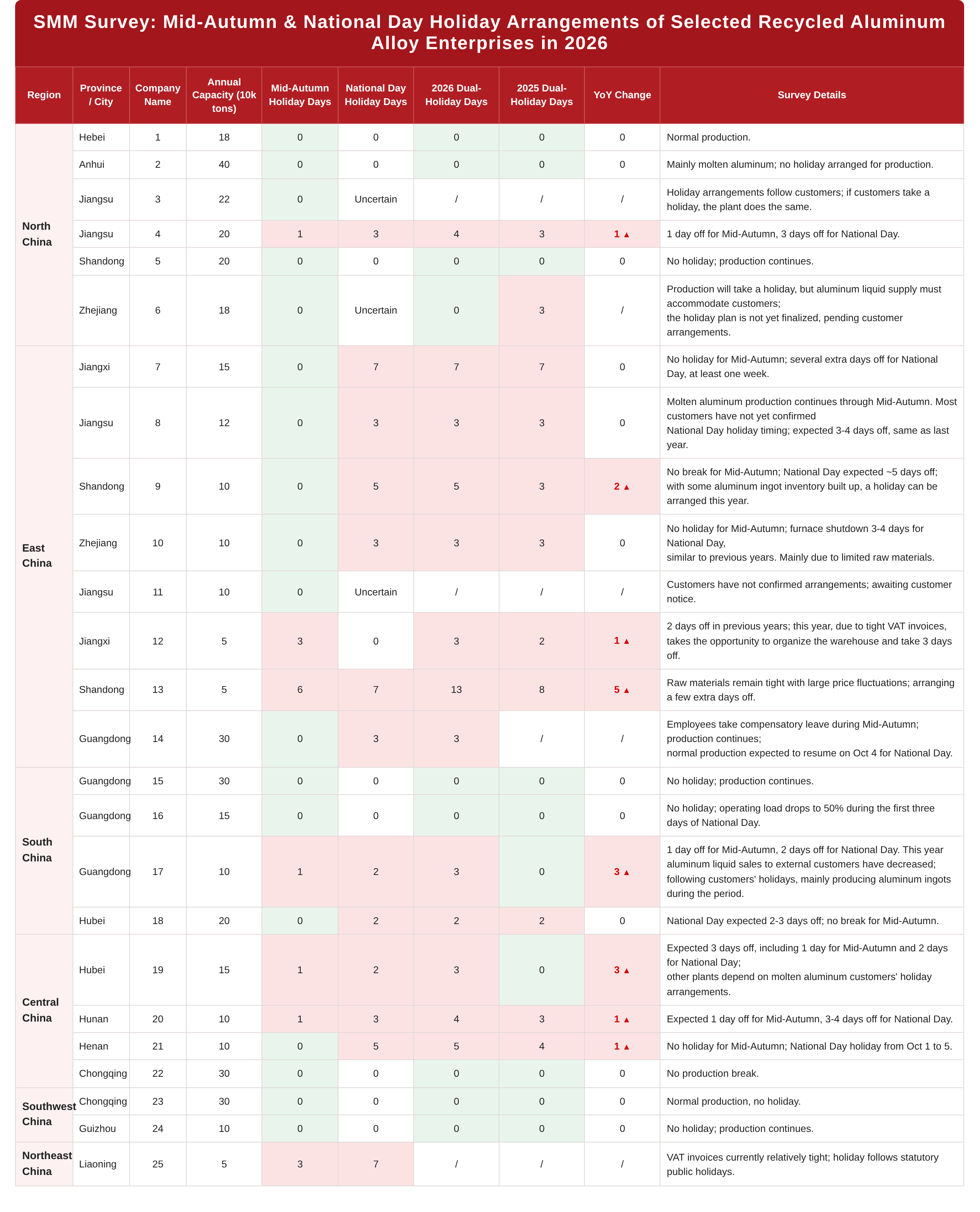
According to the SMM survey, during the 2026 Mid-Autumn Festival and National Day holidays, secondary aluminum alloy enterprises generally arranged for continuous production or brief shutdowns, though some enterprises extended their holiday duration compared with 2025. Among the 25 sampled enterprises, more than half had confirmed holiday arrangements, with individual enterprises taking up to 13 days off; all sampled enterprises in central China took holidays, mostly lasting 2 to 5 days, while half in southern China and the majority in southwestern China maintained normal production. Eight enterprises extended their holidays YoY, while the rest remained unchanged.
The longer holiday duration this year was mainly driven by tight raw material supply, high procurement costs, stricter tax invoice compliance requirements, and downstream clients' holiday arrangements. Facing increased difficulty in raw material procurement and rising operating pressure, some enterprises adjusted by reducing production loads, scheduling maintenance, or extending holidays; meanwhile, some enterprises needed to flexibly arrange production based on molten aluminum supply and client orders.
On pre-holiday demand, downstream enterprises released some stocking demand compared with the earlier period to ensure post-holiday production, but overall purchases remained primarily need-based restocking, without large-scale concentrated stockpiling. Some enterprises made advance purchases due to holiday and delivery schedules, but high aluminum prices still constrained stockpiling enthusiasm to a certain extent. On the raw material side, secondary aluminum enterprises also had some pre-holiday stocking demand, but constrained by tight supply of compliant aluminum scrap, high procurement costs, and stricter tax invoice policies, overall stockpiling was relatively cautious, with rigid restocking mainly based on their own orders and post-holiday production plans.
Overall, during the 2026 double holidays, the supply side of the secondary aluminum industry continued to show a divergent pattern, with some enterprises implementing phased production cuts, while the impact of holiday factors on overall supply was relatively limited. Pre-holiday downstream stockpiling provided some support to short-term secondary aluminum demand, while post-holiday attention should focus on the pace of production resumptions, recovery of raw material procurement, and the extent of improvement in downstream orders.