SMM, September 20:
In the metals market:
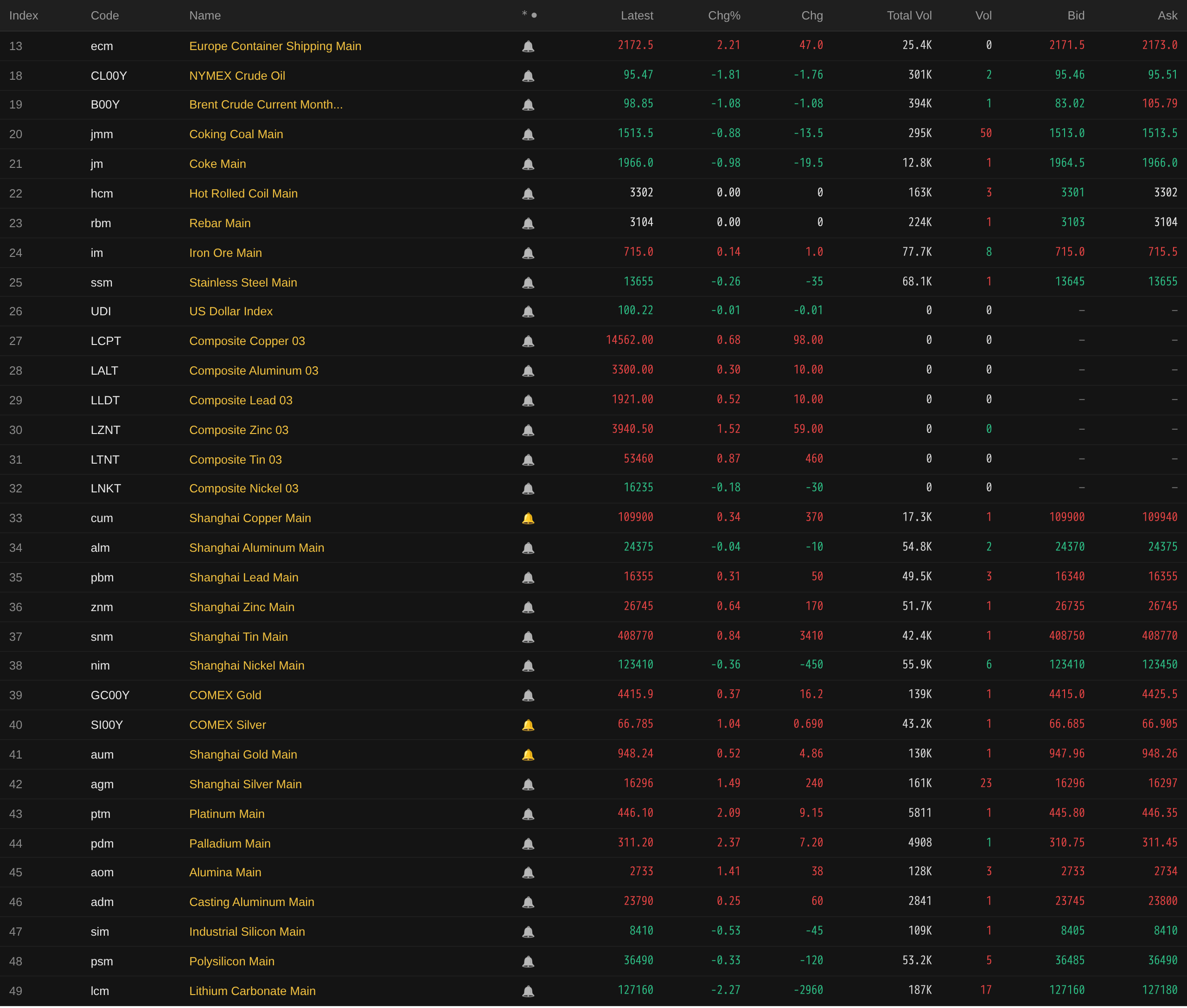
Last Friday overnight, base metals on both domestic and overseas markets generally rose, with only LME nickel, SHFE nickel, and SHFE aluminum falling together. LME nickel fell 0.18%, SHFE nickel fell 0.36%, and SHFE aluminum fell 0.04%. All other metals rose, with LME zinc leading the gains at 1.52%. LME copper rose 0.68%, LME tin rose 0.87%, and SHFE tin rose 0.84%. Fluctuations in the remaining metals were relatively small. The alumina main contract rose 1.41%, and the cast aluminum main contract rose 0.25%.
Last Friday overnight, ferrous metals generally fell, with only iron ore rising 0.14%. Stainless steel fell 0.26%, while rebar and hot-rolled coil both closed flat, with rebar flat at 3,104 yuan/mt and hot-rolled coil flat at 3,302 yuan/mt. Coking coal and coke fell together, with coking coal down 0.88% and coke down 0.98%.
Last Friday overnight in precious metals, as of the close, COMEX gold rose 0.37%, with a weekly gain of 0.16%, ending a three-week losing streak. COMEX silver rose 1.04%, with a weekly gain of 2.45%. Domestically, SHFE gold rose 0.52% and SHFE silver rose 1.49%. On a weekly basis, SHFE gold rose 0.67% and SHFE silver rose 3.94%. Goldman Sachs stated that despite the US Fed's rate hikes, it maintains its gold price forecast of $5,400/oz by the end of 2027. Continued diversification by central banks remains the key structural driver behind its bullish view on gold. The bank still sees net upside risks to its gold expectations, though accompanied by greater two-way volatility along the way. Gold prices may fall in the short term to a cyclical bottom of around $4,070/oz before gradually rebounding, and are expected to move toward $4,200/oz by the end of 2026. (Wall Street CN)
As of 8:20 am on September 20, last Friday's overnight closing prices:
Macro front
Domestically:
[Unchanged for the 16th consecutive month! September LPR quotes released: 1-year at 3.0%, over-5-year at 3.5%] China's September Loan Prime Rate (LPR) quotes were released on September 20, with both the 1-year and over-5-year LPR unchanged. The People's Bank of China authorized the National Interbank Funding Center to announce that the LPR on September 20, 2026 is: 1-year LPR at 3.0%, over-5-year LPR at 3.5%. The above LPR remains effective until the next LPR release.
[Ministry of Commerce: Total retail sales of consumer goods and services rose 2.5% YoY in January-August, with consumption structure continuing to optimize] In January-August, total retail sales of consumer goods and services rose 2.5% YoY (the same hereinafter), with the consumer market improving in quality amid stability and the consumption structure continuing to optimize. First, goods consumption grew steadily. From January to August, total retail sales of consumer goods rose 1.1%, and retail sales of consumer goods excluding automobiles rose 2.7%. Second, demand for services consumption was robust. Currently, consumer demand is becoming increasingly rich and diverse, and the consumption structure continues to improve, shifting from a focus on goods consumption to equal emphasis on goods and services consumption. From January to August, services retail sales rose 4.9%, 3.9 percentage points faster than goods retail sales. Third, rural consumption potential was released. The vitality of county-level consumer markets continued to be unleashed, and the urban-rural consumption structure kept improving.
[MOC Spokesperson Answers Journalists' Questions on China-US Economic and Trade Consultations]A journalist asked: Recent reports suggest that China and the US will soon hold the next round of economic and trade consultations. Does the Ministry of Commerce have any updates? Answer: As agreed by both China and the US, He Lifeng, Member of the Political Bureau of the CPC Central Committee and Vice Premier of the State Council, will lead a delegation to the US from September 19 to 23 for economic and trade consultations. The two sides will be guided by the important consensus of the two heads of state and conduct consultations on economic and trade issues of mutual concern. (Ministry of Commerce)
[Guangxi Financial Industry Development 15th Five-Year Plan Issued: Advancing Cross-Regional Use of RMB with ASEAN]The General Office of the People's Government of Guangxi Zhuang Autonomous Region issued the Guangxi Financial Industry Development 15th Five-Year Plan, which points out the need to advance the cross-regional use of RMB with ASEAN. Improve the level of RMB use in cross-border trade. Expand RMB use in areas such as bulk commodity trade, cross-border e-commerce, and border trade. Promote greater use of RMB settlement in Guangxi's cooperation with ASEAN in cross-border industrial and supply chains. Explore the application of digital RMB in cross-border settlement. Support online border resident mutual market trade RMB settlement. Support eligible banks in the region to lend RMB funds to ASEAN peers. Improve the level of RMB use in cross-border investment and financing. Implement "online filing + immediate completion" for domestic enterprises' RMB investment and financing in ASEAN. Build a digital RMB trade, investment, and financing center oriented toward ASEAN. Facilitate cross-border RMB capital flows, innovatively support Guangxi local enterprises in conducting direct investment and cross-border financing in ASEAN using RMB, and encourage ASEAN enterprises to use RMB to invest and develop in Guangxi. (Jin10 Data APP)
[Cui Dongshu: China's Automobiles Lead High-Quality Growth in China's Exports in 2026]Recently, the General Administration of Customs released import and export data for January-August 2026. China's goods trade exports showed relatively strong growth overall in 2026, with exports reaching $2,925.5 billion in January-August 2026, up 19% YoY. Especially in August, it reached $401.4 billion, the highest level ever for August, and China's export trade growth was very strong. Automobile exports reached $129.1 billion in January-August 2026, up 53% YoY, and August automobile exports reached $18.3 billion, up 43% YoY, showing strong vitality in China's auto sector. Auto parts exports reached $69.8 billion in January-August 2026, up 8% YoY, and August auto parts exports reached $9.1 billion, up 7% YoY, indicating immense pressure on China's auto parts exports. Motorcycle exports reached $15.5 billion in January-August 2026, up 26% YoY, and August motorcycle exports reached $2.1 billion, up 28% YoY. Fuel-powered motorcycle exports slowed down due to high oil prices, while electric motorcycles surged. We need to follow the development of independent vehicle manufacturers and change the characteristic of relying on the after-sales system in Europe and the US. (Cui Dongshu)
On the US dollar front:
Last Friday, the overnight US dollar index closed at 100.22, down 0.01%, with a weekly gain of 1.14%, marking its best weekly performance since the week of June 5. This came after the US Fed signaled further interest rate hikes. Driven by solid US economic growth and the Fed's anti-inflation stance following rate hikes, the dollar posted notable weekly gains. After the Fed's first rate hike in more than three years, JPMorgan, Standard Chartered, and Brown Brothers Harriman all believed that the decision removed the biggest obstacle to dollar strength. On Wednesday and Thursday, the dollar index consolidated near its 200-day moving average, and on Friday it edged above this key level. Historical data shows that when the daily closing price of the dollar index breaks above the 200-day moving average, the dollar tends to rise further. Previously in March and June, the index strengthened further after breaking above the 200-day moving average. As the yen pared losses following reports that the Bank of Japan conducted a "rate check," the dollar index gave back some of its weekly gains. Before that, the index could have recorded its largest weekly gain since the outbreak of the Iran war in March. The BOJ's rate check is generally seen as a precursor to official intervention. (Jin10 Data APP)
Northeast Securities stated in a research report released on September 20 that the Fed's September rate hike has landed, and the dot plot shows that Fed officials generally expect one more rate hike in 2026, after which rates may remain unchanged for some time. With the economy not yet overheating, the Fed has already begun preemptive rate hikes. Under the Fed's current guidance, the risk of a December rate hike should not be underestimated. Judging from US wage growth and the real estate situation, its endogenous inflation potential is relatively small at present, so it is not expected to enter a continuous rapid rate hike process thereafter. It is more inclined to believe that, similar to the 2016 cycle, there will be a small rate hike followed by a sustained pause. (Jin10 Data APP)
Kansas City Fed Chairman Jeff Schmid said the US economy remains strong and continues to grow. Schmid said he agrees with Fed Chairman Kevin Warsh's explanation for the rise in US Treasury yields, namely that the recent increase in yields has been driven mainly by capital demand from AI investment and geopolitical challenges, rather than solely by monetary policy factors. Schmid also believes that the US Treasury's implementation of a Treasury buyback program will not make it more difficult for the Fed to execute monetary policy. (Jin10 Data APP)
ING now expects the Fed and the European Central Bank to each raise rates once before the end of this year, a departure from its previously forecast path of "keeping rates unchanged." ING economists said in a report: "Wednesday's Fed meeting and last week's ECB meeting suggest that the two central banks are unlikely to pursue the very accommodative monetary policy we had previously expected." The economists noted that both central banks are currently facing supply-side shocks triggered by surging energy prices, although the impact on the overall economy remains limited for now; meanwhile, the sharp rise in inflation in 2022 and the lagging monetary policy response are still fresh in people's minds. The economists expect both central banks could raise rates in December. (Jin10 Data APP)
Other currencies:
ECB Governing Council member Stournaras said the ECB must be vigilant about upside inflation risks but should not act hastily. He said no second-round effects through channels such as wages have emerged yet, but it cannot be taken for granted that this will remain the case. "We are seeing a series of persistent supply-side shocks, and these factors cannot simply be ignored. At the same time, there are also strong demand factors due to fiscal expansion and the AI investment boom. We must remain vigilant." With more than a month to go before the next policy decision, Stournaras said he has not yet made up his mind, and the various economic outlook projections prepared by the ECB may provide reference. "If there is an inflation spike in September, or if rising energy costs clearly push us into an adverse scenario, then an October rate hike cannot be ruled out. But if there are some doubts, we will not take any action and will wait for the next round of projections." Stournaras stressed that this week's Fed rate hike also helps the ECB. "The Fed's rate decision enhances its credibility and also enhances the credibility of global monetary policy, because the Fed and the US dollar play a central role." (Jin10 Data APP)
Macro front:
This week, China will release the one-year loan prime rate for September 21. The US will release data including the weekly change in ADP employment for the week ending September 5, the Richmond Fed manufacturing index for September, the preliminary S&P Global US manufacturing PMI for September, the preliminary S&P Global US services PMI for September, initial jobless claims for the week ending September 19, the Q2 current account balance, new home sales annualized for August, durable goods orders monthly rate for August, the final University of Michigan consumer sentiment index for September, and the final one-year inflation expectations for September. The UK will release data including public sector net borrowing for August, the CBI industrial order balance for September, the preliminary manufacturing PMI for September, the preliminary services PMI for September, the CBI retail sales balance for September, and the GfK consumer confidence index for September. Germany will release data including the preliminary manufacturing PMI for September, the IFO business climate index for September, and the GfK consumer confidence index for October. The eurozone will release data including the preliminary consumer confidence index for September and the preliminary manufacturing PMI for September. Australia's seasonally adjusted unemployment rate for August, Switzerland's central bank policy rate as of September 24, Canada's retail sales monthly rate for July, and France's preliminary manufacturing PMI for September will also be released.
In addition, China's refined oil products will open a new price adjustment window. 2027 FOMC voting member and Chicago Fed President Goolsbee delivered remarks, Bank of Canada Governor Macklem delivered remarks, Reserve Bank of Australia Governor Bullock delivered remarks, FOMC permanent voting member and New York Fed President Williams delivered a speech at the 2026 US Treasury Market Conference, Fed Vice Chair Jefferson delivered a speech at the 2026 US Treasury Market Conference, 2027 FOMC voting member and Richmond Fed President Barkin delivered remarks, the Swiss National Bank announced its interest rate decision, FOMC permanent voting member and New York Fed President Williams held a fireside chat with former Bank of England Deputy Governor Charlie Bean at the London Macro Policy Forum, 2027 FOMC voting member and Richmond Fed President Barkin participated in a fireside chat at the Economic Club, 2026 FOMC voting member and Cleveland Fed President Hammack delivered opening remarks at a conference, 2026 FOMC voting member and Philadelphia Fed President Paulson delivered remarks at a fintech conference, and FOMC permanent voting member and New York Fed President Williams delivered remarks.
Crude oil:
Last Friday, oil prices on both sides of the Atlantic fell overnight, with WTI down 1.81% and Brent down 1.08%. On a weekly basis, WTI fell 4.58% and Brent fell 5.51%, ending the sharp rally of the previous two consecutive weeks. On Wednesday, a report cited by Wall Street CN that day said Saudi Arabia planned to restore half the capacity of the key pipeline shut last week within days and fully resume production in about six weeks; Saudi Arabia is supplying Asian refiners through transshipment via the port of Oman. On Thursday, media reports said Saudi Arabia had proposed a two-week ceasefire to the Houthis in Yemen through Oman. Other media, citing informed Iranian sources, said a major power had asked Iran to help restrain the Houthis.
However, according to Thursday's reports, Iran responded to the request to restrain the Houthis by saying that regional peace and stability depend on the US and Israel halting military operations, a precondition that casts a shadow over the prospects for negotiations and keeps market expectations cautious about a rapid de-escalation of the conflict. (Wall Street CN)
US Central Command Commander: The US has assisted more than 1 billion barrels of crude oil in transiting the Strait of Hormuz over the past two months and helped more than 2,000 commercial vessels pass through the Strait of Hormuz. Due to the strict blockade imposed by the US, Iran has not exported a single barrel of oil. (Jin10 Data APP)
On September 19 local time, US Central Command Commander Brad Cooper released a video disclosing information on shipping in the Strait of Hormuz and US military operations in the region. Cooper said that mines have been cleared from the main shipping lanes in the Strait of Hormuz, and thousands of vessels have already passed through. Gulf partners have shipped more than 1 billion barrels of crude oil through the Strait of Hormuz. He also said that over the past two weeks, the volume of crude oil, cargo, and liquefied natural gas transported through the region reached its highest level in the past six months. Cooper also said that under the U.S. blockade, Iran's crude oil exports via relevant routes were zero. (CCTV News) (Jin10 Data APP)
It is worth noting that due to the shutdown of Saudi Arabia's east-west oil pipeline, European refiners have had to scramble for alternative supplies, and the surge in fuel prices has further pushed up crude procurement costs. After its pipeline to the Red Sea was attacked, Saudi Aramco is seeking to increase crude shipments through the Strait of Hormuz. This week, Asian buyers purchased tens of millions of barrels of Saudi crude from near the strait. However, this adjustment also means these cargoes are farther away from European refiners eager for supply. Last Friday, the spot premium for North Sea crude soared to a record high. Earlier, Saudi Aramco had informed European clients that it would be unable to supply them with crude under long-term agreements next month. Traders involved in market trading said that Norway's Johan Sverdrup crude, which is relatively similar in quality to Saudi crude, was quoted at up to $35 per barrel above the Brent spot benchmark price. Less than two weeks ago, the premium for the same grade was only 60¢ per barrel. The surge in spot crude prices shows that European refiners are sparing no expense to secure crude supply in order to maintain sufficiently high refinery operating rates and ease the tight fuel supply situation. Diesel prices in the region have now risen above $200 per barrel. (Jin10 Data APP)
![[Market view: The global smartphone market will shrink by 12% in 2026, with the market structure tilting toward higher price segments]](https://imgqn.smm.cn/usercenter/BdFZr20251217171712.jpg)
![Crude oil fell, metals broadly rose, lithium carbonate surged over 4%, SHFE tin gained nearly 1%, polysilicon led gains [SMM Midday Commentary]](https://imgqn.smm.cn/usercenter/gePcx20251217171735.jpg)