SMM, September 3:
In the metals market:
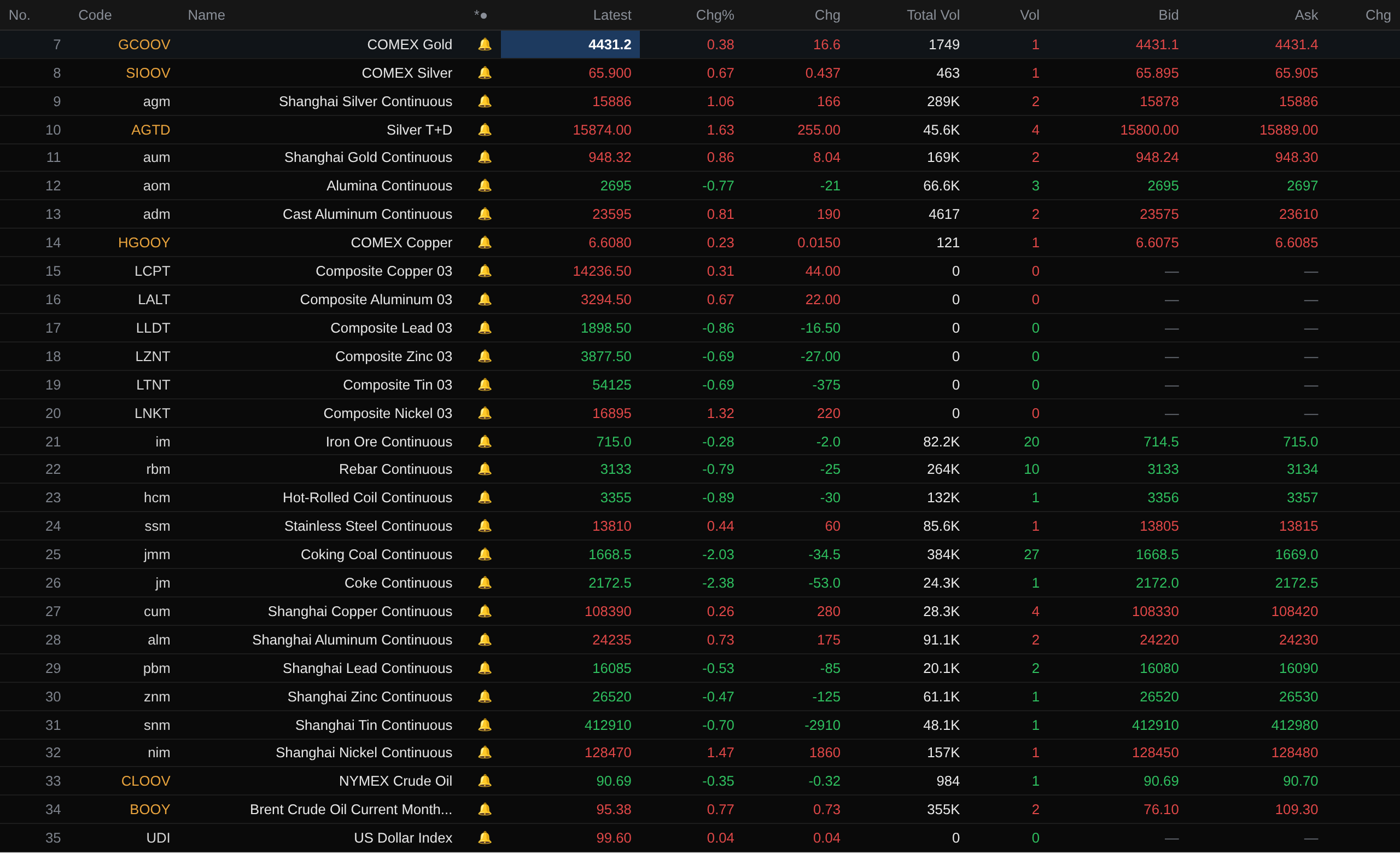
Overnight, base metals on the domestic market showed mixed performance. SHFE copper rose 0.26%, SHFE aluminum rose 0.73%, and SHFE lead fell 0.53%. SHFE zinc fell 0.47%, and SHFE tin fell 0.7%. SHFE nickel rose 1.47%. In addition, the most-traded alumina futures contract fell 0.77%, while the most-traded cast aluminum contract rose 0.81%.
Overnight, ferrous metals mostly fell. Stainless steel rose 0.44%. Iron ore fell 0.28%, rebar fell 0.79%, and hot-rolled coil fell 0.89%. For coking coal and coke: the most-traded coking coal contract fell 2.03%, and the most-traded coke contract fell 2.38%.
Overnight on the overseas market, LME base metals showed mixed performance. LME copper rose 0.31%, and LME aluminum rose 0.67%. LME lead fell 0.86%. LME zinc fell 0.69%. LME tin fell 0.69%. LME nickel rose 1.32%.
Overnight in precious metals: COMEX gold rose 0.86%, and COMEX silver rose 0.86%. Overnight, the most-traded SHFE gold contract rose 0.86%, and the most-traded SHFE silver contract rose 1.06%.
As of 7:17 on September 3, overnight closing prices:
Macro front
Domestic:
[National Energy Administration deploys major tasks for new-type power grid construction] According to the National Energy Administration, during the 15th Five-Year Plan period, China will build a high-quality new-type power grid, focusing on creating a coordinated main-distribution-micro grid architecture that enhances the safety and stability of large power grids, fully leverages the public platform role of distribution networks, and promotes flexible and diverse interactions of smart microgrids. Wang Hongzhi, head of the National Energy Administration, said that new-type power grid construction is a profound transformation involving new architecture, new technologies, and new services, requiring coordinated planning and systematic policy implementation. Efforts should be made to strengthen infrastructure advantages and build a coordinated main-distribution-micro grid architecture that enhances the safety and stability of large power grids, fully leverages the public platform role of distribution networks, and promotes flexible and diverse interactions of smart microgrids. Efforts should be made to leverage innovation leadership, accelerate the R&D and application of new grid technologies such as "AI+", flexible grid-forming, intelligent dispatch, and long duration energy storage (LDES), and develop new quality productive forces. Efforts should be made to strengthen diversified support and safeguards, upgrading new grid services that are friendly and compatible with new business forms such as efficient grid connection and consumption of new energy, high-quality power supply, and computing-power coordination. Efforts should be made to firmly uphold the bottom line of safe operation, ensure the safe and stable operation of large power grids, strengthen engineering safety and quality management, enhance grid disaster prevention and emergency response capabilities, and improve safety resilience. (Xinhua News Agency)
[Pan Gongsheng: Continue to implement a moderately accommodative monetary policy and advance the transformation of the monetary policy framework] From August 31 to September 1, 2026, the G20 held its second finance ministers and central bank governors meeting of the year in Asheville, US. The meeting discussed topics including the global economic situation and outlook, promoting economic growth, global imbalances, and sovereign debt of developing countries. Pan Gongsheng, Governor of the People's Bank of China, attended the meeting and delivered remarks. Pan Gongsheng noted that trade frictions and protectionism are weighing on the global economy through factors such as disrupting supply chains, pushing up inflation, and unsettling market expectations. All parties should firmly uphold multilateralism, make full use of the G20 finance cooperation platform, strengthen macroeconomic policy coordination, and work together to address global risks and challenges. The People's Bank of China will continue to advance the transformation of its monetary policy framework, improve the interest rate system, and continue to implement a moderately accommodative monetary policy, creating a favourable monetary and financial environment for the stable growth of the Chinese economy and the smooth operation of financial markets.
[Equipment Industry Development Center of the Ministry of Industry and Information Technology conducts survey on the electric ship industry in Fuzhou and Ningde, Fujian Province]From 24 to 26 August, Liu Xinyan, Secretary of the Party Committee and Deputy Director of the Equipment Industry Development Center of the Ministry of Industry and Information Technology, led a team to Fuzhou and Ningde, Fujian Province, to conduct a special survey on the development of the electric ship industry. The survey team visited key enterprises across the upstream and downstream segments of the industry chain to gain on-the-ground understanding of the latest progress in electric ship technology R&D, final assembly and construction, demonstration applications, and industrial ecosystem development. Going forward, under the guidance of the Ministry of Industry and Information Technology, the Equipment Industry Development Center will strengthen exchanges and cooperation with the Department of Industry and Information Technology of Fujian Province and other relevant units to jointly promote the high-quality development of the electric ship industry. (Equipment Industry Development Center of the Ministry of Industry and Information Technology)
[PBOC's August open market government bond trading resulted in a net injection of 50 billion yuan]The PBOC released liquidity injection data for various tools in August 2026. In terms of central bank lending, the medium-term lending facility (MLF) saw a net withdrawal of 100 billion yuan, pledged supplementary lending (PSL) saw a net withdrawal of 52.1 billion yuan, and other structural monetary policy tools saw a net injection of 65 billion yuan. In terms of open market operations, overnight and 7-day reverse repos saw a net withdrawal of 641.5 billion yuan, while open market government bond trading resulted in a net injection of 50 billion yuan. Central treasury cash management saw a net injection of 70 billion yuan. (Jin10 Data APP)
US dollar:
The US dollar index fell 0.1% overnight to 99.56. US private-sector employment growth slowed further in August, marking the weakest monthly performance so far this year and reigniting concerns about cooling in the US labour market. According to data released by the ADP Research Institute on Wednesday, private-sector employment increased by 37,000 in August, below the previous month's 46,000 (the July figure was revised up from an initial 44,000 to 46,000), the lowest monthly increase since January this year.
The US Fed's Beige Book showed that US economic activity has grown mildly since early July. Of the 12 Fed districts, 10 reported slight to mild growth, while 2 reported no change. Consumer spending edged up, but consumers became more price-sensitive, while high-end consumption remained strong; auto sales were sluggish due to weak confidence, high oil prices, and rising financing costs. Manufacturing activity rebounded in most districts, with some reporting strong demand for orders related to national defense and data centers. The labour market slowed down, with only a slight increase overall. Labour demand was relatively solid in manufacturing and construction, but demand declined in retail and hospitality. On prices, most districts reported mild price increases, with cost pressure from energy, transportation, raw materials, and tariffs persisting. Enterprises generally expect a positive economic outlook ahead, but remain attentive to uncertainties from energy prices, policies, and international conflicts.
US Fed's Williams said bond yields are important information for the Fed to assess economic conditions. The recent rise in yields was mainly driven by strong economic performance, an optimistic economic outlook, and robust investment demand, and was also somewhat related to the Middle East conflict. However, yields do not appear to have been significantly affected by the inflation outlook so far. Williams stressed that the Fed will consider all economic data comprehensively, and its ultimate responsibility remains achieving price stability, with bringing inflation down to 2% as the top priority. Tariffs and the Middle East war are the main factors keeping inflation above target, but no second-round inflation effects from tariffs have been seen yet. Inflation expectations remain under control, recent inflation data are encouraging, and the overall trend is downward, though services inflation remains notably elevated. He said the labour market is stable and still solid, and inflation needs to be pulled back to 2% in the foreseeable future. Before making the next policy decision, he wants to further observe and analyze economic data, and will continue to gather information for the next FOMC meeting. Williams said he supported the decision at the July FOMC meeting, believing that interest rates are at a good level and monetary policy implementation is proceeding smoothly.
According to CME "FedWatch": The probability that the US Fed will keep rates unchanged in September is 37.7%, and the probability of a cumulative 25bp hike is 62.3%. The probability that the US Fed will keep rates unchanged in October is 27.2%, the probability of a cumulative 25bp hike is 55.5%, and the probability of a cumulative 50bp hike is 17.2%. (Jin10 Data APP)
Other currencies:
The Bank of Canada kept its interest rate unchanged at 2.25%, marking the seventh consecutive meeting of holding steady, in line with market expectations. Bank of Canada Governor Macklem said at a press conference that inflation in Canada remains too high, concentrated mainly in gasoline and energy prices. Macklem noted that the bigger risk to inflation lies in how the situation in the Middle East evolves, how long oil prices will continue to fluctuate at highs, and how high they will ultimately go, adding that the central bank will closely monitor inflation data and make policy decisions accordingly. He said the central bank has limited tolerance for high inflation, and if it judges that inflation poses a persistent problem, multiple rate hikes may be needed, but rate hikes are by no means the only outcome, and the central bank is prepared to adjust monetary policy as needed. Meanwhile, the Canadian economy is growing steadily in the new phase of the trade dispute, but new US tariff measures will weigh on Q4 economic growth. Macklem also noted that some spillover effects from global bond yields on Canada have already been seen, and the central bank will take them into account; if monetary policy fails to achieve its objectives, the market will reprice. (Jin10 Data APP)
On the macro front:
Data to be released today include China's August RatingDog services PMI, Switzerland's August CPI m/m, France's final August services PMI, Germany's final August services PMI, the eurozone's final August services PMI, the UK's final August services PMI, the eurozone's July PPI m/m, US August Challenger job cuts, US initial jobless claims for the week ended August 29, the US July trade balance, the US final August S&P Global services PMI, and the US August ISM non-manufacturing PMI. In addition, watch for the Fed's release of the Beige Book on economic conditions and an interview with Fed Governor Waller.
In the crude oil market:
Both oil futures rose overnight, with WTI up 0.45% and Brent up 0.77%. Rumors about a Venezuela-related agreement triggered some profit-taking.
Data released the same day by the US Energy Information Administration showed that US commercial crude oil inventories fell by 4.5 million barrels to 424.5 million barrels in the week ended August 28, a much larger decline than the 1.1 million-barrel draw analysts had expected. Refinery operating rates rose 0.6 percentage points to 98%, the highest since August 2018, and crude oil daily average processing volumes increased by 103,000 barrels. (Wall Street CN)
According to The Wall Street Journal, Trump on Tuesday urged industry executives at a White House meeting of oil companies to build more refineries capable of producing fuel, but convincing companies to do so will not be easy. Building new refineries is not economically attractive, requiring billions of dollars in investment and three to five years of construction. The oil industry expects the energy market to return to balance long before any new refinery is completed. “No one is going to make a multibillion-dollar investment based on three months of record margins,” said Robert Campbell, an analyst at Energy Aspects. Building a new refinery faces major hurdles, starting with the daunting task of obtaining the various permits required by federal, state, and local governments. Meanwhile, as consumers buy more EVs and engine efficiency continues to improve, gasoline demand is expected to decline in the long term. (Jin10 Data APP)
![Social inventory of silicon metal in major regions edged down WoW [SMM silicon inventory]](https://imgqn.smm.cn/usercenter/OGmeJ20251217171722.jpeg)