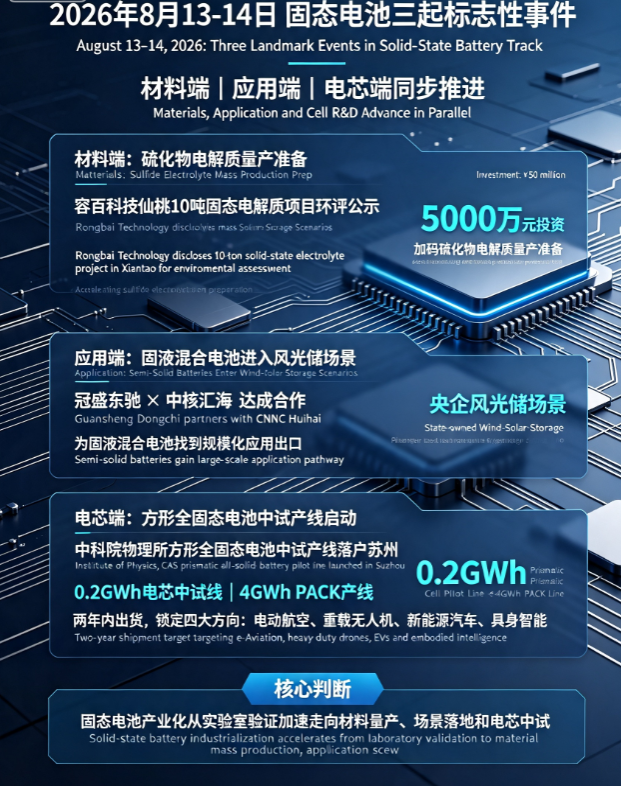
Resumen – Entre el 13 y el 14 de agosto de 2026, tres hitos reconfiguraron el panorama de las baterías de estado sólido. En el frente de los materiales, el proyecto de electrolito de estado sólido de 10 toneladas de Ronbay Technology en Xiantao superó su evaluación ambiental, con una inversión de 50 millones de RMB que acerca la producción de electrolito de sulfuro a la realidad. En el frente de las aplicaciones, Guansheng Dongchi se asoció con CNNC Haihui, asegurando un canal de empresa estatal (SOE) para sus baterías híbridas sólido-líquidas de polímero en proyectos de almacenamiento eólico-solar. En el frente de las celdas, el Instituto de Física (CAS) puso en marcha una línea piloto de baterías prismáticas de estado sólido total en Suzhou, con el objetivo de alcanzar 0,2 GWh de capacidad piloto de celdas y 4 GWh de integración de sistemas, con las primeras entregas previstas en dos años para aviación eléctrica, drones de carga pesada, vehículos eléctricos e inteligencia encarnada. Estos movimientos concurrentes indican que la industrialización de las baterías de estado sólido está pasando de avances aislados a un progreso sistemático.



I. Fundamentos materiales – El impulso de 50 millones de RMB de Ronbay a los electrolitos de estado sólido
El 14 de agosto de 2026, la Oficina Municipal de Ecología y Medio Ambiente de Xiantao publicó la primera divulgación de impacto ambiental del proyecto de electrolito de estado sólido de 10 toneladas anuales de Ronbay Xiantao Lithium Material Co., Ltd. La instalación, situada al este de la calle Xidagou en la ciudad de Changtuokou, implica una inversión de 50 millones de RMB y un nuevo edificio de producción de 693 m².
Aunque 10 toneladas parecen insignificantes en términos industriales, son muy significativas para las baterías de estado sólido. El electrolito sólido es el componente más crítico y el cuello de botella en las celdas totalmente de estado sólido. Ronbay ya había revelado que su línea piloto de electrolito de sulfuro estaba en construcción, con algunos equipos de producción en masa ya validados con materiales, con el objetivo de finalizarla a principios de 2026 y comenzar la producción en el primer semestre. Este nuevo anuncio de evaluación ambiental sitúa el proyecto en su fase de ejecución. Cabe señalar que Ronbay ya cuenta en Xiantao con un proyecto de 400 000 toneladas de material de cátodo y un proyecto de I+D e industrialización de cátodo de iones de sodio polianiónico de 6 000 toneladas. La incorporación de electrolitos de estado sólido enriquece aún más su matriz de materiales sólidos, creando una estrategia de «doble motor» que abarca tanto cátodos como electrolitos.
II. Expansión del almacenamiento de energía – Guansheng Dongchi encuentra su salida en las SOE
El 13 de agosto de 2026, Zhejiang Guansheng Dongchi Energy Technology Co., Ltd. y CNNC Haihui Wind Power Investment Co., Ltd. firmaron formalmente un acuerdo marco de cooperación estratégica en Zhejiang. CNNC Haihui, una empresa conjunta de CNNC y CNOOC, se centra en la inversión en proyectos eólicos terrestres, marinos y de almacenamiento independiente. Guansheng Dongchi, aprovechando las cuatro décadas de experiencia en fabricación de precisión de su matriz Guansheng, se especializa en la I+D y comercialización de baterías híbridas de polímero sólido‑líquido, con una cartera de productos completa y capacidad de producción en masa.
La clave de esta alianza es el acceso a escenarios. CNNC Haihui posee una amplia cartera de activos renovables, el canal de despliegue más directo para sistemas de almacenamiento. Las baterías híbridas sólido‑líquido BAXPOWER de Guansheng Dongchi ofrecen una vida de ciclo ultralarga y estabilidad en todo el rango de temperaturas, perfectas para las exigentes condiciones del almacenamiento a escala de red. La colaboración busca desplegar soluciones híbridas sólido‑líquido en proyectos de almacenamiento eólico‑solar conjunto y de almacenamiento C&I.
Desde la perspectiva sectorial, se trata de una combinación clásica de “tecnología que busca escenarios”. Las baterías de estado sólido/híbridas aún cuestan más que las de iones de litio convencionales, y el almacenamiento es muy sensible al coste. El efecto demostrativo y la capacidad de compra a gran escala de los proyectos de SOE proporcionan exactamente el impulso necesario para cruzar el “valle de la muerte”. Se espera que el proyecto de batería LFP semisólida de Guansheng Dongchi alcance su capacidad de 2 GWh a mediados de 2026, y este acuerdo asegura un canal de compra crucial para esa producción venidera.
III. Avance en celdas – El Instituto de Física de la CAS lanza línea piloto de baterías prismáticas totalmente de estado sólido
Ese mismo día, se firmó en Suzhou el proyecto de industrialización de baterías prismáticas avanzadas totalmente de estado sólido. El proyecto es una colaboración entre el Instituto de Física (CAS) y Zhongke Low‑Carbon Urban Development (Suzhou) Co., Ltd., con Zhongke Yulang Low‑Carbon Technology Industry Development (Suzhou) Co., Ltd. como contratista de construcción. La primera fase asigna 219 mu (≈14,6 hectáreas) de terreno industrial en el Parque Industrial de Suzhou, con el profesor Li Hong como líder del proyecto.
Tecnológicamente, el proyecto adopta una ruta de solidificación in situ – solidificando el electrolito líquido dentro de la celda para resolver el problema más desafiante de contacto interfacial entre electrodos y electrolito. La línea integra cinco procesos centrales: integración de electrodos, membrana conductora de iones, prelitización, laminación térmica y refrigeración líquida central. Cabe destacar que la misma línea puede producir de forma flexible celdas desde 400 Wh/kg semisólidas hasta 600 Wh/kg completamente sólidas. El proceso de electrodo seco reduce la longitud de la línea en más de la mitad y el consumo energético en un 40 % en comparación con los procesos húmedos convencionales.
La planificación de capacidad incluye una línea piloto de celdas de 0,2 GWh y una línea de integración de sistemas de 4 GWh en la primera fase, con las primeras entregas previstas en un plazo de dos años. Las aplicaciones objetivo son la aviación eléctrica, drones de carga pesada, vehículos eléctricos e inteligencia encarnada – una elección visionaria, ya que una densidad energética de 400–600 Wh/kg es exactamente el umbral que estos sectores requieren.
Desde la perspectiva de la estructura industrial regional, este proyecto crea una complementariedad diferenciada dentro del ecosistema de baterías de estado sólido de Jiangsu: Kunshan Qingtao se centra en semisólidas de óxido, Changzhou CALB en completamente sólidas de sulfuro, y Suzhou entra con la solidificación in situ cubriendo todo el espectro desde semisólidas hasta totalmente sólidas. El proyecto también vinculará empresas auxiliares en el área Suzhou-Wuxi-Changzhou para formar un “círculo de cadena de suministro de una hora”, lo que se espera impulse una producción industrial auxiliar por valor de varios miles de millones de yuanes.
IV. Tres conclusiones
Estos tres acontecimientos, coincidiendo en cuestión de días, envían señales claras:
En primer lugar, la industrialización ha pasado de las “narrativas de laboratorio” a la “validación de ingeniería”. La línea de electrolito de 10 toneladas de Ronbay, la línea semisólida de 2 GWh de Guansheng Dongchi y la línea piloto de 0,2 GWh del Instituto de Física son despliegues de capacidad concretos, no planes de PowerPoint. La industria mundial de baterías de estado sólido se encuentra en una ventana crítica del laboratorio al mercado, y algunas instituciones pronostican que el mercado mundial podría superar los 1,2 billones de RMB para 2030.
En segundo lugar, las rutas tecnológicas se están diversificando. El sulfuro (Ronbay), el híbrido polimérico (Guansheng Dongchi) y la solidificación in situ (CAS) avanzan en paralelo. Diferentes rutas se adaptan a distintos escenarios: el almacenamiento prioriza la vida útil y el coste, los vehículos eléctricos priorizan la densidad energética y la tasa de descarga, y la aviación prioriza la seguridad y el aligeramiento. Ninguna ruta dominará todos los segmentos; la competencia y complementariedad entre múltiples vías será la norma.
Tercero, los “equipos nacionales” y el capital industrial están uniendo fuerzas. CNNC Haihui (una empresa estatal) ofrece escenarios de despliegue, el Instituto de Física de la CAS lidera la I+D de celdas centrales, mientras Ronbay y Guansheng (empresas cotizadas) impulsan la comercialización: el gobierno, la investigación y la industria están formando un impulso sinérgico.
2026 se considera ampliamente un año clave para la industrialización de las baterías de estado sólido. Estos tres eventos en la misma semana no son una coincidencia. Desde los materiales hasta las celdas, desde la I+D hasta las aplicaciones, desde los laboratorios hasta las líneas de producción, el rompecabezas se va armando pieza por pieza. El próximo año pondrá a prueba si estos proyectos pueden realmente “funcionar” desde la fase piloto hasta la producción en masa. Quien primero supere la brecha entre la línea piloto y la producción en volumen se hará con una posición de liderazgo en un futuro mercado de billones de dólares.
**Nota:** Para más información o consultas sobre el desarrollo de baterías de estado sólido, póngase en contacto con:
Teléfono: 021-20707860 (o WeChat: 13585549799)
Contacto: Chaoxing Yang. ¡Gracias!
![Serie sobre baterías de estado sólido para la próxima década, parte 9 de 9: una vía completamente nueva, no una «simple secuela» de las baterías de litio líquidas [Análisis de SMM]](https://imgqn.smm.cn/usercenter/ezoBg20251217171730.jpg)
![[Estado sólido: la planta de baterías de estado sólido de 1 GWh de Chunli New Energy inicia su producción en Jiangxi]](https://imgqn.smm.cn/usercenter/MaxcL20251217171730.jpg)
![Revisión de la industria de baterías de estado sólido durante el feriado del Día Nacional: fuerte impulso político, pero avance industrial lento [Análisis de SMM]](https://imgqn.smm.cn/usercenter/QxQbN20251217171727.jpg)