1. Market Surface: Three Signals Appear Simultaneously, Signaling a Logic Shift
In the final week of July, the China aluminum ingot market saw a set of contradictory yet mutually confirming signals:
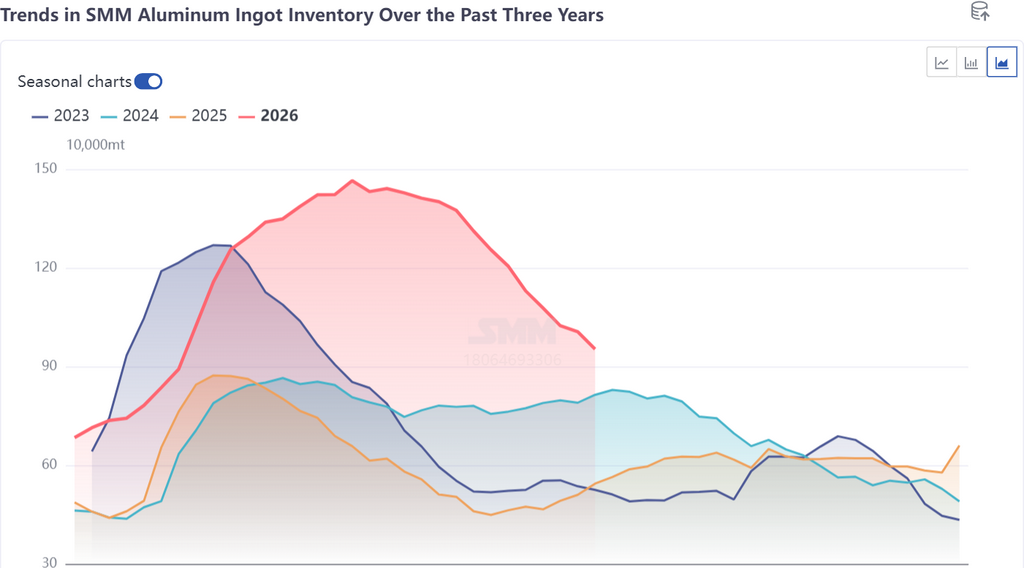
① Accelerated destocking: Inventory in major consumption areas was 953,000 mt, down 53,000 mt during the week, breaking below the key 1 million mt mark;
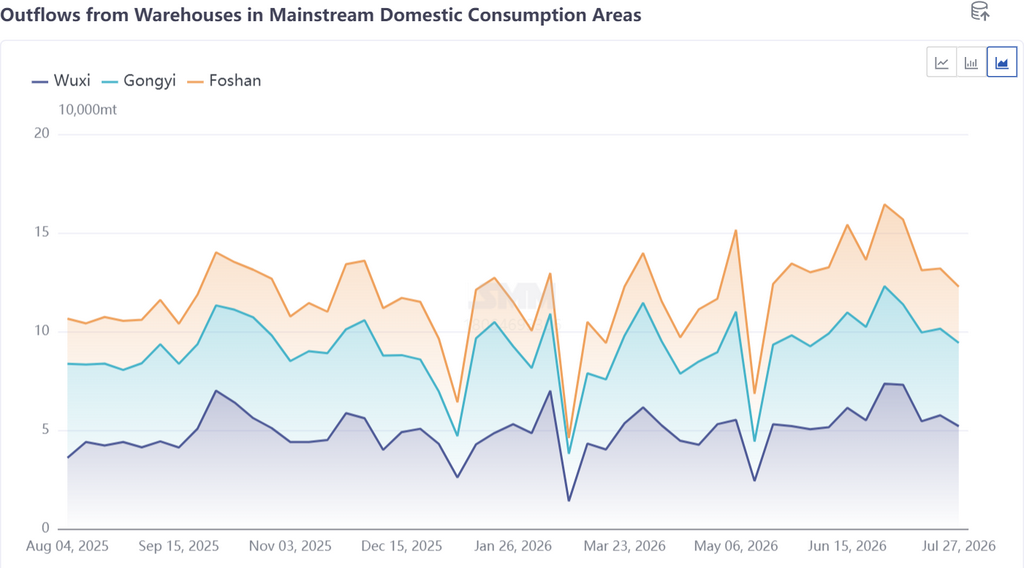
② Notable pullback in warehouse withdrawals: Weekly warehouse withdrawals were 127,700 mt, down 9,700 mt from the previous week, losing the advantage of being elevated over the same period in the recent four years;
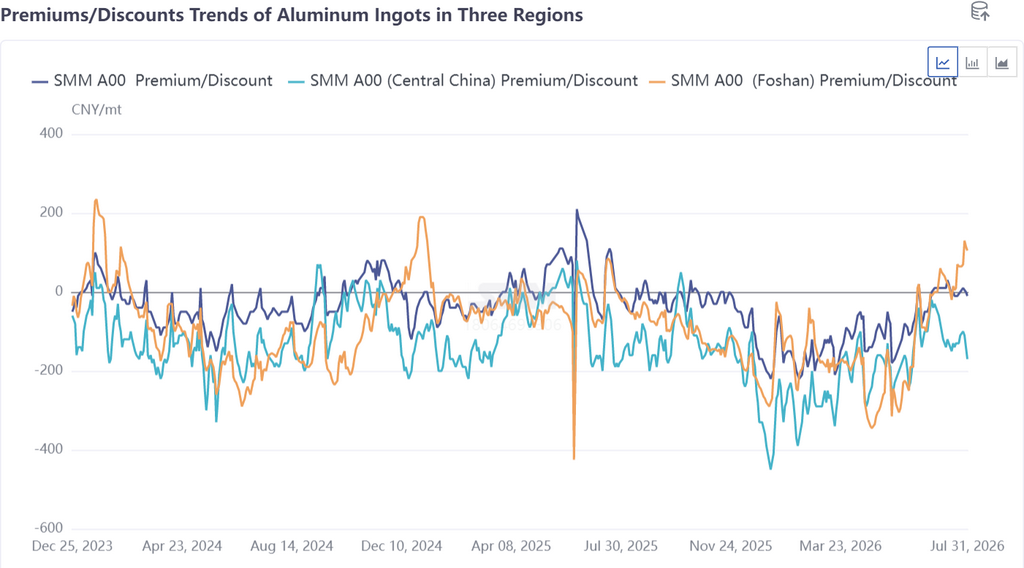
③ South China bucks the trend: Foshan’s premium against the 2608 contract stood at 115 yuan/mt, widening 50 yuan/mt WoW, making it the region with the largest destocking this week;
SMM assessment: Falling inventory amid weakening demand indicators—declining outflows and sluggish transactions in east and central China—suggests this destocking round is no longer demand-driven. The real driver of this week’s accelerated destocking came from the supply side: a slower shipment pace, particularly the sharp WoW decline in arrivals in south China. This type of “supply-contraction destocking” is fundamentally different from the “outflow-driven destocking” seen in June: once shipments recover, the destocking slope may quickly flatten; the latter’s driver came from end-user absorption, offering stronger sustainability.
2. Inventory Overview: Below 1 Million mt, with 512,000 mt Destocking the Highest in Recent Years
1. Absolute Volume and Destocking Pace
According to SMM statistics, as of July 30, China’s aluminum ingot inventory in major consumption areas stood at 953,000 mt, down 26,000 mt from Monday (July 27), and down 53,000 mt WoW from last Thursday. From the YTD high of 1.465 million mt in early May, this destocking round has cumulatively pulled back 512,000 mt, a destocking magnitude of 35%, making it the highest in both absolute volume and magnitude over the recent three years.
From a comparison with the same period in three prior years, the absolute inventory level at the end of July 2026 was still approximately 300,000-350,000 mt higher than the same period in 2024 and 2025, but the cumulative destocking slope was notably steeper—the destocking magnitudes of the same period in 2024 and 2025 were only 26% and 30%, respectively, while 2026 has reached 35%, showing a unique trend of “high starting base, accelerated destocking.” The absolute inventory level is expected to further converge toward historical averages in August.
2. Warehouse Withdrawal Trend: From “Spike in Highs” to “Pullback from Highs”
The peak warehouse withdrawals in June hit a nearly four-year high (170,000 mt in a single week) but have declined continuously since entering July. This week, China’s aluminum ingot warehouse withdrawals fell to 127,700 mt, down 9,700 mt from the previous week, temporarily losing the advantage over the same period in recent four years. The shift in withdrawals from “spike-like releases” to “trend-based decline” is the core yardstick for judging the quality shift in this destocking round.
Three headwinds behind weakening withdrawals:
The rebound in aluminum price center has curbed downstream purchases: SHFE aluminum has drifted higher since July, weakening downstream purchase willingness and cooling procurement sentiment;
The pullback in aluminum billet processing fees has weakened substitution effects: The previous logic of mutual substitution between aluminum ingots and billets has weakened notably, causing a retreat in “substitutive” demand for ingots;
Traditional off-season persists at terminals: Downstream sectors such as real estate, construction, and autos are generally under pressure, with purchases mainly driven by rigid restocking, and a lack of willingness for active stockpiling.
Key yardstick: The “outflow-driven destocking” seen in June had strong sustainability because its driver came from terminal absorption; the current combination of “weakening outflows + accelerating inventory decline” represents “passive destocking” driven by temporary supply-side contraction. Once upstream shipment pace recovers or a week sees concentrated arrivals in south China, the destocking slope may slow temporarily, or even a weekly inventory buildup may occur.
3. South China Spot Market: Sharp Arrival Decline is the Core Driver of Rising Premium
Foshan’s premium widened by 50 yuan/mt WoW to 115 yuan/mt this week, turning it into the strongest market among the three regions. The rising premium is supported by three layers:
① Sharp drop in arrivals—core variable: The persistently high proportion of liquid aluminum in southwestern upstream has significantly compressed casting ingot volumes, setting a tight arrival tone; coupled with the gradual exhaustion of certain invisible inventories and imported aluminum phases, arrivals have contracted to tight conditions. This is the first-order reason for Foshan’s rising premium, with the remaining factors serving as “amplifiers.”
② Major player price lifting—short-term catalyst: Mid-week, major players aggressively lifted prices to purchase and make markets. Suppliers, firmly bullish on the outlook, held prices firm and held back from selling, further amplifying spot signals of tight arrivals.
③ Rigid demand resilience—withdrawals rose instead of falling: Foshan’s weekly warehouse withdrawals recorded 30,400 mt, bucking the decline trend. Downstream rigid demand showed strong resilience, with higher price acceptance than in east and central China, providing demand-side floor support for the premium.
SMM analysis: The essence of Foshan’s rising premium is “supply-contraction-driven premium” rather than “demand-expansion-driven premium.” In August, the southwestern proportion of liquid aluminum is expected to rise steadily. Foshan’s visible price advantage may attract some incremental cargo, but arrival replenishment will still take time. In the short term, south China will maintain a pattern of destocking + high premium.
3. August Outlook: Destocking Trend Intact, but Efficiency of “Supply-Driven Destocking” to Be Tested
According to SMM statistics, China’s aluminum production in July 2026 (31 days) rose 1.6% YoY and 3.5% MoM. While production recovered MoM, the proportion of domestic liquid aluminum output further increased: the monthly proportion of liquid aluminum rose 1.1 percentage points MoM to 78.3%, slightly exceeding early-month expectations overall. Combined with SMM’s proportion of liquid aluminum calculations, July’s domestic aluminum casting ingot volume fell 15.1% YoY and 1.4% MoM. Production is still growing YoY, but physical supply at the casting ingot end has contracted significantly—this is the most fundamental factor supporting the continuation of destocking, and the baseline for the destocking trend remaining unchanged in August.
SMM believes that entering August, under a backdrop of weak supply and demand, the overall destocking logic for China’s aluminum ingots remains unchanged, but the core driver has shifted from “demand-driven warehouse withdrawals” to “supply contraction + shipment pace”:
Supply side continues to contract: The proportion of liquid aluminum in August is expected to rise to 78.5%, further compressing casting ingot volumes. As domestic aluminum capacity standardization advances, room for incremental aluminum ingot supply is limited;
South China arrivals remain tight: With southwestern liquid aluminum proportion high and southwestern-southern China shipment pace unlikely to improve significantly in the short term, Foshan’s tight arrival pattern persists;
Demand-side elasticity is limited: August remains in the traditional off-season, with downstream purchases mainly driven by rigid restocking, making it hard for warehouse withdrawals to stage another breakout surpassing prior highs.
Key difference: June’s destocking was driven by surging outflows—withdrawals hit 170,000 mt, a nearly four-year high, supported by real end-user digestion, showing strong sustainability; the current destocking is driven by slower shipment pace—withdrawals have fallen to 127,700 mt. Once supply-side contraction loosens, the destocking slope will rapidly flatten. The essential difference is: demand-type destocking is “downstream buying”; supply-type destocking is “upstream lacking volume.” The former is active destocking; the latter is passive destocking. Therefore, support from the supply side determines the continuation of the destocking direction, but demand-side performance will decide the subsequent destocking speed.
![Warehouse withdrawals pull back, but destocking accelerates — Is China's aluminum ingot destocking logic changing? [SMM Analysis]](https://imgqn.smm.cn/usercenter/YYogD20251217171650.jpg)

![Alumina Weakness Hard to Change: Cost Support Battles Surplus, 2,600 Level Under Test [SMM Analysis]](https://imgqn.smm.cn/usercenter/wvGIW20251217171655.jpg)