SMM July 31 news:
Metals Market
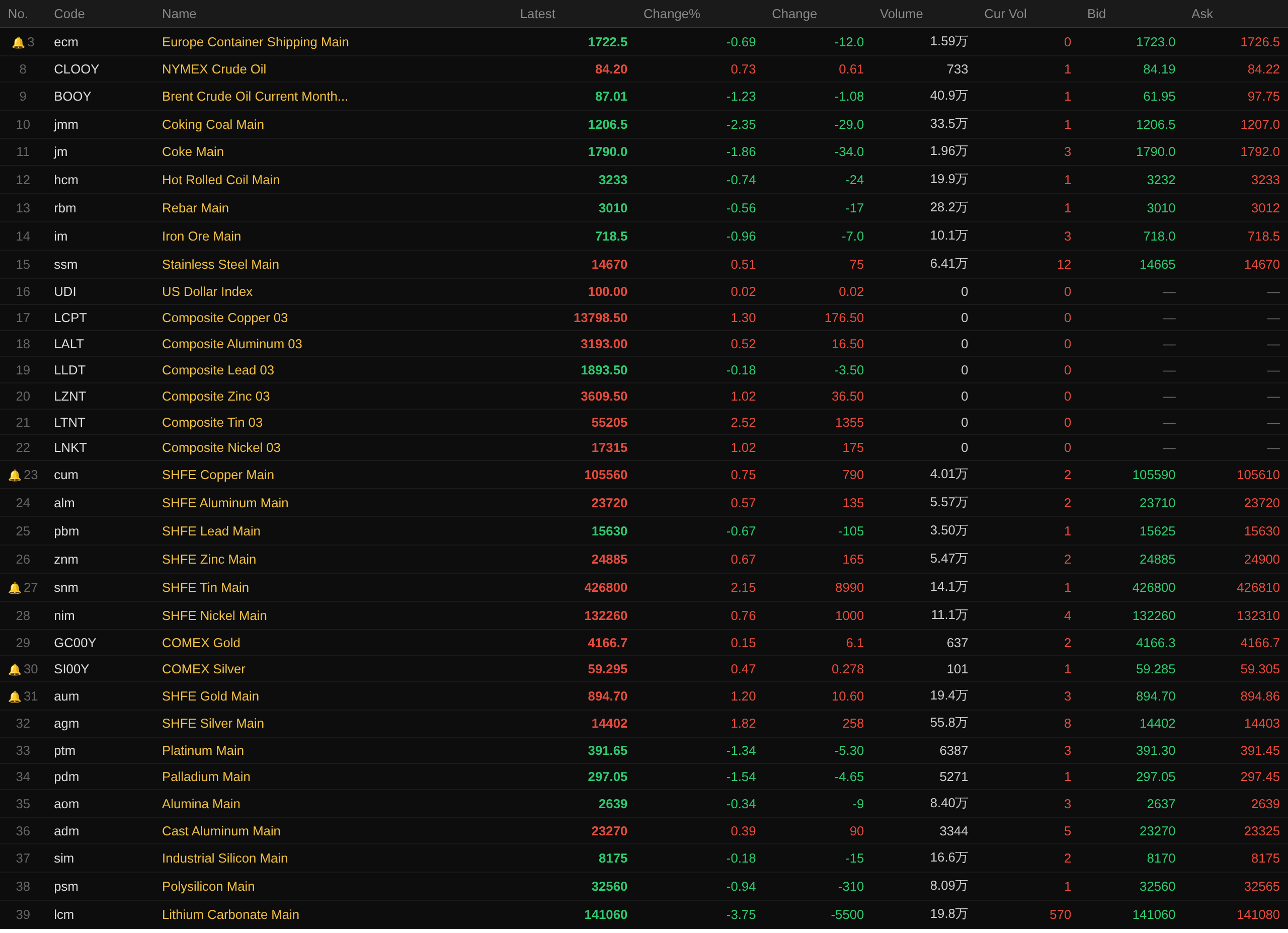
Overnight, base metals on both domestic and overseas markets generally rose, with LME lead and SHFE lead falling, LME lead down 0.18% and SHFE lead down 0.67%. LME tin and SHFE zinc rose over 2%, with LME tin up 2.52% and SHFE tin up 2.15%. LME copper, LME zinc, and LME nickel all rose over 1%, with LME copper up 1.3%, LME zinc up 1.02%, and LME nickel also up 1.02%. Alumina main contract fell 0.34%, while cast aluminum main contract rose 0.39%.
Overnight, the ferrous metals complex mostly fell, with only stainless steel rising, up 0.51%. Iron ore fell 0.96%, hot-rolled coil fell 0.74%, and rebar fell 0.56%. For coking coal and coke, coking coal fell 2.35% and coke fell 1.86%.
In precious metals, overnight COMEX gold rose 1.61%, and COMEX silver rose 2.02%. Domestically, SHFE gold rose 1.2%, and SHFE silver rose 1.82%.
As of 6:42 a.m. on July 31, overnight closing prices:
Macro Front
China:
[The Political Bureau of the CPC Central Committee held a meeting, decided to convene the Fifth Plenary Session of the 20th CPC Central Committee, and analyzed and studied the current economic situation and economic work] The Political Bureau of the CPC Central Committee held a meeting on July 30 and decided that the Fifth Plenary Session of the 20th Central Committee of the Communist Party of China will be held in Beijing in October this year. The main agenda is for the Political Bureau to report its work to the Central Committee and study major issues concerning persistently advancing full and rigorous Party self-governance. The meeting analyzed and studied the current economic situation and made arrangements for economic work in H2. Xi Jinping, General Secretary of the CPC Central Committee, presided over the meeting. It was noted at the meeting that since the 18th CPC National Congress, full and rigorous Party self-governance has achieved great accomplishments, opening a new chapter in the self-reform of a century-old party, and driving historic achievements and transformations in the cause of the Party and the country, securing the historical initiative of strengthening both the Party and the nation. At the same time, as profound changes take place in global, national and Party conditions, full and rigorous Party self-governance faces many new circumstances and problems. The entire Party must, from the strategic perspective of consolidating the Party’s ruling position and fulfilling its missions and tasks, deeply recognize the great significance of persistently advancing full and rigorous Party self-governance, strengthen confidence, maintain resolve, uphold and apply the valuable experience of full and rigorous Party self-governance in the new era with higher standards and more concrete measures, address and solve prominent problems in Party building, and consolidate and develop the positive political environment formed through governing the Party.
[National Energy Administration: China's renewable energy power generation share exceeded 40% for the first time in H1] From the press conference held by the National Energy Administration, it was learned that in H1, China’s renewable energy developed rapidly, with its power generation accounting for more than 40% of total generation for the first time. In H1, national renewable energy power generation reached nearly 2 trillion kWh, up about 9% YoY, accounting for 41.2% of total power generation, exceeding 40% for the first time. Among this, wind and solar power generation totaled 1.25 trillion kWh, up 9.3% YoY. In terms of installations, new renewable energy installations in H1 reached 117 million kW, accounting for 73.9% of total new installations, continuing to dominate new capacity. As of end-June, the country’s renewable energy installed capacity reached 2.455 billion kW, accounting for over 60% of China’s total installed capacity. (CCTV News)
[China’s coal-fired power generation share fell below 50% of total generation for the first time in H1] From today’s press conference held by the National Energy Administration, it was learned that in H1, China’s green and low-carbon energy transformation accelerated. As of end-June, combined wind and solar power installed capacity reached 1.95 billion kW, up 16.8% YoY. In terms of power generation, wind and solar power generation exceeded 1.2 trillion kWh in H1, accounting for about a quarter of the country’s total electricity consumption. Meanwhile, China’s coal-fired power generation was 2.5 trillion kWh, with its share of total generation falling to 49.7%, marking the first time that H1 coal-fired generation share fell below 50%. (CCTV News)
Dollar:
As of the overnight close, the US dollar index continued to fall, dropping 0.83% to 99.98, breaking below the 100 integer level and posting a three-day losing streak. US economic growth in Q2 was lower than expected, but strong consumer spending and business investment indicated resilient domestic demand. Preliminary data released Thursday by the Commerce Department’s Bureau of Economic Analysis showed that Q2 annualized real GDP growth was 1.5%, below market expectations. A decline in net exports dragged on the overall figure, but consumer spending and business investment remained strong, partially offsetting external pressures.
Data released Thursday by the US government showed that the US PCE price index fell 0.1% MoM in June, the first monthly decline since the pandemic in 2020, further explaining why the Fed chose to keep rates unchanged this week. The PCE annual inflation rate slowed to 3.7% from May’s three-year high of 4.1%. However, it remains unclear whether inflation will continue to ease. The cooling in June was mainly due to falling oil prices after the US and Iran reached a fragile temporary ceasefire agreement. The core PCE price index rose 0.1% MoM in June, below market expectations, and the YoY growth rate dropped from 3.4% to 3.3%. The Fed regards the PCE index, especially the core PCE, as the most accurate gauge of US inflation trends. Currently, the gauge shows US inflation has been above the Fed’s 2% target for a sixth consecutive year. (Jin10 Data APP)
According to CME “FedWatch”: The probability of the Fed keeping rates unchanged through September is 36.6%, while the probability of a cumulative 25bp rate hike is 63.4%. The probability of the Fed keeping rates unchanged through October is 26.9%, that of a cumulative 25bp hike is 56.3%, and that of a cumulative 50bp hike is 16.9%. (Jin10 Data APP)
Macro:
Today the market will see the release of China’s July official manufacturing PMI, US Q2 employment cost index QoQ, US July Chicago PMI, US July University of Michigan consumer sentiment index final reading, US July one-year inflation expectations final reading, UK July Nationwide house price index MoM, Switzerland June real retail sales YoY, France July CPI MoM preliminary, Germany July seasonally adjusted unemployment change and unemployment rate, Canada May GDP MoM, Eurozone July CPI YoY preliminary and MoM preliminary, Japan June unemployment rate, and the Bank of Japan target rate as of July 31.
In addition, China will start a new round of fuel price adjustments. Amazon and Apple reported earnings after the US stock market close on July 30. Japanese NAND flash memory maker Kioxia reported earnings. The Bank of Japan released its interest rate decision and economic outlook report. BOJ Governor Kazuo Ueda held a press conference on monetary policy.
Crude Oil:
Overnight, oil prices on both markets declined, with WTI down 0.59% and Brent down 1.23%, as the market continued to await progress on the reopening of the Strait of Hormuz.
The recently slowing crude oil lightering service in the Strait of Hormuz has revived, helping move millions of barrels of crude out of the strait. Amid escalating hostilities in the Middle East, this transport method has once again played a key role. The lightering mode emerged during the most intense period of conflict and has become a vital lifeline for some oil-producing countries to maintain exports. Vessels transport crude from the Persian Gulf—often with their Automatic Identification System (AIS) transponders turned off to avoid detection—and then conduct ship-to-ship (STS) transfers with another tanker outside the Strait of Hormuz, which then delivers the crude to buyers around the world. Although crude transport through the Strait of Hormuz is still below pre-conflict levels, the crude that has been successfully shipped out has played an important role in easing market concerns about oil price spikes. Two people with direct knowledge said at least two shipping companies involved in Hormuz transport have seen their lightering volume approach pre-escalation levels. (Jin10 Data APP)
Turkey expects crude oil flows from Iraq to continue despite the failure to renew a decades-old pipeline agreement that expired on Monday, according to Turkish officials familiar with the matter. Officials said talks on Tuesday between Turkish President Erdogan and Iraqi Prime Minister Ali Zaidi on the 986 km (613 mile) Kirkuk-Ceyhan pipeline failed to reach a final result, but the two sides agreed to keep crude flowing while negotiations continue. They added that any eventual agreement would be backdated to July 27, the expiration date of the previous 53-year deal. (Jin10 Data APP)

![Market Supply and Demand Both Sluggish but Inventory Buildup Risk Remains, Short-Term Lead Prices to Stay Under Pressure [SMM Lead Morning Brief]](https://imgqn.smm.cn/usercenter/mIbTL20251217171721.jpg)
![US dollar index moves lower, LME zinc center moves higher [SMM Morning Meeting Summary]](https://imgqn.smm.cn/usercenter/VPThK20251217171754.jpg)