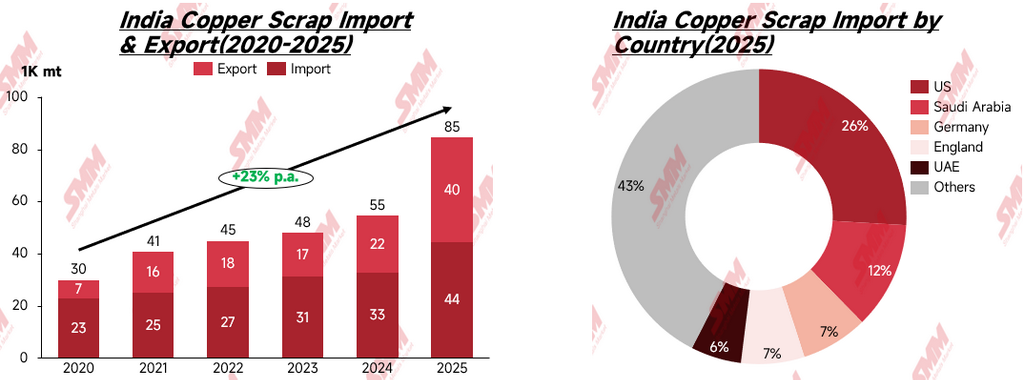
India has become an increasingly active buyer in the global copper scrap market, with its import volumes showing clear growth in recent years.
The expansion is primarily driven by rising domestic raw material demand. Continued investment in infrastructure, power grids, cables and manufacturing has supported rapid growth in copper consumption. However, India’s domestic scrap collection remains insufficient to meet the needs of secondary copper rod plants, copper ingot producers and other copper processors, making imported scrap an important source of feedstock.
India has also maintained strong imports despite tight global supply because it can accept and process a wider range of copper scrap than some other Asian markets. Millberry, No. 1 copper scrap and high-quality copper granules can be used in copper rod and other high-grade copper products. No. 2 copper scrap, mixed materials and more complex feedstock can be dismantled, sorted and smelted into copper ingots, copper anodes or other secondary copper products. Brass and other copper alloy scrap can also be used in brass ingots, bars and components.
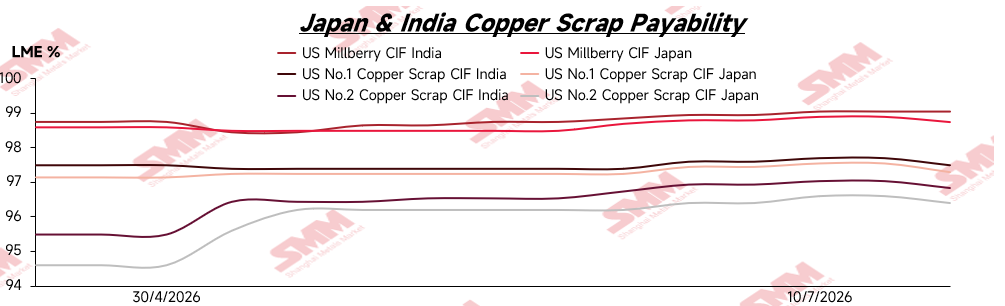
According to SMM market research, Indian buyers often offer higher prices or payabilities than buyers in China, Japan and South Korea, particularly for materials requiring further dismantling, sorting or smelting. This pricing advantage is supported by several factors.
First, tariff adjustments have reduced direct import costs. Since February 2025, India has lowered the basic customs duty to zero for certain copper scrap products under tariff codes 74040012, 74040019 and 74040022. As basic customs duty cannot normally be offset through subsequent sales, its removal directly reduces the landed cost of eligible material and creates additional room for higher bids.
Second, competition for feedstock remains intense. Domestic scrap supply has not kept pace with the expansion of secondary copper rod, copper ingot, brass and smelting capacity. When plants have sufficient orders but limited raw material inventories, the losses caused by production cuts or furnace shutdowns may exceed the cost of paying several tenths of a percentage point more in payability. Some producers are therefore willing to bid aggressively to maintain operating rates.
Third, India has a large number of small and medium-sized companies engaged in manual dismantling, sorting, copper granule production and pyrometallurgical processing. Detailed manual sorting can reduce copper losses and improve recovery rates from cables, motors and mixed scrap. Compared with markets facing higher labour and treatment costs, Indian processors have greater flexibility in handling different grades and forms of material. This allows certain complex scrap products to achieve higher valuations in India.
Logistics also provide an advantage. India is relatively close to major supply regions such as the UAE, Saudi Arabia, Oman, East Africa and parts of Europe. Cargoes from these regions can often reach India with lower freight costs and shorter transit times than shipments to East Asia. Even when Indian buyers offer higher headline payabilities, their delivered costs may remain commercially acceptable due to lower logistics and financing expenses.
Overall, India’s high copper scrap bids are supported by domestic feedstock shortages, strong competition among buyers, flexible processing routes, relatively low sorting costs and favourable access to nearby supply regions. The removal of basic customs duties on certain copper scrap products has further strengthened its purchasing capacity.
As copper demand from India’s power grids, cable industry, infrastructure and manufacturing sector continues to grow, its demand for overseas copper scrap is expected to remain resilient. However, high payabilities will also squeeze processing margins. Whether Indian buyers can continue offering aggressive prices will ultimately depend on domestic copper product prices, plant operating rates, financing costs and actual metal recovery returns.
![Copper Prices High, Downstream Secondary Copper Rod Enterprises Mainly Wait and See [SMM Secondary Copper Daily Review]](https://imgqn.smm.cn/usercenter/GfvuY20251217171708.jpg)
![[SMM Analysis] Why Can India Consistently Purchase Copper Scrap Outside China at High Prices?](https://imgqn.smm.cn/usercenter/tXxfd20251217171713.jpg)