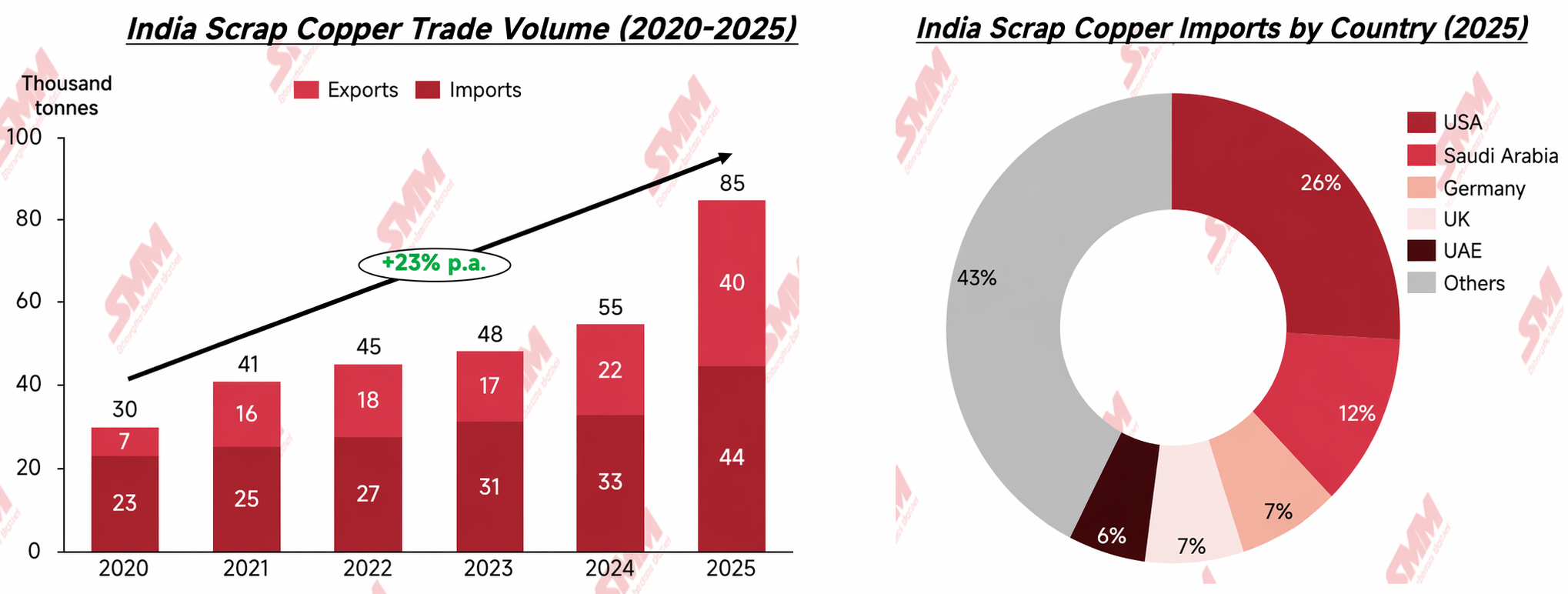
In recent years, India has gradually emerged as an active buyer in the global copper scrap market, with the scale of its copper scrap trade showing a marked growth trend.
The rapid climb in India’s copper scrap imports is fundamentally driven by its continuously expanding raw material demand. As one of the world’s fast-growing economies, India has been pressing ahead with infrastructure, power grid, wire and cable, and manufacturing construction, fueling sustained copper consumption growth. However, India’s domestic copper scrap recycling volume has yet to fully meet the production needs of secondary copper rod, copper ingot, and other copper processing enterprises, making imported copper scrap an important raw material supplement.
Furthermore, against the backdrop of tight global copper scrap supply, India’s ability to maintain a relatively high import volume is also linked to its comparatively lenient import standards and diversified raw material processing capabilities. Compared with China’s requirements regarding the grade, form, and impurity content of imported copper scrap, India can accept a broader range of copper scrap types. Bare bright copper, No.1 copper, and high-grade copper wire nodules can be directly used for copper rod or other high-grade copper semis production; No.2 copper, mixed copper materials, and some complex raw materials can be dismantled, sorted, and smelted to produce products such as copper ingot and copper anode; brass and other copper alloy scrap can also enter the production of brass ingot, copper billet, and parts. Such diversified absorption routes enable India to take in more overseas copper scrap resources across different grades and forms.
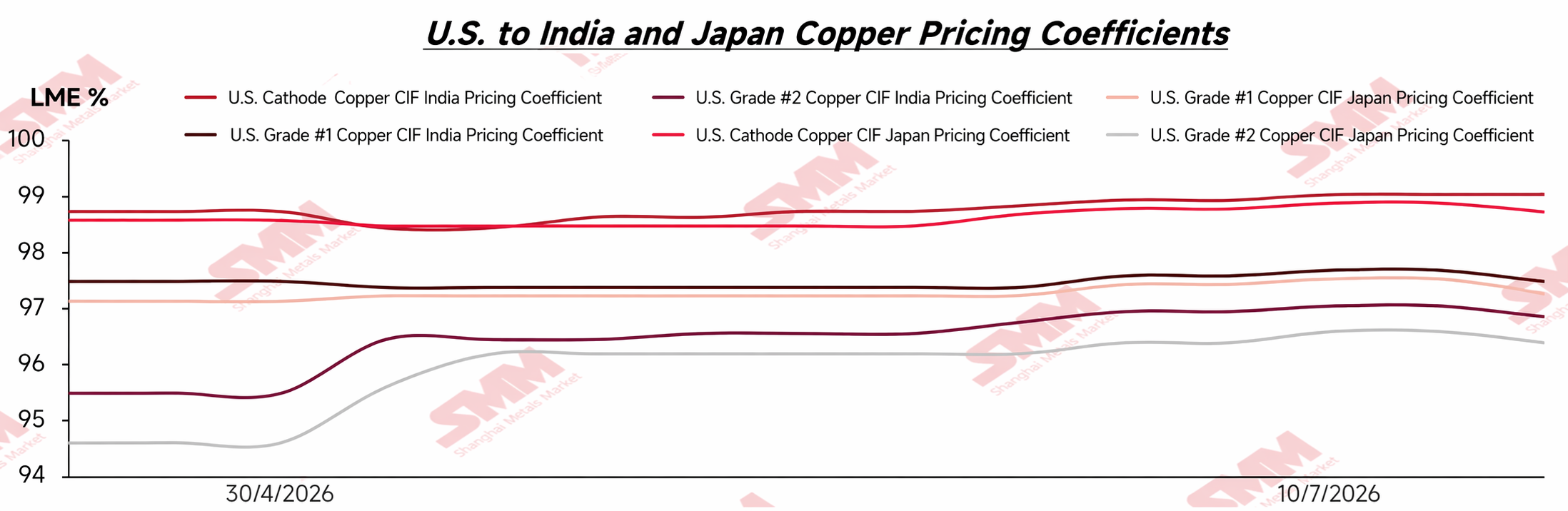
In addition, according to SMM market surveys, in competition for certain overseas cargoes, the purchase prices or price ratios offered by Indian buyers are often higher than those in traditional import markets such as China, Japan, and South Korea. This pricing advantage is particularly pronounced for complex raw materials requiring further dismantling, sorting, or smelting.
India’s ability to sustain relatively high purchase bids is not driven by a single factor, but rather by a combination of tariff policy, domestic raw material demand, a flexible processing system, lower processing costs, and logistics conditions.
First, tariff adjustments have released some room for Indian buyers to raise their bids. Effective February 2025, India reduced the basic import tariffs on certain copper scrap items under HS codes 74040012, 74040019, and 74040022 to zero. It should be noted that the basic tariffs previously applied to these codes were not uniformly 2.5%; they involved rates of 10%, 5%, or 2.5%, respectively. The basic tariff is an actual import cost that cannot be offset through subsequent sales, so the reduction to zero directly lowered the landed cost for eligible copper scrap.
Second, domestic copper scrap supply in India cannot simultaneously keep pace with the growing raw material demand from secondary copper rod, copper ingot, brass, and secondary smelting enterprises, leading to intense competition for sources of supply. When factory order books are strong and raw material inventories are low, production stoppages, production cuts, and lost orders caused by material shortages often outweigh the incremental cost of paying a few extra tenths of a percentage point in the price ratio. Some enterprises are therefore willing to compete for overseas cargoes by raising their bids.
Third, India has a large number of small and medium-sized enterprises engaged in manual dismantling, sorting, copper wire nodule processing, and pyrometallurgical smelting. For scrap cables, motors, and mixed copper materials, more meticulous manual sorting helps reduce copper losses and improve metal recovery rates. Compared with markets where labour and processing costs are higher, Indian enterprises have greater flexibility in processing methods and raw material blending, allowing them to channel different grades and forms of raw materials into the corresponding production stages. Consequently, certain complex raw materials that require significantly larger discounts in other markets can command a higher valuation in India.
Geography and freight structure also offer India certain advantages. India is relatively close to major supply sources such as the UAE, Saudi Arabia, Oman, and parts of Europe. For cargoes from these regions, shipping times and ocean freight costs to India are generally lower than those to East Asian markets; some European cargoes also enjoy a voyage advantage to India. Even if the nominal price ratio offered by an Indian buyer is higher, as long as freight costs, transit times, and tied-up capital are lower, the final landed cost at the plant may still remain at a reasonable level.
Overall, India’s ability to procure overseas copper scrap at high prices is primarily supported by domestic raw material shortages, competition among enterprises for supply, diversified raw material processing routes, relatively low manual sorting costs, and logistical advantages for cargoes from the Middle East, East Africa, and parts of Europe.
As copper demand from India’s power grid, wire and cable, infrastructure, and manufacturing sectors continues to grow, its procurement demand for overseas copper scrap is expected to remain resilient. However, in a climate of tight global copper scrap supply, excessively high purchase price ratios will also compress processing margins. Whether India’s high-price procurement is sustainable will still depend on local selling prices for copper rod and copper products, factory operating rates, capital costs, and actual metal recovery returns.
![Copper Prices High, Downstream Secondary Copper Rod Enterprises Mainly Wait and See [SMM Secondary Copper Daily Review]](https://imgqn.smm.cn/usercenter/GfvuY20251217171708.jpg)
![[SMM Analysis] Why Can India Sustain High Bids for Overseas Copper Scrap?](https://imgqn.smm.cn/usercenter/MXbup20251217171745.jpg)