I. High Imports and Negative TCs Coexist: China’s Copper Concentrate Supply-Demand Mismatch Unlikely to Ease in H2
In H1 2026, China’s copper concentrate imports pulled back slightly from a high level, but the tightness in the spot market intensified further.
Customs data showed that in January-June 2026, China imported 14.6106 million mt of copper ores and concentrates, down 0.84% YoY. Of this, June imports totaled 2.3348 million mt, down 1.10% MoM but up 0.02% YoY. On a quarterly basis, Q2 imports fell about 6.8% from Q1, presenting a “high-then-low” pattern in H1.
Meanwhile, spot copper concentrate TCs continued to hit new lows. On July 24, the SMM Imported Copper Concentrate Index (weekly) stood at -$154.76/dmt, down further from -$146.15/dmt on July 17. As new and expanded domestic smelting capacity gradually came online, copper concentrate import requirements were theoretically expected to grow in tandem, yet H1 imports did not show the anticipated notable growth. Supply increases failed to match the expansion in smelting demand, further exacerbating spot market tightness.
II. Q2 Imports Cooled, with Divergent Performance Among Major Suppliers
By monthly data, China’s copper concentrate imports fell to 2.3516 million mt in April, down 10.59% MoM; rebounded slightly to about 2.361 million mt in May, and fell again to 2.3348 million mt in June. Although monthly imports from April to June remained above 2.3 million mt, the overall pace cooled compared to Q1.
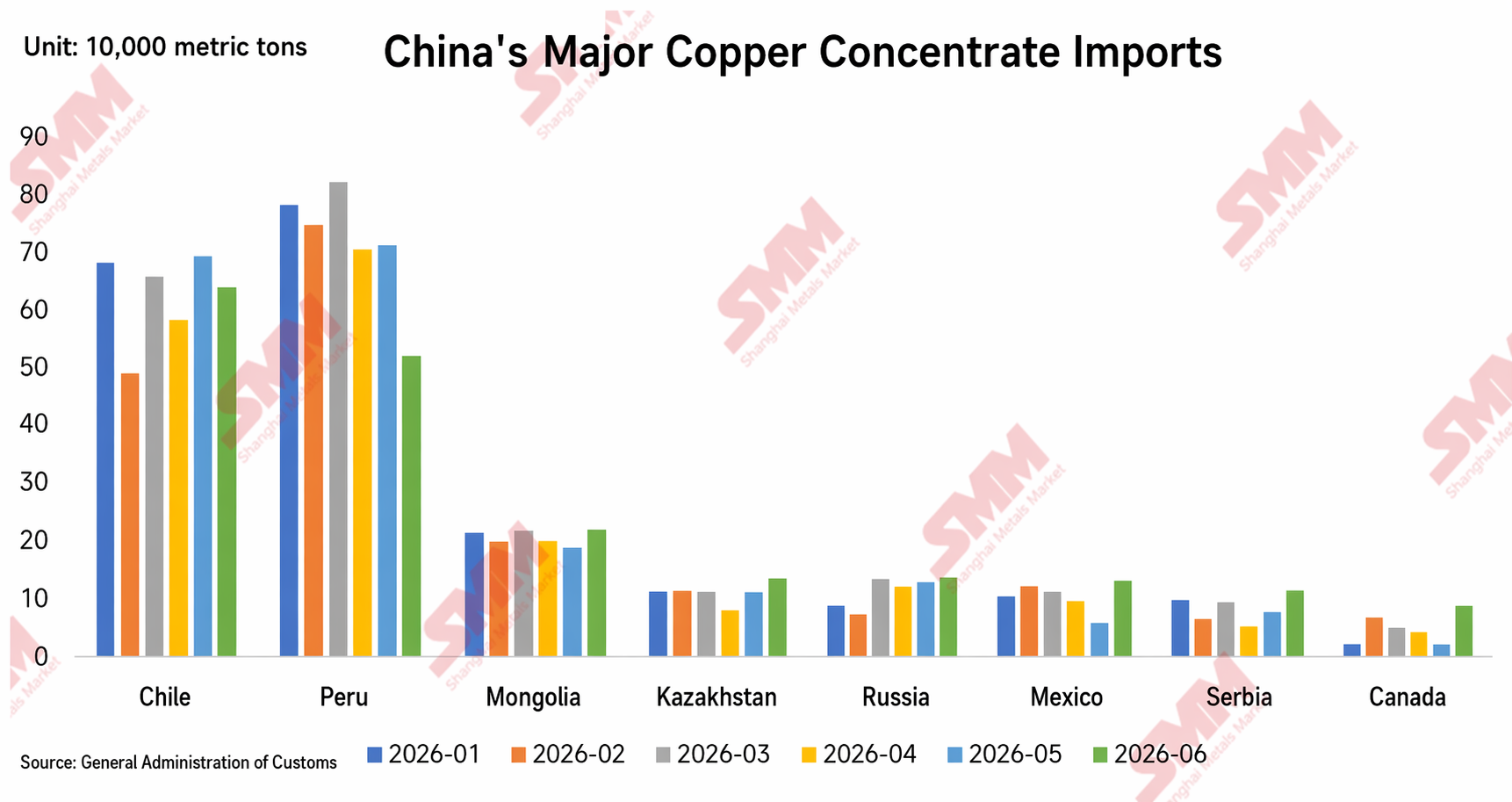
By source country, Peru and Chile remained China’s top copper concentrate suppliers, but their performances diverged markedly in June.
In June, China imported 638,200 mt of copper concentrates from Peru, up 22.05% YoY; and 516,800 mt from Chile, down 23.29% YoY. Over the same period, imports from Mongolia were 214,200 mt, up 12.79% YoY; from Russia 133,700 mt, up 80.40% YoY; and from Serbia 110,100 mt, up 73.45% YoY. This indicates that increased shipments from Peru, Mongolia, Russia, and Serbia partly offset the decline in arrivals from Chile. Traditional South American sources still form the bedrock of China’s imports, but June data already show that incremental growth in China’s copper concentrate imports is dispersing toward Mongolia, Russia, and some Central Asian and European sources. However, monthly import variations are also influenced by factors such as shipping schedules, port loading, customs clearance pace, and concentrated arrivals under long-term contracts. One should not simply interpret a single month’s country-specific changes as the full-year supply trend for mines.
3. Imports Stay High, Yet Why Do Spot TCs Keep Falling
Customs import data cover long-term contract ore, equity ore, spot ore, trader inventory ore, and resources already committed to end users, whereas spot TCs more reflect the tightness of marginal copper concentrates available for procurement. Even if more than 2.3 million mt of copper concentrates arrive at Chinese ports each month, as long as the majority of these volumes are locked in by long-term contracts or specific smelters, the supply truly available for free circulation in the spot market and meeting smelters’ requirements in terms of grade and impurities may remain very limited.
SMM’s global copper concentrate supply-demand balance table shows that global copper concentrate production in 2026 is expected to be 19.113 million mt Cu, while actual copper concentrate demand is around 19.743 million mt Cu. After factoring in inventory adjustments, the year still faces a “hard deficit” of about 606,000 mt Cu—the deepest deficit year in the 2025–2030 forecast period. This indicates that the current market is not entirely devoid of mine supply growth; rather, supply is being released more slowly than smelting demand is expanding, while some new resources are being absorbed by local smelting capacity at the mine site, failing to generate trade flows available for Chinese procurement.
4. Three New Smelting Projects Will Increase Rigid Procurement Demand in H2
From a domestic demand perspective, the three new smelting projects planned to commence production in H2 will become a significant new variable in China’s copper concentrate import demand. The impact of new smelting projects on the copper concentrate market cannot be measured solely by their designed annual capacity. Projects typically go through commissioning and production ramp-up stages from initial feed to stable output, so actual production release may lag behind nominal startup progress; however, raw material procurement and safety stockpiling often begin before the first metal is produced, meaning import demand could materialize earlier. In particular, projects planning to feed materials in Q3 normally need to build a certain scale of copper concentrate inventory ahead of and around startup. Even if these projects only release part of their effective capacity this year, their procurement and arrivals demand may still support imports from late Q3 through Q4. The negative TC environment may prompt existing smelters to cut spot purchases, step up maintenance, or alter their raw material mix, but new projects have a higher requirement for uninterrupted feed during the early ramp-up phase and cannot make procurement decisions entirely based on short-term processing margins. At the same time, long-term contract deliveries, sulphuric acid, and by-product credits from gold and silver may still offset part of the negative TC pressure, meaning actual smelting production cuts could be smaller than the theoretical losses implied by TCs.
Therefore, domestic copper concentrate demand in H2 is very likely to remain highly resilient. The actual feeding months, ramp-up speeds, and raw material stockpiling scale of the three new projects will directly determine whether China’s copper concentrate imports rebound primarily in Q3 or are pushed back to Q4 or even early 2027.
V. Overseas Mine Supply Sees Some Recovery, but New Production Does Not Equal New Imported Supply
In terms of overseas copper ore supply, there are some expectations of recovery in H2, but the impact on China's copper concentrates imports varies significantly across projects.
Mongolia's Oyu Tolgoi represents a relatively clear supply growth. Rio Tinto disclosed that Oyu Tolgoi's copper production increased 31% YoY in H1 2026, and the underground mine ramp-up is progressing as planned. Given the short overland transport distance between Mongolian copper concentrates and the Chinese market, the production increase is expected to continue providing direct support for Chinese imports. However, road transport, border clearance, and changes in Mongolia's domestic mining policies could still cause periodic disruptions.
Some South American mines also tend to release more production in H2. Anglo American expects that its mine operations in Peru will produce 310,000–340,000 mt of copper in 2026, while those in Chile will produce 390,000–420,000 mt. Both operations are more concentrated in H2 for annual production, with Chilean output still affected by water availability and Peruvian output depending on ore grade arrangements.
Antofagasta's H1 copper production was 285,000 mt, down about 9% YoY, but the company expects quarterly production to increase sequentially for the rest of the year. Approximately 7,000 mt of processed but not yet recognized copper production at Los Pelambres is also expected to be reflected in H2. These developments are conducive to marginal improvements in Chilean copper mine production and shipments, but the challenges faced by mature mines—such as declining ore grades, equipment maintenance, and water constraints—may still limit supply flexibility.
By contrast, Indonesia's Grasberg remains one of the largest supply uncertainties in H2. On July 23, Freeport-McMoRan disclosed during its Q2 earnings call that the resumption of production at the underground Block Cave project at the Grasberg mine in Indonesia is progressing in line with Q1 expectations, and the ramp-up of Production Blocks 2 and 3 is currently advancing according to the plan formulated in April. Previously, due to a wet ore ingress incident in September 2025 at the underground mine, part of Grasberg's production was suspended, and the company subsequently initiated cleaning, repair, and phased production resumption. According to Freeport, the Grasberg Block Cave completed repairs in Q1 2026 and started production ramp-up in March, reaching planned operating levels in Q2. The company currently expects Grasberg's capacity to recover to about 65% in H2 2026, further improve to around 80% by mid-2027, and plans to approach full operations by end-2027. More importantly, Grasberg has already established an integrated local industry chain from mine to smelting. Even as mine output gradually recovers, more copper concentrates are being processed domestically in Indonesia, meaning that the mine's production increase will not translate into incremental copper concentrates imports for China on a like-for-like scale.
Similarly, the DRC's Kamoa-Kakula project is experiencing a similar situation. Ivanhoe Mines maintains its 2026 copper production guidance for the project at 290,000-330,000 mt, and expects production in H2 to be higher than H1 as mining rates rise and inventories are released. However, the project's production scope includes copper anode, blister copper, and salable copper concentrates, not all of which are concentrates available for export.
Meanwhile, the associated 500,000 mt/year smelter at Kamoa-Kakula is operating at about 60% of designed capacity, and its further production ramp-up is being constrained by raw material supply of concentrates. Consequently, increased production at this project will benefit global copper product supply, but may not proportionally increase the copper concentrates China can import.
6. H2 Imports Likely to Rebound HoH; TCs Unlikely to See V-Shaped Recovery
Aggregating factors both in and outside China, it is expected that China's copper concentrate imports in H2 2026 will likely rebound from H1, but the scale of increase will remain constrained by the degree to which overseas mines meet their targets.
Demand side, stockpiling, feeding, and ramp-up of three new smelting projects will increase raw material procurement demand. Supply side, Oyu Tolgoi continues to expand production, mine output from Peru and some Chilean mines will be weighted toward H2, Zambia will temporarily ease concentrate exports, and the processing of stockpiled ore at Cobre Panamá may also contribute a small increment.
But on the other hand, Grasberg's recovery pace is slower than previously expected, local smelting capacity in Indonesia and Africa is absorbing more of the mines' own concentrates, Cobre Panamá has yet to resume normal mining, and mature Chilean mines continue to face constraints from grades, water resources, and equipment operation. An increase in global copper ore production does not mean an equivalent amount of tradeable copper concentrates will enter the Chinese market.
Under the base scenario, H2 copper concentrate imports into China are expected to stay high and are likely to increase from H1; however, whether full-year imports can achieve YoY growth still depends on the actual feeding progress of the three new smelting projects and the production realization at major projects such as Oyu Tolgoi, South American mines, and Grasberg. Imports are more likely to fluctuate at high levels rather than show sustained, rapid one-way growth.
In terms of pace, Q3 imports may be supported by stockpiling for new projects, Zambia's export window, and improved shipments from South America; Q4 will depend more on whether domestic new smelting projects can successfully ramp up production and whether the supply recovery at overseas mines meets expectations. Spot TCs, however, will be slow to recover even as imports pick up. As long as the global copper concentrate "hard deficit" persists, the smelting sector does not implement large-scale and sustained production cuts, and mining regions continue to increase local smelting shares, the resources available for free procurement in the market will remain tight. SMM expects that from H2 2026 to 2027, spot TCs are more likely to exhibit an "L-shaped low-level operation with periodic rebounds" rather than a rapid V-shaped recovery.
High copper prices can improve mine cash flow and project development willingness, yet it is hard to significantly shorten the recovery cycle of underground mines, the construction period of new mines, and the production ramp-up of beneficiation systems within half a year. As of July 20, the LME three-month copper price was approximately $13,633/mt. For China's copper concentrate imports in H2, actual production from overseas mines, tradable resource flows, the progress of new smelting project commissioning, and spot TCs remain more direct factors than the absolute level of copper prices.
Overall, the H2 copper concentrate market is not short of supply growth; rather, there remains a clear mismatch between the timing, product form, and destination of new supply arrivals and the expansion of China's smelting demand. China's copper concentrate imports may stay high and rise MoM, but increased imports and deeply negative spot TCs could still coexist over an extended period.
![Price spread between futures contracts narrows, hold back from selling intensifies, spot premiums may stop falling and stabilize [SMM Copper Morning Meeting Minutes]](https://imgqn.smm.cn/usercenter/tXWun20251217171711.jpg)
![Copper futures see slight correction as macro and fundamentals intertwine [SMM Copper Morning Comment]](https://imgqn.smm.cn/usercenter/FSTyq20251217171713.jpg)