SMM July 24 News:
Metal markets:
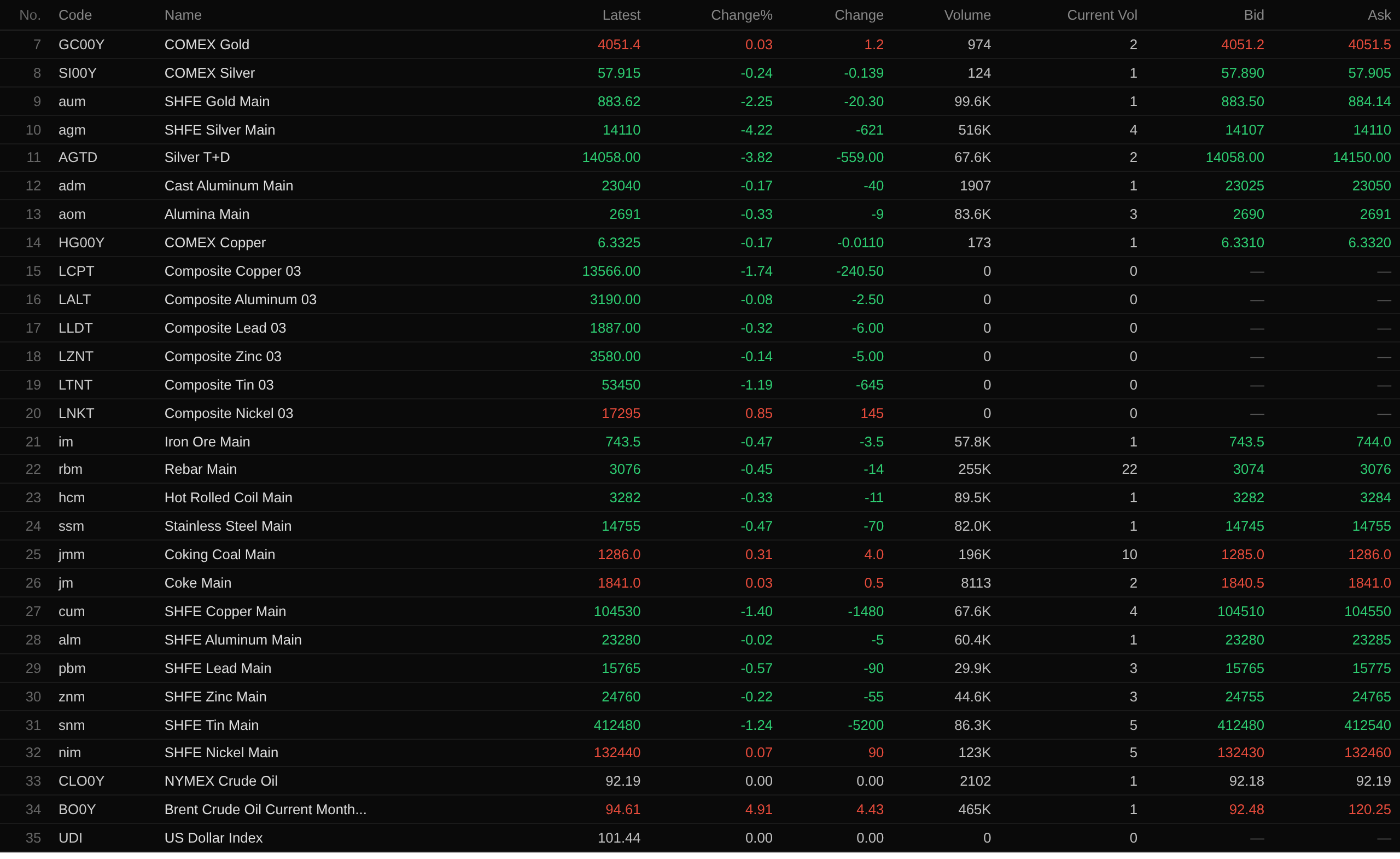
Overnight, base metals in the domestic market generally fell. SHFE copper fell 1.4%, SHFE aluminum edged down, SHFE lead fell 0.57%, SHFE zinc fell 0.22%, SHFE tin fell 1.24%. SHFE nickel edged up. Furthermore, the most-traded alumina futures contract fell 0.33%, and the most-traded cast aluminum contract fell 0.17%.
Overnight, ferrous metals mostly fell. Stainless steel fell 0.47%, iron ore fell 0.47%, rebar fell 0.45%, and HRC fell 0.33%. Coking coal and coke: the most-traded coking coal futures contract rose 0.31%, and the most-traded coke futures contract edged up.
Overnight in the overseas market, LME base metals mostly moved downward. LME copper fell 1.74%. LME aluminum fell 0.08%, LME lead fell 0.32%. LME zinc fell 0.14%. LME tin fell 1.19%. LME nickel rose 0.85%.
Overnight in precious metals: COMEX gold fell 2.4%, COMEX silver fell 3.99%. Overnight, the most-traded SHFE gold futures contract fell 2.25%, and the most-traded SHFE silver futures contract fell 4.22%.
As of 7:07 AM on July 24, overnight closing prices:
On the Macro Front
China:
[Ministry of Commerce: Will further strengthen the domestic economic cycle and optimize the dual domestic and international cycles] On July 23, Ministry of Commerce Vice Minister Yan Dong stated at a press conference that since the beginning of this year, according to the deployment of the Central Committee of the Communist Party of China and the State Council, efforts have been stepped up to advance the formulation and implementation of related “15th Five-Year” special plans in the commercial sector. The next step will continue to focus on high-quality development as the primary task, continuously improve policy effectiveness, further strengthen the domestic economic cycle, optimize the dual domestic and international cycles, and make new positive contributions to national economic development. (From Wallstreetcn APP)
[Ministry of Commerce: China and US economic and trade teams are exploring a framework arrangement to promote reciprocal tariff cuts each worth $30 billion] Meng Huating, Director-General of the Department of Foreign Investment Administration of the Ministry of Commerce, responded to a question on the progress of establishing trade and investment councils between China and the US at a State Council Information Office press conference on the 23rd, stating that currently, the economic and trade teams of China and the US are maintaining close communication on the specific arrangements for the trade council’s structure, functions, and operational model, and are exploring a framework arrangement to promote reciprocal tariff cuts each worth $30 billion. The Chinese side is extensively soliciting opinions from domestic enterprises, business associations, local governments, and US-invested enterprise associations and other stakeholders on the relevant proposed tariff cut arrangement. The US side is also seeking public comment on the trade council and reciprocal tariff cut arrangement. Both sides will maintain close exchanges and finalize the specific product tariff cut arrangements as soon as possible and promote implementation to further expand bilateral trade. (Xinhua News Agency)
[People’s Bank of China conducts 500 billion yuan MLF operation] The People’s Bank of China announced that to maintain ample liquidity in the banking system, on July 24, 2026, it would conduct a 500 billion yuan MLF operation via fixed quantity, interest rate tender, and multiple-price bidding method, with a term of 1 year.
[CSRC: Promote steady increase in the scale and proportion of medium and long-term funds entering the market, strengthen policy reserves to cope with global market fluctuations and cross-border risk contagion] The China Securities Regulatory Commission held a symposium on Party building and regulatory work. The meeting emphasized that the changes unseen in a century are accelerating, geopolitical conflicts persist, and the risk of resonance and contagion in global financial markets is rising. At the same time, a new round of technological revolution and industrial transformation is accelerating breakthroughs, positive factors on the macro policy front, fundamentals front, and capital front are accumulating, the effects of capital market reforms are continuously emerging, and the market overall possesses good allocation value. The meeting stressed implementing comprehensive measures to fully maintain stable market operations and enhance capital market resilience. It called for more precise and effective counter-cyclical adjustments, promoting the steady increase in the scale and proportion of medium and long-term funds entering the market, strengthening policy reserves to cope with global market fluctuations and cross-border risk contagion, and building a strong seawall against external risk shocks. It urged deepening reforms to enhance institutional inclusiveness and adaptability, implementing detailed measures for comprehensive investment and financing reforms, and better leveraging the functions of the stock, fund, bond, and futures markets.
[Beijing issues measures to accelerate the development led by AI agents, accelerating key technological breakthroughs in general AI agents across models and chips] Multiple departments in Beijing jointly formulated the “Several Measures of Beijing on Accelerating Development Led by AI Agents,” which have been approved by the municipal government and are now officially issued for implementation. The measures mentioned supporting innovative entities in implementing Harness Engineering, focusing on optimizing context engineering, task persistence, multi-agent collaboration, and system scalability to solidify the common foundation for AI agents. It aims to accelerate key technological breakthroughs in general AI agents across models and chips, support innovative entities in continuously improving the intermediate software stack, research and develop key operators and frameworks suitable for AI agent development, promote adaptation and optimization with indigenous large models, and improve the length of complex task chains and the stability of long-range task execution. (From Wallstreetcn APP)
[ZCE solicits opinions on revising futures trading management measures and market maker management measures] Zhengzhou Commodity Exchange issued an announcement soliciting public opinions on the revision of the “Zhengzhou Commodity Exchange Futures Trading Management Measures” and the “Zhengzhou Commodity Exchange Market Maker Management Measures.” In accordance with the Futures and Derivatives Law of the People’s Republic of China, the Futures Trading Management Regulations, the Measures for the Administration of Futures Exchanges, and other relevant laws, regulations, and rules, ZCE plans to revise the Management Measures, and is now soliciting public opinions from the market. The revision notes are as follows: First, improve the applicable circumstances for ZCE’s emergency measures by adjusting Article 16 of the Trading Management Measures. Second, for products with night trading sessions, introduce a call auction 5 minutes before the start of the daytime session on trading days with a night session, adjusting relevant provisions in both the Trading Management Measures and Market Maker Management Measures. Adding a daytime call auction can generate a fairer price at the start of daytime trading, promoting stable market operations. (From Wallstreetcn APP)
US Dollar:
The overnight US dollar index rose 0.32%, closing at 101.12. Inflationary pressures reheated, and the probability of a Fed rate hike next week surged to about 38%. Sameer Samana of Wells Fargo Investment Institute said: Escalating tensions in the Middle East have pushed up crude oil prices, raising concerns that inflation could re-accelerate, delaying rate cuts or even possibly forcing the Fed to raise rates. (Wallstreetcn)
Data-wise: US initial jobless claims fell sharply last week, indicating the US labour market remains stable and Fed officials need to continue focusing on curbing inflation. The US Labor Department said Thursday that initial jobless claims for the week ending July 18 fell by 22,000 to 187,000, compared to expectations of 212,000. Thursday’s report is the latest signal of sustained labor market stability. The unemployment rate unexpectedly fell to 4.2% in June, a one-year low, but the drop was driven more by a shrinking workforce than by employment growth. The US labour market shows an unusual equilibrium: limited labour supply, slow new job additions, and relatively limited layoffs keep the unemployment rate historically low. This situation increasingly prompts Fed policymakers to focus more on inflation, still well above the 2% target, rather than expressing more concern about the strong labour market. (Jinshi Data APP)
Other Currencies:
[European Central Bank holds interest rates steady] The European Central Bank held interest rates steady on Thursday, but investors expect the bank to raise rates in coming months to curb inflation sparked by the Middle East war. The ECB’s deposit facility rate was held at 2.25%, in line with broad market expectations, after the bank made its first rate increase in nearly three years last month. Tensions escalating in the Strait of Hormuz have pushed global oil prices back towards $100 a barrel, reviving the risk of war-driven inflationary pressures. (Jinshi Data APP)
Macro front:
Data to be released today include Germany’s August Gfk consumer sentiment index, UK June seasonally adjusted retail sales m/m, France’s July preliminary manufacturing PMI, Germany’s July preliminary manufacturing PMI, Eurozone’s July preliminary manufacturing PMI, UK’s July preliminary manufacturing PMI, UK’s July preliminary services PMI, US July preliminary S&P Global manufacturing PMI, US July preliminary S&P Global services PMI, and US June new home sales annualized total. Also pay attention to: AMD Advancing AI Conference held in San Francisco from July 22-23; Intel’s Q2 earnings report released after the US market close on July 23.
Crude Oil:
Overnight, both oil futures extended their gains from the previous four trading sessions, with US crude rising 6.37% and Brent crude rising 4.91%.
Brent crude oil futures rose to $100/barrel for the first time in two months. This followed Yemen’s Houthis claiming an attack on two Saudi oil tankers sailing in the Red Sea, intensifying the Middle East conflict and threatening further oil supply disruptions. The Houthi attack opened a new front in the regional conflict, following already troubled traffic in the Strait of Hormuz due to US-Iran clashes. Since the conflict erupted, the Bab al-Mandab Strait at the mouth of the Red Sea has become a lifeline for oil exports. In recent days, both US and Iranian sides have downplayed the possibility of peace talks, making a scenario of long-term hostilities appear possible. (Jinshi Data APP)
A significant backwardation appeared in the price spread between Brent crude oil futures and spot prompt prices, signaling market fears that conditions could worsen. The president of Rapidan Energy Group stated: The scope of the second round of military conflict will be larger than the first. The risks are immense, not just for the shipping industry but for energy infrastructure as well. Oil market participants indicated political pressure is mounting on President Trump to end the war and control surging energy costs. (Wallstreetcn)
![Metals Broadly Fall, SHFE Tin, SHFE Copper, and Polysilicon Drop More Than 1%, Precious Metals Collectively Slump, SHFE Silver and Platinum Fall Nearly 5% [SMM Midday Review]](https://imgqn.smm.cn/usercenter/VphiQ20251217171736.jpg)
![Futures pulled back, stimulating sporadic purchases, and North China spot premiums slightly rebounded [SMM North China Copper Spot]](https://imgqn.smm.cn/usercenter/tXxfd20251217171713.jpg)
![Copper prices pulled back and downstream purchases increased slightly over the weekend, resulting in improved overall trading [SMM South China Spot Copper]](https://imgqn.smm.cn/usercenter/grvgR20251217171710.jpg)