China's April Copper Market: Rising Imports vs. Falling Exports Amid Geopolitical Shifts

Published: May 20, 2026 18:01
In April 2026, China's copper cathode import and export market exhibited a clear pattern of "rising imports and falling exports.

In April 2026, China's copper cathode import and export market exhibited a clear pattern of "rising imports and falling exports." As some domestic consumption demand recovered and the price spread between domestic and overseas markets adjusted, copper cathode imports registered double-digit growth MoM, while exports pulled back notably after a high base in the prior period. Notably, inflows of EQ copper cathode from countries such as the DRC and Russia remained elevated, pushing the share of EQ copper imports in April to above 70%, hitting a record high for the same period in recent years.

Based on the total import and export data released by the General Administration of Customs, China's copper cathode exports in April were 25,600 mt, down 56.01% MoM and down 67.05% YoY. Although single-month exports saw a notable seasonal pullback, combined with overall Q1 performance, cumulative exports from January to April still maintained positive growth of 30.84% YoY. On the import side, China's copper cathode imports in April rebounded to 270,500 mt, up 15.27% MoM and up 8.19% YoY. The rebound in April imports effectively eased the tight spot cargo conditions in parts of the domestic market. However, from a longer-term perspective, cumulative imports from January to April were still down 21.10% YoY, reflecting structural adjustments in overall long-term contract and spot cargo flows this year compared with previous years.
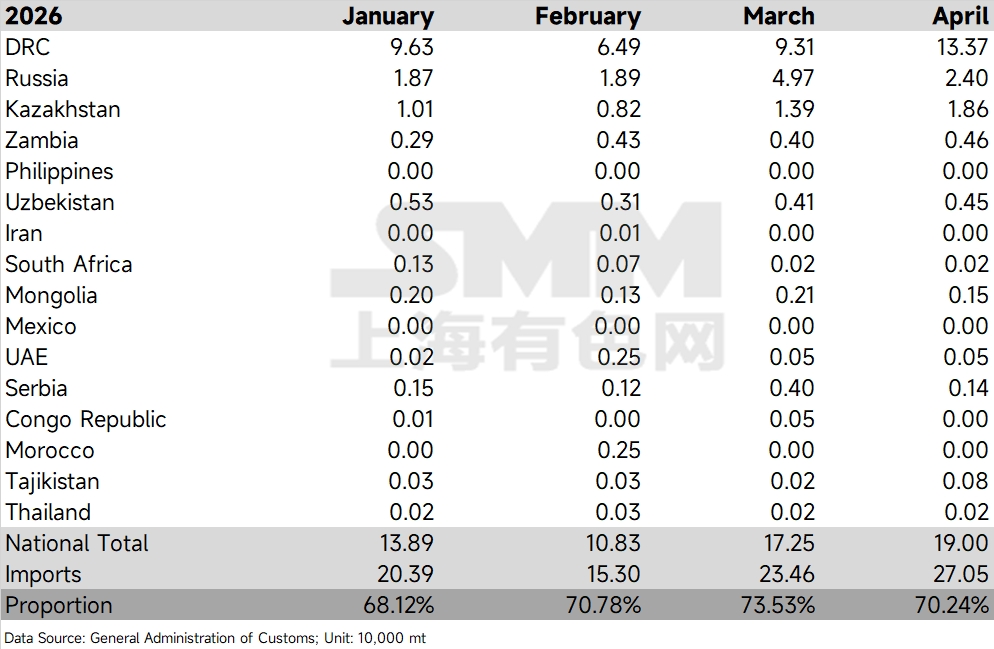
A deeper analysis of the import structure reveals that the major EQ copper cathode source countries within the statistics collectively contributed the vast majority of the incremental volume, with the DRC continuing to stand out as the top performer. In April, China's copper cathode imports from the DRC reached 133,700 mt, a significant increase of over 40,000 mt from March's 93,100 mt, representing a notable MoM gain and solidifying its position as the largest supplier of EQ copper to China. In comparison, April copper cathode imports from Russia came in at 24,000 mt, a pullback from March's 49,700 mt; supply from Kazakhstan rose steadily to 18,600 mt; others such as Zambia recorded 4,600 mt and Uzbekistan recorded 4,500 mt, maintaining an overall stable inflow.

Guided by this flow pattern, total imports from major EQ source countries reached 190,000 mt in April, showing a continuously rising trend compared to 138,900 mt in January, 108,300 mt in February, and 172,500 mt in March. In terms of the share trend, EQ copper cathode imports accounted for 70.24% in April. Although this pulled back slightly by 3.29 percentage points from March's historical high of 73.53%, a comparison over a longer timeframe against historical data from 2022 to 2026 shows that this ratio is far above the typical fluctuation range of 45%–65% during the same period from 2022 to 2024, basically flat with the 2025 highs with a slight breakthrough. This indicates that EQ sources have become the de facto absolute dominant supply in China's current copper cathode imports.

Looking ahead, the proportion of EQ copper cathode imports has remained at a high level above 70% for three consecutive months, indicating that the penetration of geopolitical flow shifts and new ex-China smelting capacity into the Chinese market is deepening further. The MoM rebound in April imports was primarily driven by some rigid restocking demand during China's traditional Q2 peak season and a phased improvement in the import window. EQ copper, with its certain price advantage, has been absorbed smoothly within the current copper cathode system. Going forward, close attention should be paid to the pace of ex-China EQ cargo arrivals at ports from May to June, as well as changes in operating rates of downstream enterprises in China toward the end of the peak season. If consumption fails to continuously absorb the high inflow of EQ copper, visible inventory in China may face localized inventory buildup pressure.

It is worth noting that in Africa, taking the DRC as an example, copper is basically produced through SX-EW. Earlier issues such as sulphuric acid and sulphur shortages may have led to production cuts, and the volume flowing into China is expected to see limited significant increase going forward. In addition, it has recently been observed in the spot market that some EQ cargo originates from countries such as Chile that primarily produce registered copper, which means the actual proportion of EQ copper cathode entering China is estimated to be higher than the statistics above suggest.

Data Source Statement: Except for publicly available information, all other data are processed by SMM based on publicly available information, market communication, and relying on SMM's internal database model. They are for reference only and do not constitute decision-making recommendations.

For any inquiries or for more information, please contact: lemonzhao@smm.cn
For more information on how to access our research reports, please contact:service.en@smm.cn
Related News
[SMM Analysis]From Aurubis to Nexans and Wieland: Why Are European and US Copper Companies Expanding Recycling Capacity?
13 mins ago
[SMM Analysis]From Aurubis to Nexans and Wieland: Why Are European and US Copper Companies Expanding Recycling Capacity?
Read More
[SMM Analysis]From Aurubis to Nexans and Wieland: Why Are European and US Copper Companies Expanding Recycling Capacity?
[SMM Analysis]From Aurubis to Nexans and Wieland: Why Are European and US Copper Companies Expanding Recycling Capacity?
[SMM Analysis: From Aurubis to Nexans and Wieland: Why Are European and US Copper Companies Expanding Recycling Capacity?]European and US copper companies have accelerated investment in recycled raw materials. Copper scrap is therefore becoming more than a supplement to primary copper. It is increasingly viewed as a strategic resource that can improve raw material security, diversify earnings and reduce product carbon footprints.
13 mins ago
Tertiary Minerals Discovers New Shallow Copper Zone at Mushima North, Expanding Project Footprint
18 mins ago
Tertiary Minerals Discovers New Shallow Copper Zone at Mushima North, Expanding Project Footprint
Read More
Tertiary Minerals Discovers New Shallow Copper Zone at Mushima North, Expanding Project Footprint
Tertiary Minerals has identified a new shallow copper-mineralised zone at its Mushima North project in Zambia, extending the project's mineralisation footprint beyond the area currently covered by its existing Exploration Target.​ Preliminary portable X-ray fluorescence (pXRF) results from scout drill hole 26TMNRC-076 at the newly named Western Zone returned 25 metres grading 0.38% copper from a depth of 19 metres, including 13 metres at 0.53% copper from 29 metres and a higher-grade interval of 3 metres at 0.75% copper from 33 metres. The Western Zone is located approximately 900 metres west-southwest of the existing Discovery Zone at Target A1.​ The results remain preliminary and require confirmation through certified laboratory assays, while the true widths of the mineralised intersections have yet to be established. Nevertheless, the location of the intercept is significant because it lies outside the boundary of the Discovery Zone, where Tertiary previously established an Exploration Target of 15–30 million tonnes grading 40–60 g/t silver equivalent.​ Tertiary has now completed its 39-hole, 3,639-metre Phase 4 drilling programme at Mushima North. Additional pXRF results from seven holes are expected shortly, followed by laboratory assays. The company also plans to begin metallurgical testing and Mineral Resource modelling, targeting a maiden Mineral Resource Estimate for the Discovery Zone before the end of 2026.​ The discovery remains at an early exploration stage and therefore has no immediate impact on Zambia's copper supply. However, the identification of mineralisation nearly one kilometre beyond the existing Discovery Zone suggests potential for a broader mineralised system and could increase the prospective scale of the Mushima North project if subsequent drilling and laboratory assays confirm the preliminary results.
18 mins ago
[SMM Analysis] From Aurubis to Nexans and Wieland, Why Are European and US Copper Companies Collectively Doubling Down on Recycled Raw Materials?
25 mins ago
[SMM Analysis] From Aurubis to Nexans and Wieland, Why Are European and US Copper Companies Collectively Doubling Down on Recycled Raw Materials?
Read More
[SMM Analysis] From Aurubis to Nexans and Wieland, Why Are European and US Copper Companies Collectively Doubling Down on Recycled Raw Materials?
[SMM Analysis] From Aurubis to Nexans and Wieland, Why Are European and US Copper Companies Collectively Doubling Down on Recycled Raw Materials?
[SMM Analysis: From Aurubis to Nexans and Wieland, Why Are European and American Copper Companies Collectively Ramping Up Recycled Raw Materials?] In recent years, the copper industry in Europe and the United States has significantly accelerated its push into recycled raw materials, and participants are no longer limited to traditional secondary copper smelters. From integrated smelters such as Aurubis, Boliden, and Glencore to wire-and-cable and copper-processing enterprises such as Nexans and Wieland, different segments of the industry are simultaneously strengthening their capabilities in copper scrap recycling, pretreatment, smelting, and internal recycling. This means the logic behind the development of the secondary copper industry in Europe and the United States is shifting: recycled raw materials are no longer merely a supplement to primary copper supply, but are gradually becoming an important strategic resource for companies to ensure raw material security, stabilize profit sources, and reduce the carbon footprint of their products.
25 mins ago
China's April Copper Market: Rising Imports vs. Falling Exports Amid Geopolitical Shifts - Shanghai Metals Market (SMM)