El Niño Risk Exposes Zambia’s Hydropower Dependence as Copper Expansion Raises Power Demand

Published: Aug 18, 2026 14:56

Zambia’s exposure to El Niño-related rainfall weakness is emerging as a renewed risk to the country’s copper-growth ambitions, with hydropower still accounting for the majority of installed electricity capacity while planned mine expansions are expected to require significantly more power.​

The risk had already been flagged domestically in June, when Zambia’s Ministry of Green Economy and Environment highlighted forecasts for a new 2026–27 El Niño season and warned of the potential for drought, water shortages, reduced crop yields and other climate-related challenges. More recent international forecasts have since strengthened the outlook for a significant El Niño event during late 2026 and early 2027.​

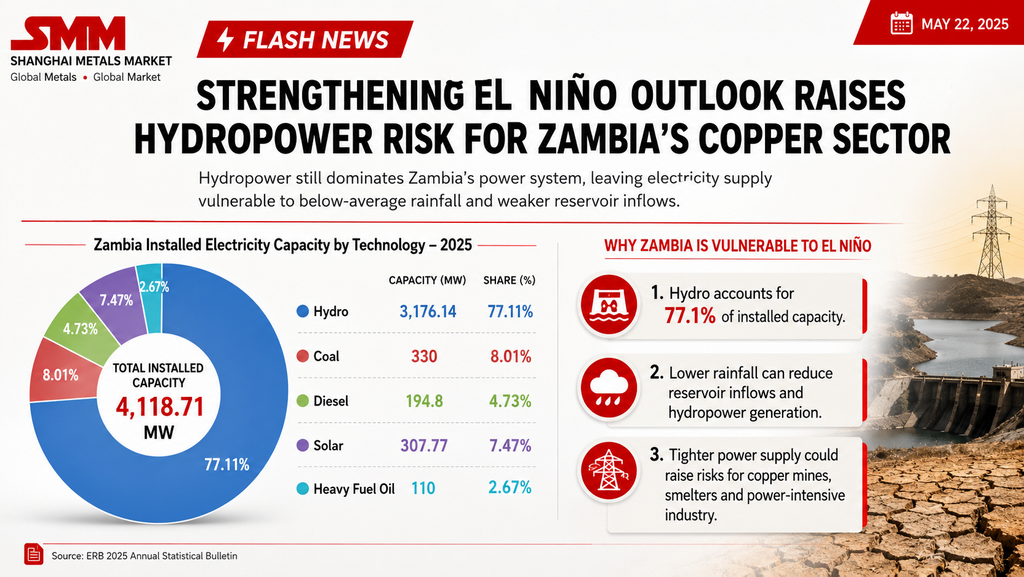
According to the Energy Regulation Board’s 2025 Annual Statistical Bulletin, Zambia had 4,118.71 MW of installed electricity generation capacity at the end of 2025. Hydropower accounted for 3,176.14 MW, or 77.11% of total capacity, followed by coal at 8.01%, solar at 7.47%, diesel at 4.73% and heavy fuel oil at 2.67%. This generation mix leaves electricity availability particularly sensitive to rainfall patterns and reservoir inflows.​

The exposure is significant because Zambia’s copper-growth strategy will require substantially more electricity. The country is targeting annual copper production of 3 million tonnes by 2031, supported by mine expansions, new developments and additional processing capacity. Industry estimates indicate that approximately 2,000 MW of additional power capacity will be required to support the expansion of the mining sector and associated industrial demand.​

El Niño therefore presents a potential constraint on both sides of Zambia’s copper-growth equation. While mining investment is increasing future electricity demand, prolonged rainfall weakness could simultaneously restrict output from the hydropower system that currently supplies more than three-quarters of installed generation capacity.​

The experience of the 2023–24 drought illustrates this vulnerability. Weak rainfall and lower reservoir inflows sharply reduced hydroelectric generation, contributing to severe electricity shortages and increased reliance on imports and load-management measures. A repeat of similar conditions during the 2026–27 rainy season could again tighten the power balance as mining demand continues to rise.​

The key issue for Zambia is therefore not simply expanding installed capacity, but increasing the resilience of the electricity system. Continued investment in solar, thermal generation, regional power imports, transmission infrastructure and other non-hydro sources will be increasingly important if the country is to insulate copper production growth from rainfall variability.​

For the copper market, the strengthening El Niño outlook adds a potentially important supply-side risk to Zambia’s medium-term production ambitions. With hydropower still representing 77.1% of installed capacity and the mining sector requiring roughly 2,000 MW of additional power, the ability to diversify electricity supply could become a critical determinant of whether Zambia can translate its expanding project pipeline into the targeted 3 million tonnes of annual copper production.

Data Source Statement: Except for publicly available information, all other data are processed by SMM based on publicly available information, market communication, and relying on SMM's internal database model. They are for reference only and do not constitute decision-making recommendations.

For any inquiries or for more information, please contact: lemonzhao@smm.cn
For more information on how to access our research reports, please contact:service.en@smm.cn
Related News
BHP's Copper Business Surpasses Iron Ore, Driving Record Earnings and Future Growth Plans
5 mins ago
BHP's Copper Business Surpasses Iron Ore, Driving Record Earnings and Future Growth Plans
Read More
BHP's Copper Business Surpasses Iron Ore, Driving Record Earnings and Future Growth Plans
BHP’s copper business has overtaken iron ore as the group’s largest earnings contributor, underscoring the growing strategic importance of the metal to the world’s biggest listed miner.​ For the financial year ended June 30, BHP reported $18.19 billion in operating earnings from copper, surpassing its iron ore division. The shift came as record copper prices supported stronger profitability across the group, with full-year underlying attributable profit rising 30% to $13.20 billion.​ The company also highlighted a project pipeline that could increase copper production by as much as 40% by 2035, reinforcing copper’s central role in BHP’s long-term growth strategy. This comes despite expectations for weaker near-term output as lower grades at Escondida and operational constraints in South Australia weigh on production.​ BHP’s stronger copper exposure is increasingly shaping both its earnings profile and capital-allocation priorities. Copper, alongside iron ore, steelmaking coal and potash, has been identified as a core commodity supporting long-term demand linked to electrification, infrastructure and energy-system expansion.​ The group also reported net debt of $8.7 billion as at June 30 and declared a full-year dividend of $1.72 per share, its highest annual payout in four years.​ From a copper-market perspective, the results highlight how high prices and expectations of sustained structural demand are reshaping the economics of major diversified miners. BHP’s plan to expand copper output by up to 40% by 2035 suggests that future growth in the sector will increasingly depend on large-scale brownfield expansions and new projects capable of supporting rising global demand.
5 mins ago
Data: SHFE, DCE market movement (Aug 18)
12 mins ago
Data: SHFE, DCE market movement (Aug 18)
Read More
Data: SHFE, DCE market movement (Aug 18)
The following table shows the ferrous and nonferrous metals movement on the SHFE and DCE on 18 Aug , 2026
12 mins ago
[SMM Analysis]From Aurubis to Nexans and Wieland: Why Are European and US Copper Companies Expanding Recycling Capacity?
43 mins ago
[SMM Analysis]From Aurubis to Nexans and Wieland: Why Are European and US Copper Companies Expanding Recycling Capacity?
Read More
[SMM Analysis]From Aurubis to Nexans and Wieland: Why Are European and US Copper Companies Expanding Recycling Capacity?
[SMM Analysis]From Aurubis to Nexans and Wieland: Why Are European and US Copper Companies Expanding Recycling Capacity?
[SMM Analysis: From Aurubis to Nexans and Wieland: Why Are European and US Copper Companies Expanding Recycling Capacity?]European and US copper companies have accelerated investment in recycled raw materials. Copper scrap is therefore becoming more than a supplement to primary copper. It is increasingly viewed as a strategic resource that can improve raw material security, diversify earnings and reduce product carbon footprints.
43 mins ago
Zambia’s exposure to El Niño-related rainfall weakness is emerging as - Shanghai Metals Market (SMM)