SMM February 2 News:
Key Points: On January 29, 2026, Idemitsu Kosan officially commenced the construction of a large-scale solid-state electrolyte pilot plant, marking a critical step after three decades of dedication to the sulfide route and 13 years of deep collaboration with Toyota. The facility is designed to achieve an annual capacity of several hundred metric tons, aiming to address core engineering scale-up and cost-reduction challenges prior to mass production. It will provide definitive material support for Toyota’s planned mass production of all-solid-state battery-equipped car models in 2027–2028, signaling a global shift in solid-state battery competition from the laboratory to the factory.

Introduction
On January 29, 2026, Japan’s Idemitsu Kosan announced that it had made a final investment decision on a large-scale pilot facility for solid-state electrolytes and officially began construction, marking a key phase in its mass production roadmap. This article provides an overview of Idemitsu’s solid-state battery strategy.


As a leading Japanese energy company, Idemitsu Kosan is a key player in the global sulfide-based solid-state battery sector. It focuses on the R&D, mass production, and full-chain deployment of solid electrolytes—the core material for solid-state batteries. Through its deep partnership with Toyota, Idemitsu is advancing commercial adoption, leveraging its sulfur by-product resources from petroleum operations and long-term technological expertise to build an integrated production system from raw material (lithium sulfide) to electrolyte. The company aims to support the mass production of vehicles equipped with all-solid-state batteries in 2027–2028, positioning itself at the forefront of global solid-state battery competition through patents and production capacity.
I. Technology Roadmap
Idemitsu adopts sulfide-based solid electrolytes as its core technology while developing other electrolyte types to form a differentiated technical portfolio:
Core Route: It has extensively developed sulfide electrolytes, using sulfur by-products from petroleum refining as raw materials. Through nanoscale composite technology, sulfur, lithium, phosphorus, and other elements are uniformly mixed at the molecular level to produce highly flexible electrolyte layers. This addresses industry challenges such as cracking and performance degradation during charge–discharge cycles, enabling endurance through tens of thousands of cycles without failure, suitable for high-energy-density battery requirements.
Process Breakthrough: A continuous melting–cooling–crushing process combined with 3D printing enables precise control of electrolyte layer thickness at the micron level, reducing production costs by 50% while improving efficiency and product consistency to facilitate mass production.
II. Battery Overview
Idemitsu focuses on solid-state battery electrolyte R&D. Through joint development with Toyota, its products enable breakthroughs in core performance metrics:
Energy Density: Supported battery energy density reaches 450–500 Wh/kg, twice that of conventional liquid lithium batteries, significantly extending vehicle driving range.
Charging and Range: Supports fast charging to 80% in 10 minutes; equipped vehicles can achieve a range of 1,000–1,200 km, alleviating range and charging anxiety.
Safety and Low-Temperature Performance: Thermal runaway temperature is 200°C higher than liquid batteries, with no leakage risk; passes extreme safety tests such as nail penetration and crush tests. Supports ultra-low-temperature startup at -30°C, addressing winter range degradation.
Cycle Life: Cycle life exceeds 1,000 cycles, with an expected battery service life of up to 40 years, meeting long-term vehicle usage needs.
III. Capacity Planning
Idemitsu adopts a phased approach—small-scale verification, pilot production, and scaled expansion—while synchronizing raw material and electrolyte capacity development in coordination with Toyota’s battery industry chain:
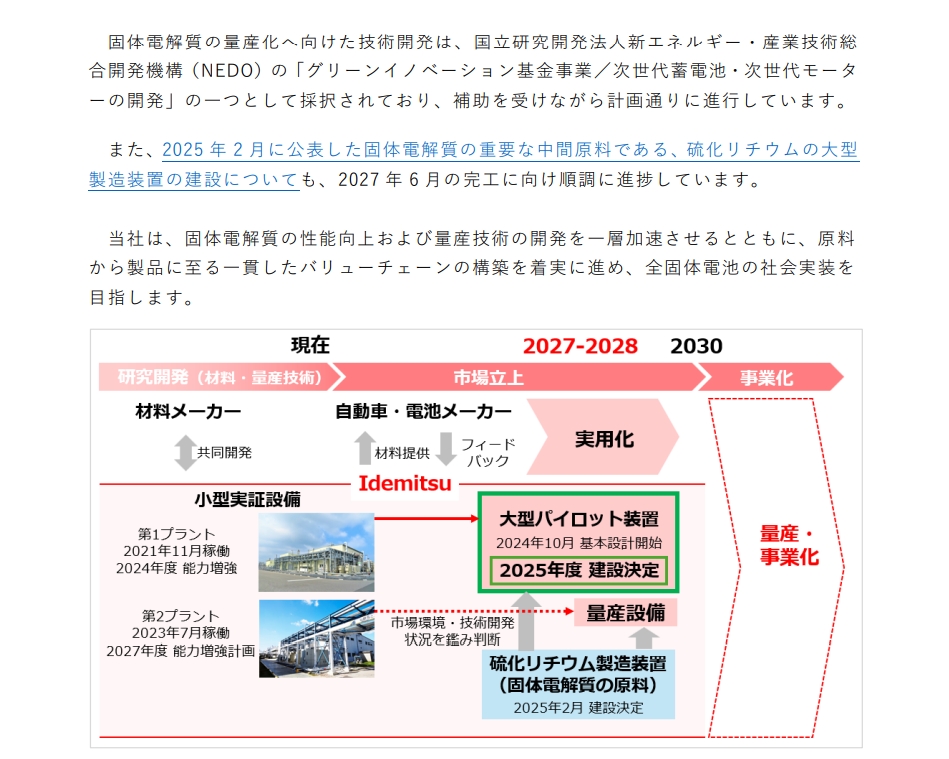
Existing Capacity: Operates two small solid electrolyte verification lines; Line 1 focuses on customized electrolyte R&D and production for Toyota, while Line 2 develops other electrolyte types.
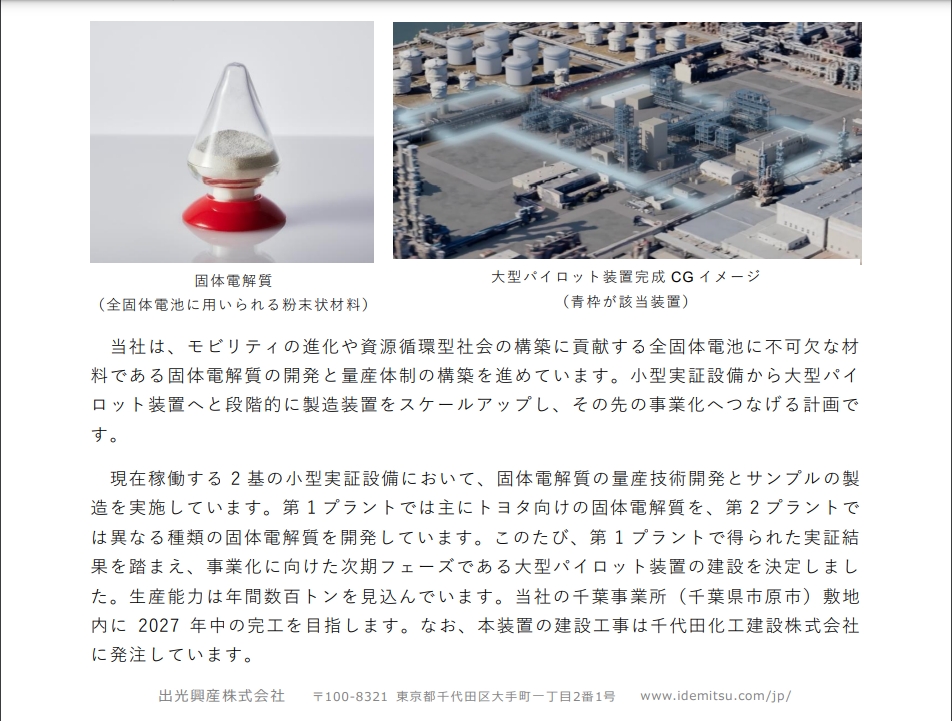
Pilot Capacity: In January 2026, began construction of a large solid electrolyte pilot plant at the Chiba facility, scheduled for completion in 2027, with planned annual capacity of several hundred metric tons. It will commercialize technology validated in Line 1, with Chiyoda Corporation handling construction.
Raw Material Capacity: In February 2025, began building a large-scale lithium sulfide production unit with a total investment of 21.3 billion yen, expected to complete in June 2027. Annual capacity will reach 1,000 mt, meeting electrolyte demand for 50,000–60,000 EVs, ranking among global top tier.
Supporting Plans: Collaborates with Toyota to build a kt-scale sulfide electrolyte pilot plant in Shizuoka (scheduled for 2025–2026), supporting battery demand for 2,000 high-end vehicles; supports Toyota’s plan for 10 GWh solid-state battery capacity by 2030 (equivalent to 100,000 vehicles) by supplying electrolytes.
IV. Company Profile and Patent Overview
1. Company Profile
Idemitsu Kosan, headquartered in Chiyoda, Tokyo, is a leading Japanese integrated energy enterprise. Its businesses include petroleum refining, chemical products, and new energy materials. Since discovering the application value of sulfur in new energy in the mid-1990s, Idemitsu has focused on lithium sulfide mass production technology since 1994. Leveraging unique sulfur by-product resources, it has built core competitiveness in solid-state battery electrolytes, focusing on R&D and mass production system development for all-solid-state battery materials. It supports the global NEV and ESS industries and is a key material supplier in Japan’s solid-state battery industry chain.
2. Patent Status
Idemitsu has established a strong patent portfolio in sulfide solid-state batteries, creating solid technological barriers:
Patent Scale: As of the end of 2024, it filed 19 patent applications related to lithium sulfide, ranking first globally—nearly double the second-place holder. It filed 223 patent applications related to sulfide solid electrolytes, ranking second globally, close to the industry leader.
Core Patent: Holds core patent No. 7013456 for sulfide solid electrolyte (published January 31, 2022), covering key aspects such as electrolyte synthesis and mass production processes, supporting scaled production and technological iteration.
Patent Value: The portfolio spans raw material preparation, electrolyte synthesis, and performance optimization, strengthening Idemitsu’s technical edge and supporting collaborations with partners like Toyota, enhancing its influence in the industry chain.
V. Financing and Cooperation
1. Financing and Government Support
Dedicated Investment: Invested approximately 21.3 billion yen in lithium sulfide and solid electrolyte capacity construction, focusing on mass production technology and capacity expansion.
Government Subsidies: The large lithium sulfide production unit received a 7.1 billion yen subsidy from Japan’s Ministry of Economy, Trade and Industry. Solid electrolyte mass production technology development was selected for the NEDO Green Innovation Fund project, receiving government grants to advance R&D and capacity building as planned.
2. Key Partnerships
Deep Collaboration with Toyota: Partnered with Toyota since 2013, spending a decade overcoming core challenges in sulfide electrolytes. The companies agreed to jointly promote mass production of BEVs equipped with all-solid-state batteries in 2027–2028, with Idemitsu supplying core electrolytes.
Industry Chain Synergy: Collaborates with Chiyoda Corporation on the large solid electrolyte pilot plant; works with Sumitomo Metal on sulfide recycling technology to achieve 95% battery recycling utilization, building a resource circulation system; participates in Toyota-led local solid-state battery industry chain, cooperating with Nippon Steel and others to strengthen the supply chain.
VI. Company Updates
June 2023: Announced plans to enhance solid-state battery electrolyte supply capability and began preliminary preparations for mass production.
October 2024: Commenced basic design of the large solid electrolyte pilot plant, targeting completion in 2027 to support Toyota’s BEV mass production plan.
February 2025: Announced construction of a large lithium sulfide production unit with planned annual capacity of 1,000 mt, expected to complete in June 2027.
April 2025: Completed capacity enhancement of Line 1 of the small solid electrolyte verification facility, increasing customized electrolyte supply for Toyota from several metric tons to over ten metric tons.
June 2025: Solid electrolyte mass production technology recognized under METI’s “Storage Battery Supply Assurance Plan,” strengthening compliance and industrial standing.
January 29, 2026: Made final investment decision on the large solid electrolyte pilot plant, officially starting construction and marking a critical phase in mass production deployment.
SMM Solid-State Battery Zone:
https://new-energy.smm.cn/new_energy/151036
According to SMM forecasts, all-solid-state battery shipments will reach 13.5 GWh by 2028, while semi-solid-state battery shipments will reach 160 GWh. Global lithium-ion battery demand is projected to reach approximately 2,800 GWh by 2030, with the EV sector's lithium-ion battery demand showing a CAGR of around 11% from 2024 to 2030, ESS lithium-ion battery demand at a CAGR of about 27%, and consumer electronics lithium battery demand at a CAGR of roughly 10%. Global solid-state battery penetration is estimated at about 0.1% in 2025, with all-solid-state battery penetration expected to reach around 4% by 2030, and global solid-state battery penetration potentially approaching 10% by 2035.
**Note:** For further details or inquiries regarding solid-state battery development, please contact:
Phone: 021-20707860 (or WeChat: 13585549799)
Contact: Chaoxing Yang. Thank you!
![[SMM New Energy] Another Lithium Battery Giant Conducts Equity Acquisition](https://imgqn.smm.cn/usercenter/QXufg20251217171730.jpg)
![[SMM New Energy] A Billion Yuan Solid-State Battery Project Commences Construction in Zhejiang](https://imgqn.smm.cn/usercenter/zWZVI20251217171730.jpg)
![[SMM New Energy] ShanShan Co., Ltd. Forecasts Profit for 2025](https://imgqn.smm.cn/usercenter/WyqWW20251217171729.jpg)