Pr-Nd oxide production in July declined 11% MoM, will demand recover in August to break the deadlock? [SMM analysis]

Đã xuất bản: Jul 31, 2026 17:51
[SMM Analysis: Pr-Nd Oxide Production in July Down 11% MoM; Can Demand Recover in August to Break the Deadlock?] In July, the supply side of China's rare earth oxide market saw a notable contraction. According to statistics, Pr-Nd oxide production this month declined by 11% MoM. This decrease was not due to a single factor, but rather the combined effect of simultaneous production cuts by both ore separation enterprises and scrap recycling enterprises. Some ore separation companies proactively halted production while awaiting further policy guidance. The scrap recycling side was even weaker, with companies that had already been cutting production not only failing to recover, but some further reduced output. The price inversion between scrap prices and product selling prices intensified, and the operational pressure in the recycling segment remained greater than in the ore separation sector. Medium-heavy rare earth oxide production was also impacted, with an equally significant MoM decline.

SMM, July 31: In July, China's rare earth oxide market saw a significant supply contraction. According to statistics, Pr-Nd oxide production fell by 11% MoM, a decline driven not by a single factor but by simultaneous production cuts at both raw ore separation enterprises and scrap recycling enterprises. Some raw ore separation plants proactively halted operations pending further policy guidance; the scrap recycling side was even weaker, as enterprises already in a state of reduced production not only failed to recover but some further curtailed output. The price inversion between scrap and product selling prices intensified, and operational pressure in the recycling segment remained greater than in the raw ore segment. Medium-heavy rare earth oxide production was also affected, showing a notable MoM decline.
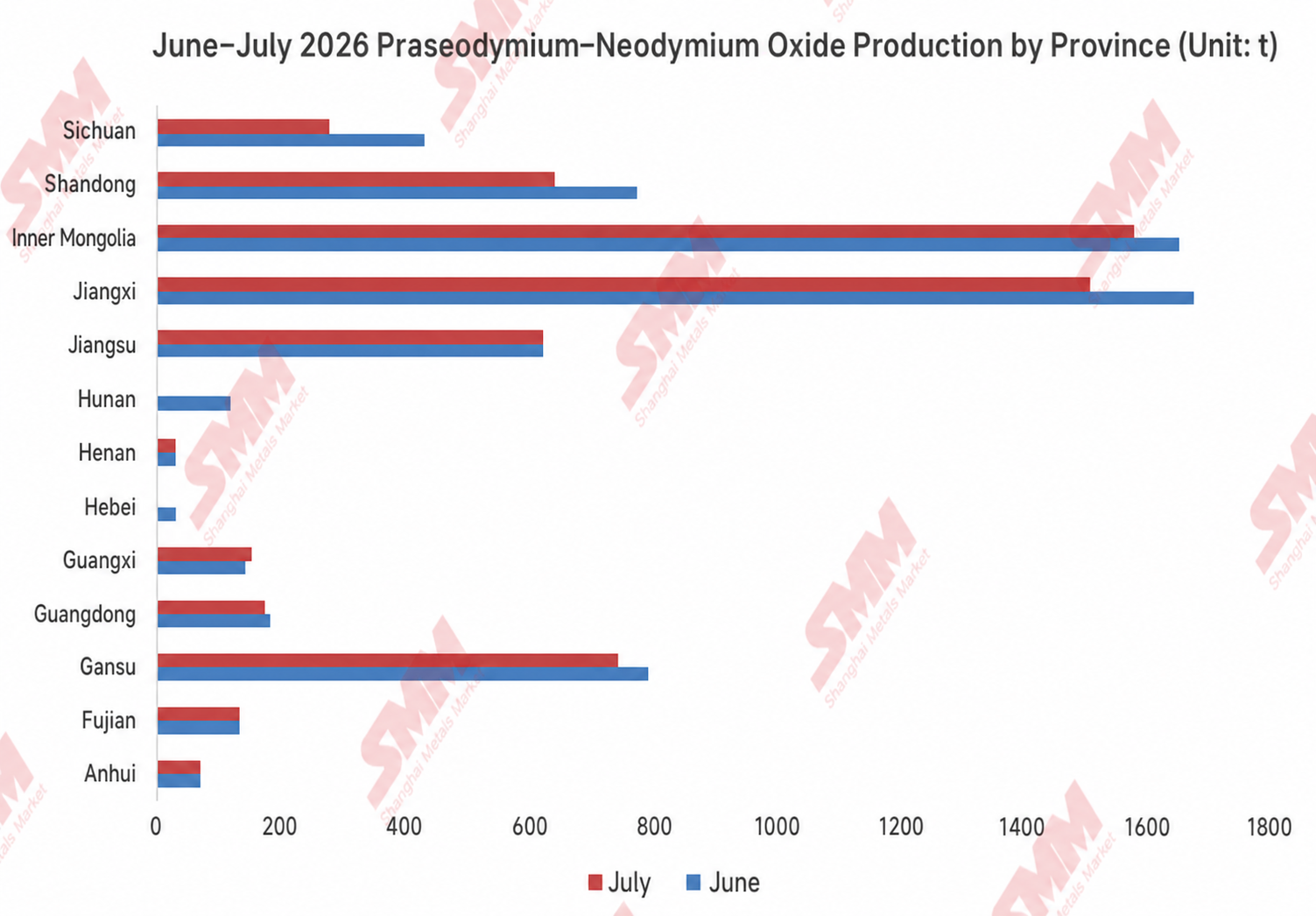
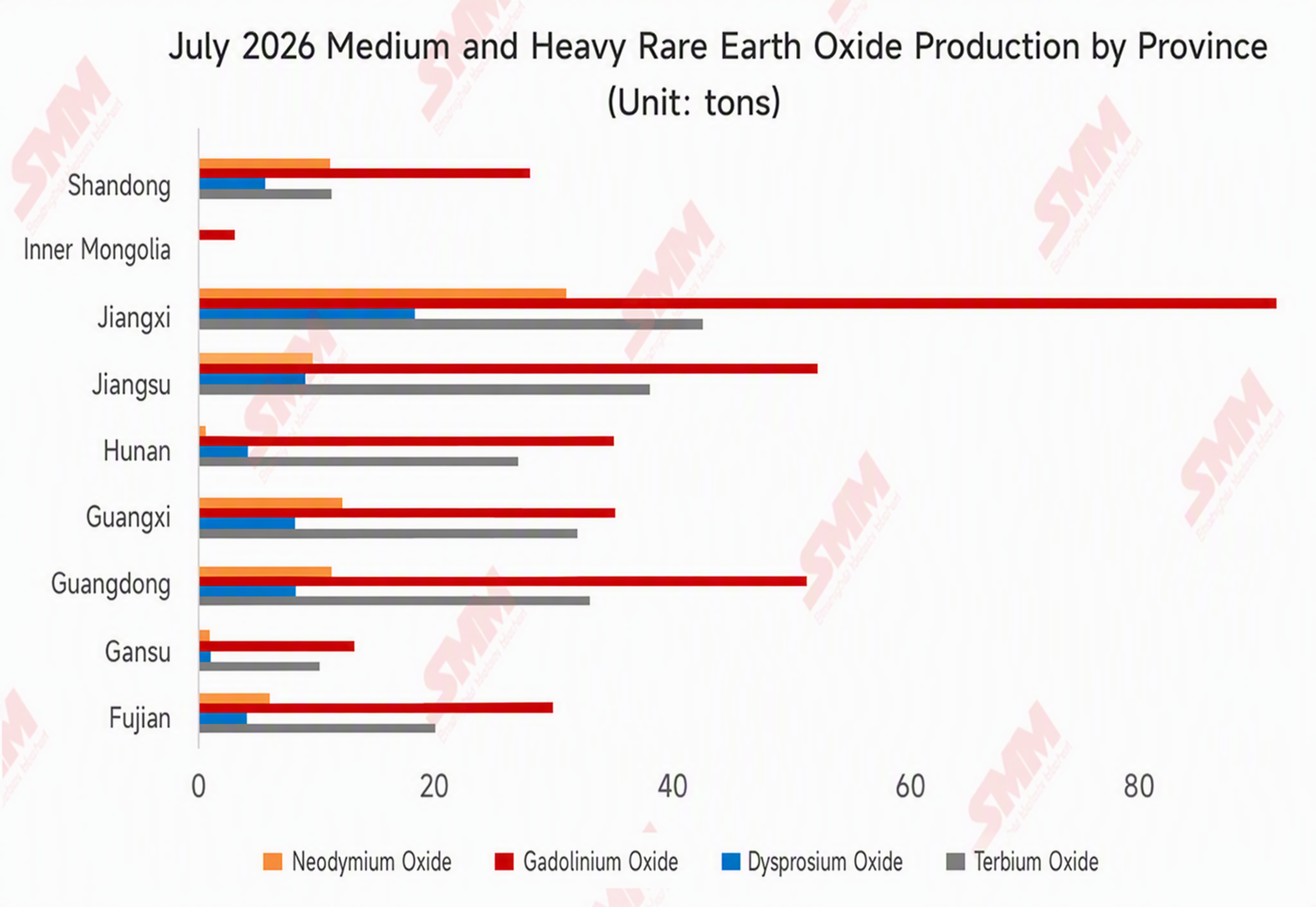
Looking ahead to August, the market holds cautiously optimistic expectations for supply recovery. On one hand, market participants are generally awaiting policy guidance for H2 production, which will clarify the operating conditions of separation plants and is expected to bring operating rates back to normal levels. On the other hand, some leading scrap recycling enterprises plan to attempt a small-scale production resumption in August, but constrained by profit margins, the actual recovery momentum may be limited, and the overall increase in operating rates is expected to be mild. Overall, rare earth oxide production in August is likely to edge up MoM, but the recovery pace will not be overly aggressive, especially in the scrap recycling segment. Most market participants believe that the incentive to resume production there will continue to be suppressed, so while supply improves marginally, it will be difficult to quickly return to the highs seen earlier this year.

The real game of the market now lies in when demand will kick in. Recently, downstream magnetic material enterprises have been mainly digesting long-term contracts, with low spot market inquiry activity. Buyers and sellers have different psychological price levels, leading to a stalemate where rare earth oxide prices struggle to move up or down. Most industry players are eyeing the second half of August, as according to traditional seasonal patterns, the "September-October peak season" is the peak consumption period for rare earth permanent magnets, and downstream pre-stockpiling typically begins in mid-to-late August. If end-user orders then pick up noticeably as expected, concentrated procurement demand will directly break the current supply-demand weak equilibrium. Since supply recovery is limited while demand elasticity is greater, once orders surge, the supply-demand gap may widen, thereby pushing rare earth prices to break through upward.
Tuyên bố về Nguồn Dữ liệu: Ngoại trừ thông tin công khai, tất cả dữ liệu khác được SMM xử lý dựa trên thông tin công khai, giao tiếp thị trường và dựa trên mô hình cơ sở dữ liệu nội bộ của SMM. Chúng chỉ mang tính chất tham khảo và không cấu thành khuyến nghị ra quyết định.

Hình ảnh trong bài viết này có chú thích được AI dịch, chỉ để tham khảo.

Để biết thêm thông tin hoặc có thắc mắc gì, vui lòng liên hệ: lemonzhao@smm.cn
Để biết thêm thông tin về cách truy cập báo cáo nghiên cứu, vui lòng liên hệ:service.en@smm.cn
Tin Liên Quan
Bình luận giao dịch chiều 31/7 của SMM về đất hiếm
24 phút trước
Bình luận giao dịch chiều 31/7 của SMM về đất hiếm
Đọc thêm
Bình luận giao dịch chiều 31/7 của SMM về đất hiếm
24 phút trước
Hongda Electronics báo cáo tỷ lệ sử dụng công suất ổn định cho tụ tantalum và MLCC
29 phút trước
Hongda Electronics báo cáo tỷ lệ sử dụng công suất ổn định cho tụ tantalum và MLCC
Đọc thêm
Hongda Electronics báo cáo tỷ lệ sử dụng công suất ổn định cho tụ tantalum và MLCC
Hongda Electronics cho biết trên nền tảng tương tác của công ty rằng tỷ lệ sử dụng công suất hiện tại cho các sản phẩm tụ tantalum và MLCC đang ở mức hợp lý. Công ty sẽ tiếp tục theo dõi động thái thị trường và không ngừng hoàn thiện bố trí sản phẩm dựa trên nhu cầu thị trường.
29 phút trước
Sản lượng hợp kim Pr-Nd của Trung Quốc trong tháng 7 tăng 3,74% theo tháng, nhờ tăng trưởng ở Nội Mông.
1 giờ trước
Sản lượng hợp kim Pr-Nd của Trung Quốc trong tháng 7 tăng 3,74% theo tháng, nhờ tăng trưởng ở Nội Mông.
Đọc thêm
Sản lượng hợp kim Pr-Nd của Trung Quốc trong tháng 7 tăng 3,74% theo tháng, nhờ tăng trưởng ở Nội Mông.
Sản lượng hợp kim Pr-Nd của Trung Quốc đã tăng 3,74% so với tháng trước và 7,57% so với cùng kỳ năm trước trong tháng 7, nhờ hoạt động gia công tại Nội Mông được đẩy mạnh. Nguồn cung oxit Pr-Nd thắt chặt đã đẩy chi phí nguyên liệu lên cao, siết chặt biên lợi nhuận và kìm hãm sản lượng tại một số nhà sản xuất. Nhu cầu nam châm yếu khiến tỷ lệ vận hành ở khâu hạ nguồn giảm 3% so với tháng trước, dẫn đến dư cung trên thị trường. Trong tháng 8, sản lượng hợp kim dự kiến tăng khoảng 1% so với tháng trước, trong khi sản lượng nam châm có thể tăng 2,65% so với tháng trước, giúp cải thiện cân bằng cung cầu.
1 giờ trước
Đăng ký để Tiếp tục Đọc
Tiếp cận những phân tích mới nhất về kim loại và năng lượng mới
Đã có tài khoản?đăng nhập tại đây